

Maryland Bans Guns in Parks, Bars and Buses. Justice Thomas Says History Isn’t on Its Side.
The Supreme Court passed on a sweeping challenge to Maryland’s gun-free zones Monday. Justice Clarence Thomas used the moment to tell gun owners the fight isn’t over, and how to bring the next one.
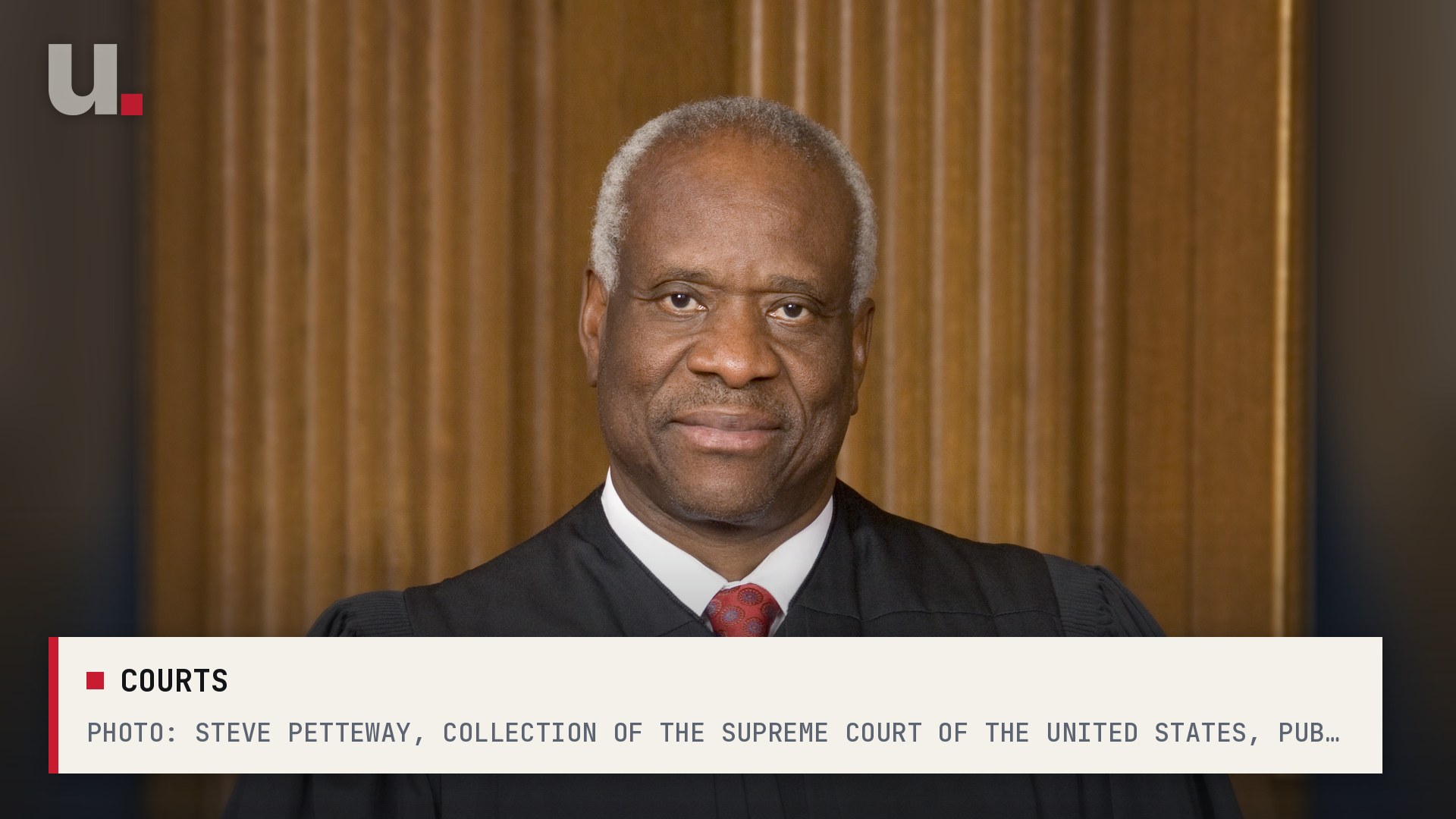
A law-abiding Maryland gun owner with a carry permit can walk out his front door armed. What he can’t do is carry that gun onto a city bus, into a restaurant that pours beer, through a hospital lobby, into a public protest, or across tens of thousands of acres of state park and forest land. Step over any of those lines and the permit stops protecting him.
On Monday, the Supreme Court declined to hear a challenge to those rules. The one-line entry in the Court’s order list for Novotny v. Moore, No. 25-1324, reads like a loss. Read the four pages Justice Clarence Thomas attached, and it looks more like a map for the next fight.
Why the Court said no for now
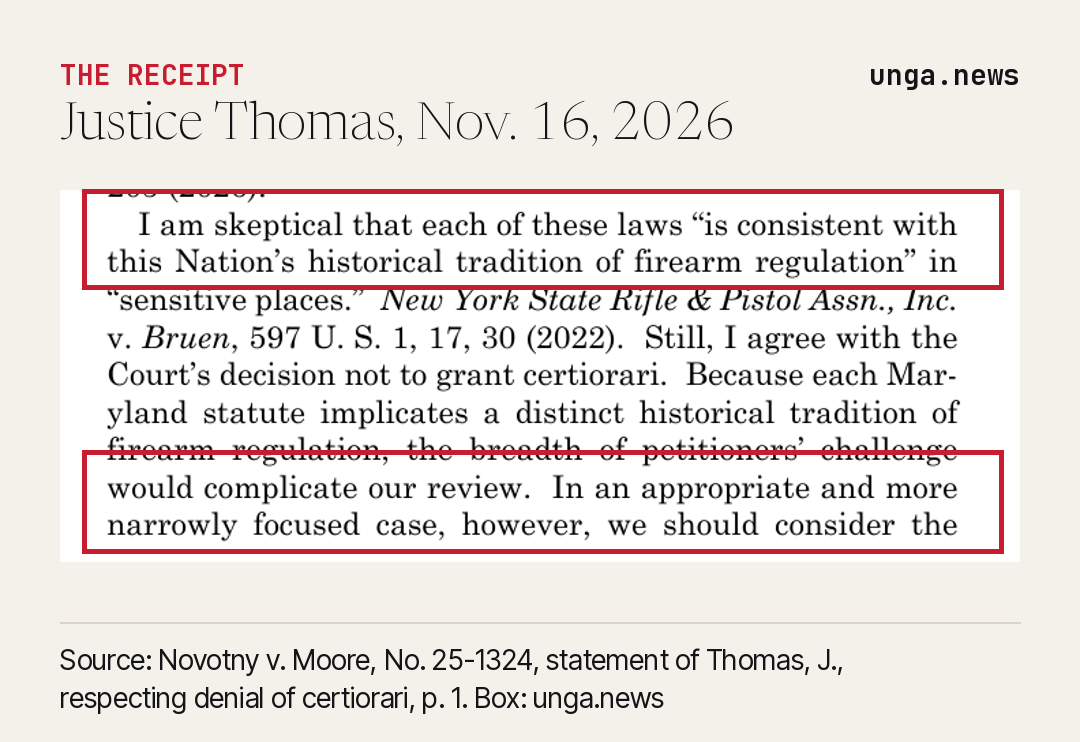
Thomas didn’t pretend Maryland’s laws were fine. “I am skeptical that each of these laws ‘is consistent with this Nation’s historical tradition of firearm regulation’ in ‘sensitive places,’” he wrote.
His problem was the shape of the case. The challengers went after a whole basket of Maryland restrictions at once, and Thomas noted that each one “implicates a distinct historical tradition of firearm regulation.” A ban at a polling place has deep roots in American history. A ban at a state park or a bar has to be judged against its own history. Lump them together and the justices would be refereeing a dozen fights in one opinion. “In an appropriate and more narrowly focused case, however, we should consider the scope of States’ authority to ban firearms in ‘sensitive places,’” he wrote.
That’s not a shrug. Justices don’t write separate statements on a cert denial to say nothing. They write them to tell lawyers what to file next.
The loophole states found after Bruen
To see why Thomas cares, go back to 2022. In New York State Rifle & Pistol Association v. Bruen, the Court held that Americans have a right to carry a gun in public for self-defense, and that any limit has to match the nation’s historical tradition of gun regulation. The Court allowed that some “sensitive places” have always been off-limits, such as legislatures, polling places and courthouses. But it also warned that the historical record “yields relatively few 18th- and 19th-century ‘sensitive places’ where weapons were altogether prohibited,” and that stretching the idea to every crowded spot “would eviscerate the general right to publicly carry arms for self-defense.”
Several states read that warning as a to-do list. Maryland passed some of its restrictions in 2023, the year after Bruen, according to NBC News. Thomas went through what other states did in his statement. New Jersey bans firearms in at least 25 kinds of places, including zoos, public libraries, casinos and state-owned beaches. New York lists 20 “sensitive” locations, from “any place of worship” to residential settings licensed by the health department. California has 29, including athletic facilities, banks and any government-permitted public gathering.
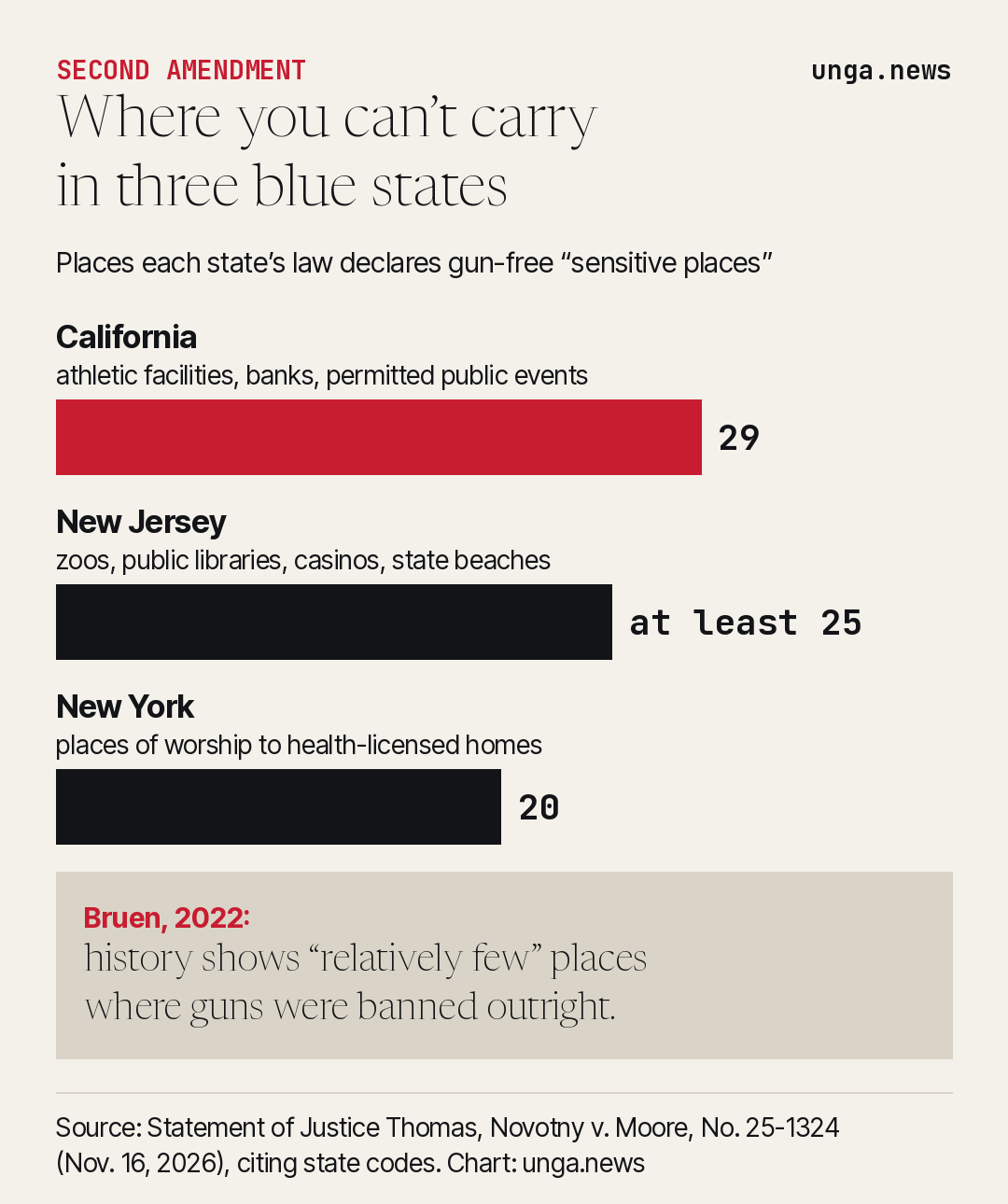
Put those lists together and you get what Thomas called the real effect: firearms banned “wherever people gather for eating, drinking, recreation, amusement, and free speech.” He called that “an affront to the right of ‘law-abiding citizens’ to ‘carr[y] arms in public for’ their ‘ordinary self-defense.’” A permit that works only on the sidewalk between gun-free zones isn’t much of a permit.
Lower courts keep waving them through
Thomas also called out the judges below. The Fourth Circuit, in Kipke v. Moore, upheld all but one of Maryland’s location bans. The Second Circuit upheld New York bans covering treatment centers, urban parks, zoos, bars and theaters. The Ninth Circuit upheld Hawaii bans on parks, playgrounds, restaurants that serve alcohol and even parking areas next to “sensitive places,” before the Supreme Court reversed that case on other grounds. Thomas’s verdict on the lower courts: they “have largely blessed these ahistorical ventures.”
Maryland’s attorney general, Anthony Brown, told the justices there are “vast areas of shared consensus” about which places count as sensitive, according to NBC. The gun owners and four gun-rights groups who brought the case called Maryland’s officials “openly hostile” to the right to carry, NBC reported. Monday’s order leaves the Maryland rules in place while that argument waits for a better vehicle.
Where the next case comes from
The Court has shown it will act when a case is clean. In June, in Wolford v. Lopez, it struck down a Hawaii rule that made it a crime to carry onto private property open to the public, like a store or a gas station, unless the owner gave permission. NBC notes Maryland had a similar provision, and a lower court already threw it out, which is why it wasn’t part of Monday’s appeal.
That’s the pattern Thomas is pointing to. One ban, one historical question, one clear answer. Gun-rights lawyers now have every reason to bring the next challenge that way: a single Maryland park ban, or New Jersey’s beach ban, or California’s bank ban, each tested on its own history. The Third Circuit has already agreed to rehear New Jersey’s sensitive-place laws with the full court after vacating a decision that upheld many of them, so another case may be closer than Annapolis would like.
Thomas ended plainly: “I harbor serious doubts that our Nation’s historical tradition of firearm regulation supports many of these sweeping restrictions.” For Maryland gun owners who can’t carry on the bus to work, a no today came with instructions for getting a yes.
Sources
- Supreme Court of the United States — Order List, Monday, November 16, 2026 (610 U.S.)
- Supreme Court of the United States (via Courthouse News) — Novotny v. Moore, No. 25-1324, Statement of Justice Thomas respecting the denial of certiorari (Nov. 16, 2026)
- NBC News — Supreme Court rejects challenge to Maryland’s ‘sensitive places’ gun ban (Nov. 16, 2026)
- Associated Press — Supreme Court declines to hear challenge to Maryland ‘sensitive places’ gun law (Nov. 16, 2026)