

Massachusetts Sued ICE to Stop Arrests at Its Courthouses. ICE Says Federal Law Comes First.
A new state law tried to keep immigration agents out of courtrooms without a judge’s warrant. Agents made at least 38 arrests in three weeks anyway, and now the state wants a federal judge to step in.

Massachusetts wrote a law telling federal immigration agents to stay out of its courthouses unless a judge signs off. ICE kept showing up anyway. On Monday, the state took the fight to federal court.
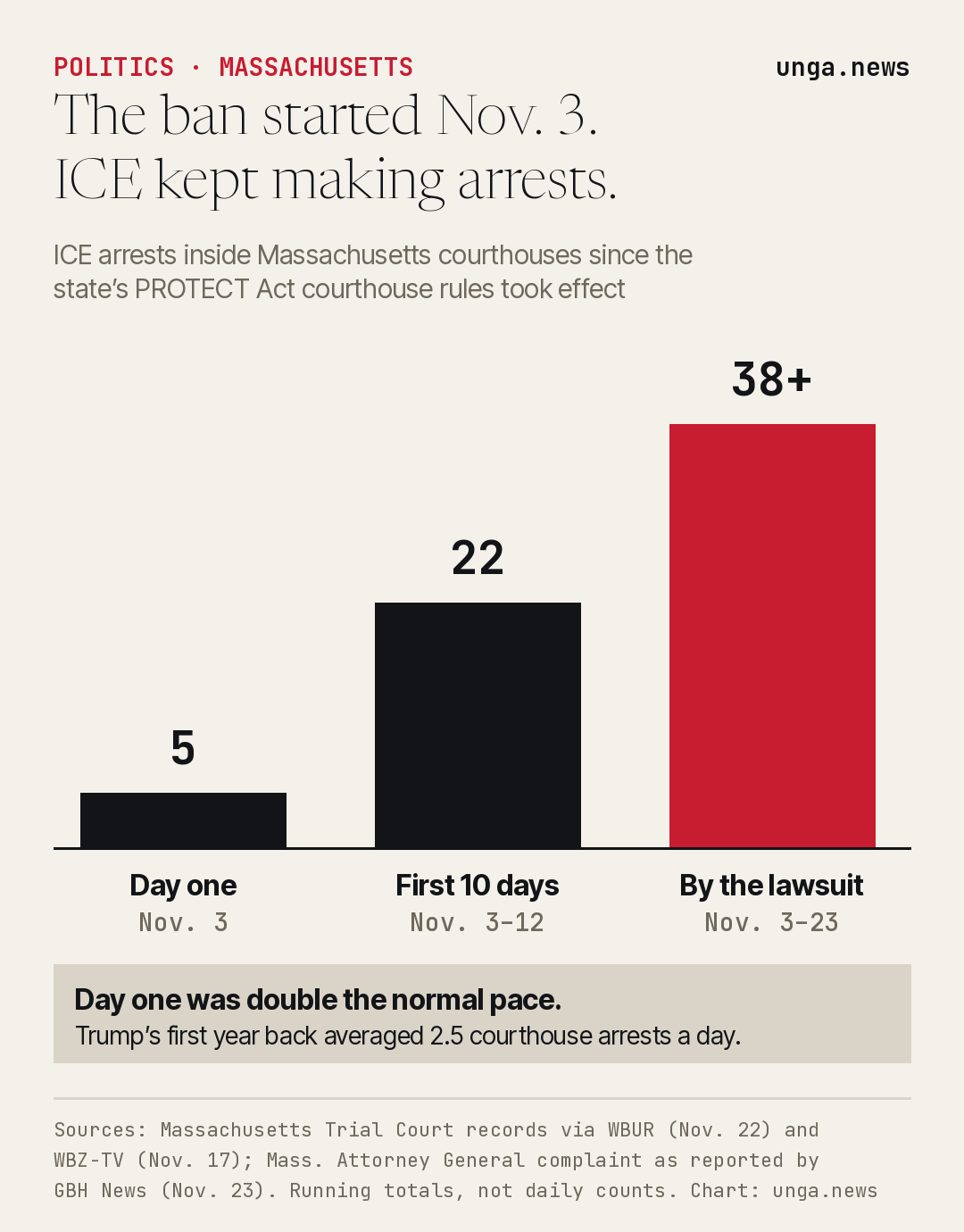
Attorney General Andrea Campbell filed a lawsuit against the federal government over civil immigration arrests made inside Massachusetts courthouses without a judicial warrant. Her office says agents have broken the state’s new PROTECT Act “nearly every single day,” and counts at least 38 people arrested that way since the courthouse rules kicked in on Nov. 3, according to GBH News, which first reported the filing.
The Department of Homeland Security has a short answer for all of it. “The Supremacy Clause makes it clear that sanctuary politicians do not control federal law enforcement,” a spokesperson said.
A state law built to keep ICE out
Gov. Maura Healey signed the PROTECT Act on Aug. 5. It bars most civil immigration arrests without a judicial warrant or court order at public schools, child care centers, health care settings and, starting Nov. 3, courthouses. It labels a warrantless civil arrest at a courthouse “false imprisonment” under state law, lets the attorney general sue federal officials who break it, and limits how much state and local agencies can help with federal civil immigration enforcement.
There was always a catch. State training materials for police, cited by WBZ-TV, say local officers “have no authority to enforce the act.” Court staff can’t interfere with a federal arrest either. That left the attorney general’s office as the only enforcer, and a lawsuit as its main tool. When Healey was first asked how the law would be enforced, her answer was, “don’t bring the fight.”
Agents didn’t back off. Massachusetts Trial Court records reviewed by WBUR show five courthouse arrests on Nov. 3, the very first day, about twice the daily average for 2025. Court security logged 22 in the first 10 days. By the time Campbell filed, her count was 38 or more.
Who agents picked up
The cases give a sense of who ICE is looking for when it walks into a Massachusetts courtroom. In Framingham on Nov. 17, 24-year-old Rhyan Oliveira was arraigned on three felony charges from an alleged domestic violence incident. Prosecutors said he tried to stop his girlfriend from leaving the house, rammed her car with his BMW and threatened to kill her if she called police. His public defender called the allegations baseless and said he had no criminal record. A judge released him on conditions, and plainclothes ICE agents arrested him in the courthouse lobby minutes later, WBUR reported.
In Fall River, agents arrested 29-year-old Johnson Joseph, a Haitian national, shortly after his arraignment on an assault and battery charge involving a family or household member, according to The New Bedford Light. In Marlborough, they took a Brazilian woman facing a misdemeanor shoplifting charge.
Campbell argues the arrests hurt the very cases those courts are hearing. “ICE’s intentional violation of state law has created unnecessary fear, made it more difficult to operate our courts and hold defendants accountable,” she said, adding that someone facing serious charges “could ultimately be released from ICE custody without their criminal case ever being resolved.” Middlesex District Attorney Marian Ryan filed a document backing the suit. Healey said in her own statement that the “Trump Administration’s ICE arrests at Massachusetts courthouses are interfering with our justice system.”
Why ICE likes the courthouse
DHS has been open about why it goes to court for its targets, and the reasoning hasn’t changed since the agency scrapped Biden-era limits on courthouse arrests in May 2025. “The ability of law enforcement to make arrests of criminal illegal aliens in courthouses is common sense,” the department said again this month. “It conserves valuable law enforcement resources because they already know where a target will be. It is also safer for our officers and the community. These illegal aliens have gone through security and been screened to not have any weapons.”
Think about the alternative. When a sanctuary city won’t honor an ICE detainer, a person in jail can walk out without the agency ever being told. Then officers have to find him at home, at work or on the street, where nobody has checked him for a gun. DHS pointed to exactly that in 2025, when officers picked up Juan Carlos Baez, who had prior convictions for trafficking cocaine and heroin, after he left Boston Municipal Court. Boston doesn’t honor ICE detainers, so the courthouse steps were where agents could reach him.
Andrew Arthur, a former immigration judge now with the Center for Immigration Studies, told WBUR the state law stands on shaky ground. “States can’t regulate the activity of the federal government, and courthouses are public places where anybody can go,” he said. He also turned the due process argument around: enforcing immigration law is part of due process too, and “that due process right is subverted when states like Massachusetts prevent DHS from taking people into custody.”
Beacon Hill versus the Supremacy Clause
Campbell’s complaint rests on the idea that Massachusetts has “the sovereign right to both manage its judicial system and determine whether and how to deploy state resources.” That part is not controversial. A state can decide its own police won’t help ICE, and Massachusetts already has.
The harder question is whether a state can make a federal officer doing a federal job guilty of “false imprisonment” under state law. The Constitution makes federal law the supreme law of the land, and courts have long thrown out state laws that try to control how federal agents enforce it. DHS is betting this one goes the same way.
There’s also a practical irony here. The state’s own lawsuit says the arrests keep criminal cases from being resolved. The surest way to fix that is to honor detainers and hand people over at the jail door after their cases are done, which is exactly the kind of cooperation Massachusetts and Boston have chosen to limit. Instead, Beacon Hill passed a law, watched federal agents treat it as a suggestion, and is now asking a federal judge to referee.
ICE, for its part, says it doesn’t plan operations aimed at schools, hospitals or churches and makes targeted arrests based on intelligence. In the courthouses, at least, it shows no sign of leaving. More than three dozen arrests in three weeks is the clearest answer Massachusetts has gotten so far.
Sources
- GBH News — Massachusetts sues ICE for arresting immigrants at courthouses in breach of new state law (Nov. 23, 2026)
- WBUR — ICE continues courthouse arrests, despite state’s new PROTECT Act (Nov. 22, 2026)
- CBS Boston / WBZ-TV — ICE arrests continue at sensitive locations in Massachusetts despite PROTECT Act (Nov. 17, 2026)
- U.S. Department of Homeland Security — DHS Makes Common Sense Courthouse Arrests of Criminal Illegal Aliens (May 6, 2025)
- Fall River Reporter — Massachusetts AG Campbell holding press conference following ICE arrests at courthouses after PROTECT Act (Nov. 22, 2026)