

Measles Has Spread Nonstop for a Year. The CDC Is Putting $100 Million Into Stopping It.
A health panel says the same measles strain has circulated in America for 12 straight months, ending a status the country held since 2000. The CDC is putting $100 million into outbreak response.
The Pan American Health Organization announced on Nov. 17 that the United States, Mexico and Bolivia have all lost their “measles elimination” status. For America, it’s the first time since the country earned that label in 2000, and the CDC is putting about $100 million into the outbreak response.
The rule behind the decision is simple. A country loses the status when the same strain of measles keeps spreading inside its borders, without a break, for 12 months or more. One sick traveler or an outbreak stamped out within a year doesn’t count. A chain that runs for a full year does, and PAHO’s commission, which met Nov. 10 through 13, found that had happened here.
Trust, and what the CDC now admits
The CDC’s joint statement doesn’t just blame a virus. It also names a trust problem, saying public faith in health agencies “declined during COVID due to pandemic overreach, including lockdowns and mandates.” The plan is to win people back with “transparency, informed consent, and clear, evidence-based information,” answering parents’ questions about benefits and risks instead of lecturing them.
The statement also recognizes that some Americans turn down the shot for religious or personal reasons and others can’t get it for medical ones. For those families, the CDC says it will make sure doctors have the tools to spot measles fast and treat complications.
Where the government is putting its money
CDC Director Dr. Erica Schwartz’s answer is money and boots on the ground. According to the agency, the CDC has sent about $100 million in extra funding since August to fight measles and other diseases vaccines prevent, enough to carry state and local health departments through most of 2027.
That splits almost evenly: $50.2 million to find risks, close vaccine gaps and move fast when an outbreak starts, and $49.8 million to beef up the labs and disease detectives who catch cases early.
“We know where transmission is occurring and we’ve invested $100 million in state and local health departments to reach those communities,” Schwartz said. “Losing a designation doesn’t mean we abandon an evidence-based approach. It means we remain focused on stopping outbreaks.”
The CDC also sends its own outbreak teams when states ask. Texas, South Carolina, Virginia, Kansas, New Mexico and Wisconsin called them in, and the agency says those outbreaks were brought “rapidly and successfully under control.” Pennsylvania and New York have since asked for the same help.
The statement says Health Secretary Robert F. Kennedy Jr. and Schwartz “continue to recommend MMR vaccination as the most effective way to prevent measles.”
The numbers behind the slide
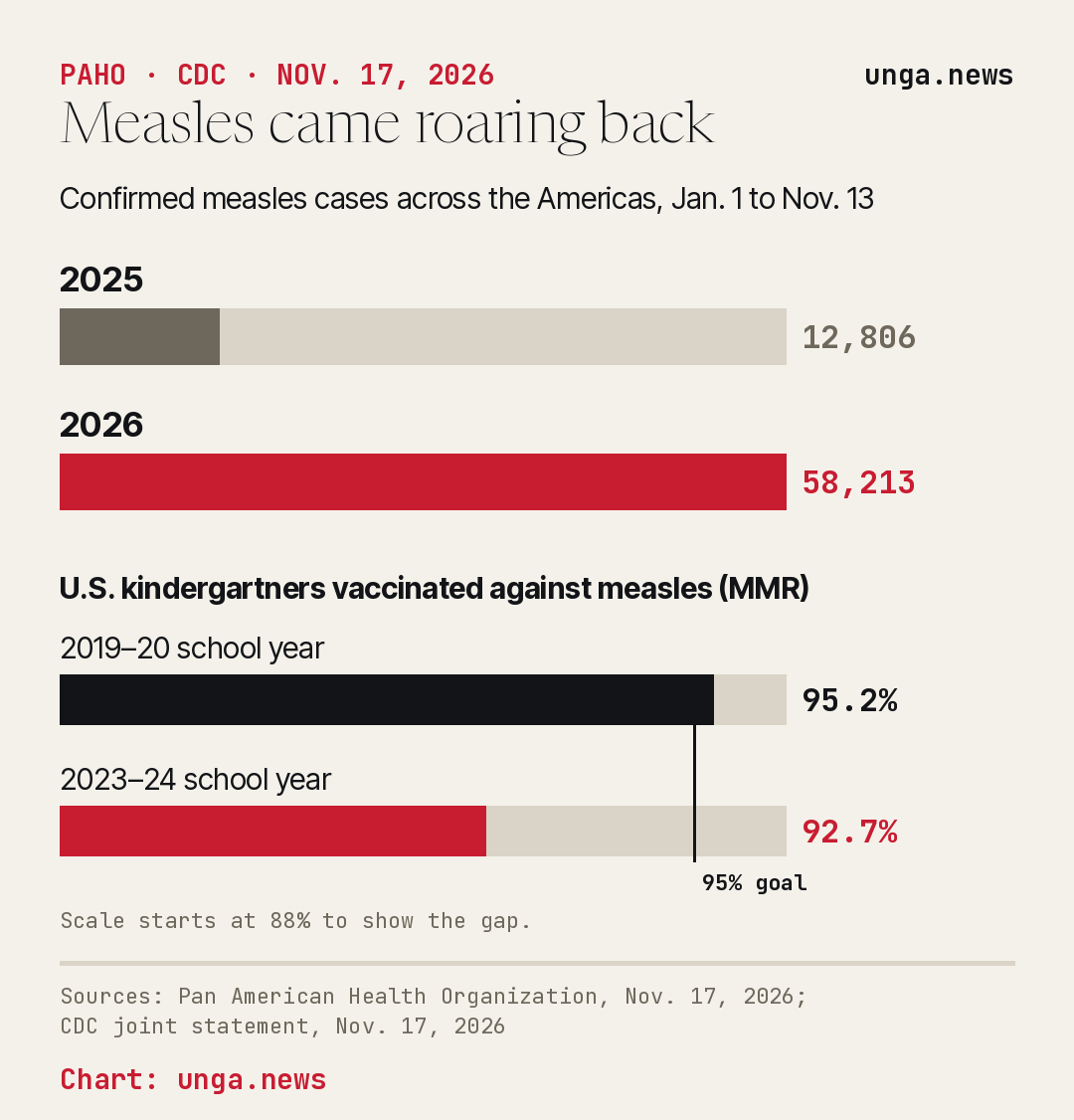
This didn’t happen overnight. The CDC points to the pandemic years, when routine checkups and childhood shots got knocked off schedule. Kindergartners with their measles shots fell from 95.2% in the 2019–2020 school year to 92.7% in 2023–2024. Health officials aim for at least 95%, because measles is about as contagious as a disease gets: PAHO says one sick person can infect as many as 18 others who have no immunity.
A national average also hides the weak spots. The CDC cites a Johns Hopkins-led study that found vaccination falling in 78% of the 2,066 counties it looked at across 33 states.
The toll this year is real. UNICEF, citing CDC data, says more than 5,400 U.S. cases have been confirmed so far in 2026, the most in a year since the resurgence of 1989 to 1991. Ninety-six percent were people who were unvaccinated or whose status was unknown. Kids and teens ages 5 to 19 made up 40% of cases, and children under 5 another 18%.
Across the whole hemisphere, PAHO counts 58,213 confirmed cases and 82 deaths this year through Nov. 13, up from 12,806 cases at the same point last year.
The road back
Even PAHO’s director, Dr. Jarbas Barbosa, gave the U.S. credit, praising “the significant efforts undertaken by the United States to manage the measles outbreak through strengthened surveillance, timely case detection and response, targeted vaccination activities, and coordination across the public health system.”
There’s a path back, and it’s been walked before. Venezuela and Brazil lost their status in 2018 and 2019, broke their chains of spread and helped the Americas win the label back in 2024. Canada, which lost its status a year ago, has already stopped the outbreak behind it and is working its way back.
“This is a serious warning for our Region, but it is not an irreversible setback,” Barbosa said. “Elimination is not a trophy that we win once and put on a shelf.”
The label is gone. The CDC now says the way back is informed consent and straight answers for parents, and the Americas have already shown the status can be won back.
Sources
- CDC — Joint Statement: Loss of U.S. Measles Elimination Status
- Pan American Health Organization — PAHO urges countries to step up efforts to stop measles outbreaks and move towards elimination in the Americas
- UNICEF — Measles spreading “in places where the disease was under control”, UNICEF warns
- NBC News — U.S. loses measles-elimination status, erasing decades of progress