

Meta Ordered to Pay $25 Billion After a Jury Found Facebook Spent 11 Years Lying About Users' Data and Its 'Equal' Rules
A New Mexico judge cut a $219.5 billion penalty to $25 billion, the largest ever against the owner of Facebook and Instagram. One statement jurors found deceptive: Facebook's promise of "no special protections for any group — whether on the right or the left."
Meta, the company that owns Facebook and Instagram, was ordered Wednesday to pay New Mexico $25 billion for deceiving the public about how Facebook handled people's personal data and how it enforced its own content rules. Judge Francis Mathew of the state's 1st Judicial District Court in Santa Fe signed the order four weeks after a jury found Meta had broken the state's consumer protection law 43.9 million times, the Albuquerque Journal reported. It is the largest penalty ever imposed on the company, the AP reported.
The case grew out of the 2018 Cambridge Analytica scandal, when a political consulting firm got hold of data from as many as 87 million Facebook users through a personality-quiz app, CNBC reported. But the trial reached well past that one leak. Jurors weighed 29 public statements made by Facebook and its leaders, and found 26 of them false or deceptive, the Journal reported.
The judge didn't mince words. "The lies extended beyond Facebook's data practices as well," he wrote in his findings and judgment.
How a jury got to 43.9 million
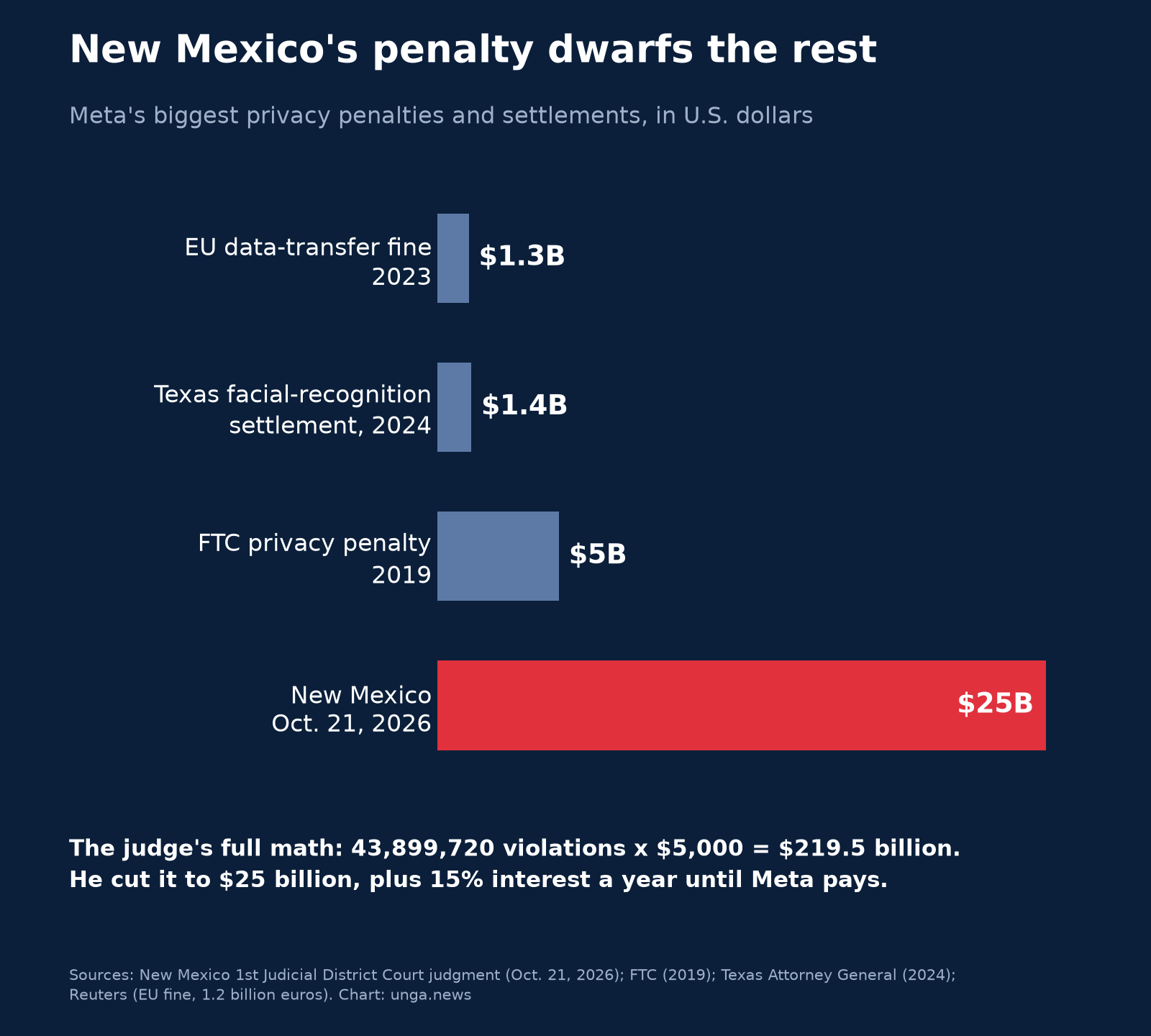
New Mexico's Unfair Practices Act allows a penalty of up to $5,000 for each willful violation. The jury counted one violation for every New Mexican in a statement's expected audience: 1,386,648 for statements aimed at the state's Facebook users, or 2,100,000 for those that reached the whole state, the judgment says. Multiply 43,899,720 deceptive-practice violations by $5,000 and you get $219.5 billion.
Mathew ruled Meta deserved the maximum per violation, citing "the involvement of senior Facebook leadership" and "the clearly intentional and systematic nature of Facebook's repeated misstatements." He then cut the total to $25 billion and ordered 15% annual interest until it is paid. At that rate, the bill grows by about $3.75 billion a year while Meta appeals. Under New Mexico's constitution, the money goes to education, the AP reported. "We may have paid for the construction of schools for the next 100 years," Attorney General Raúl Torrez said.
"We do not and never will sell any of your information"
That promise came from Mark Zuckerberg in a 2010 Washington Post column, and it is the first statement on the jury's verdict form. In 2018, then-Chief Operating Officer Sheryl Sandberg told PBS, "We do not sell data or give your personal data to advertisers, period." Jurors found all six statements about users' control of their data deceptive and willful.
The evidence behind those findings is hard to read. In a private email cited in the judgment, Zuckerberg wrote that users "probably don't understand their current privacy settings or care about who sees their updates," and laid out a plan: "Give them a chance to change their privacy settings but obviously don't encourage it." When Facebook announced in 2014 that apps could no longer scoop up users' friends' data, it had already spent more than a year planning secret exemptions for favored business partners, the judge found.
After Cambridge Analytica broke, Zuckerberg promised to investigate every app with access to large amounts of data, audit suspicious ones and tell everyone affected. The judge found Facebook ran just 14 forensic "audits" over three years. Its investigators flagged at least 2,000 apps tied to data misuse, but Facebook narrowed its own definition of misuse and notified users about only two apps. One internal document said its data-deletion policy aimed in part "to optimize for external optics." When the investigation quietly ended in 2021, a company representative testified, "as far as the public is concerned, nobody else remembers the ADI."
One rulebook for everyone? Not quite.
In July 2018, Facebook told the public: "There are no special protections for any group — whether on the right or the left." The jury found that statement, and two others promising equal enforcement, deceptive and willful, according to the verdict form.
Behind the scenes, Facebook ran a program called CrossCheck. For business partners, celebrities and influencers on its lists, rule-breaking posts stayed up during an extra review that averaged about 12 days in the U.S. Ordinary users' posts came down right away and went back up only if they won an appeal, the judgment says. In a 2020 document, Guy Rosen, then head of Facebook's integrity division, acknowledged that "today we effectively delay enforcement for policy-violating content for xcheck as it remains up and accrues VPVs while we take another look." VPVs are views.
Think of a referee who swears the rulebook applies to every player, while keeping a private list of stars whose fouls get a nearly two-week review before any whistle blows. Everyone else gets ejected on the spot.
Conservatives spent years saying Facebook's rules bent depending on who was posting. Zuckerberg later conceded some of it. In a 2024 letter to House Judiciary Chairman Jim Jordan, he said Biden White House officials pressured Meta to take down COVID-19 posts, that the "government pressure was wrong," and that "in retrospect, we shouldn't have demoted" the New York Post's Hunter Biden laptop story, the BBC reported. In January 2025, he ended Meta's U.S. fact-checking program, saying "we've reached a point where it's just too many mistakes and too much censorship," NBC News reported.
The jury didn't give the state everything. Jurors found the state hadn't proven Meta misled people when it said it removes content like "fake COVID cures," or when it described its fact-checking partners in 2022, the verdict form shows.
BREAKING: Meta, $META, ordered to pay $25 billion in penalties related to the Cambridge Analytica scandal in New Mexico. (@unusual_whales)
— @unusual_whales View on 𝕏
Big number, big company
Meta can absorb it. The company earned $60.5 billion in profit on $201 billion in revenue in 2025, its earnings report shows, so $25 billion is about five months of profit. The bigger problem for Meta is the precedent. In 2019 it paid the Federal Trade Commission a record $5 billion for deceiving users about privacy and agreed to new oversight. The judge noted that earlier penalties and consent decrees "have not deterred Meta" from deceiving New Mexicans.
Meta did not immediately respond to requests for comment Wednesday, the AP reported. In court filings, it asked the judge to cap the penalty at $3.45 billion, said it does not sell user data and argued the state never proved any consumer was actually misled, Reuters reported. "The jury didn't make findings that any New Mexican heard or saw these statements, or was harmed by them," Meta lawyer Matt Nicholson told the court on Oct. 1, according to the AP. The company has said it will appeal.
What happens next
The money won't move soon. Meta is expected to appeal, and an appeals court could cut the number of violations, the AP reported. Interest keeps piling up in the meantime. The judge also has yet to rule on the state's request for an order forcing changes at the company.
New Mexico got here by going it alone. It refused to join a multistate settlement and took Meta to trial instead, the state Justice Department said. It is the state's second win over Meta this year: in March a Santa Fe jury ordered Meta to pay $375 million over child safety, and a judge later added $567 million for a teen mental health fund, Reuters reported.
"For too long, powerful technology companies have operated as though their size and influence put them beyond the reach of the law," Torrez said. Facebook spent 11 years telling the public its data was safe and its rules were the same for everyone. Twelve jurors in Santa Fe read the fine print, and now the bill is $25 billion and growing.
Sources
- New Mexico 1st Judicial District Court — State of New Mexico v. Meta Platforms, Inc., Findings of Fact, Conclusions of Law and Judgment (Oct. 21, 2026)
- New Mexico 1st Judicial District Court — Special Verdict Form, State of New Mexico v. Meta Platforms, Inc. (Sept. 25, 2026)
- New Mexico Department of Justice — The New Mexico Department of Justice Secures Another Landmark Victory Against Big Tech, with Historic $25 Billion Penalty Against Facebook
- New Mexico Department of Justice — Jury Finds Facebook Violated New Mexico Consumer Protection Law, Faces Billions in Potential Civil Penalties
- AP — Meta ordered to pay New Mexico $25 billion for deceiving users about privacy on Facebook
- Albuquerque Journal — Judge orders Meta to pay $25 billion to New Mexico for violations of state law
- CNBC — Meta ordered to pay $25 billion penalty in New Mexico Cambridge Analytica case
- Reuters (via CNA) — Meta ordered to pay $25 billion to New Mexico after jury finds company misled consumers about data privacy
- BBC News — Meta fined $25bn for 'lies' over user data privacy
- Washington Post — Meta ordered to pay $25B in New Mexico for misleading users on privacy
- Meta — Meta Reports Fourth Quarter and Full Year 2025 Results
- Federal Trade Commission — FTC Imposes $5 Billion Penalty and Sweeping New Privacy Restrictions on Facebook
- Texas Attorney General — Attorney General Ken Paxton Secures $1.4 Billion Settlement with Meta Over Its Unauthorized Capture of Personal Biometric Data
- Reuters — Meta hit with record $1.3 bln fine over data transfers
- BBC News — Zuckerberg regrets bowing to Biden 'pressure' over Covid
- NBC News — Meta is ending its fact-checking program in favor of a 'community notes' system similar to X's
- X (@unusual_whales) — BREAKING: Meta, $META, ordered to pay $25 billion in penalties