

Meta’s Former SI Chief Raised $1 Billion Betting Against Chatbots. Now His Lab Is Showing Results
Yann LeCun’s new lab taught machines to plan in layers and to ask what would have happened if they’d made a different move. So far, it all happens inside simulators.

Every chatbot you have used works the same basic way. It reads a mountain of text and guesses the next word. Yann LeCun, the scientist who shaped Meta’s SI research for 12 years, has long argued that this trick will never give a machine real common sense about the physical world. Earlier this year, investors handed him more than $1 billion to prove there is a better way. Two papers out of his new lab now put fresh, hard numbers on that bet.
The lab is called Advanced Machine Intelligence, or AMI Labs, and it is headquartered in Paris with offices in New York, Montreal and Singapore. In March it raised $1.03 billion at a $3.5 billion pre-money valuation, according to Reuters, in a round co-led by firms including Jeff Bezos’s Bezos Expeditions. TechCrunch reported that Mark Cuban and former Google chief Eric Schmidt also put money in. LeCun still teaches at New York University, and NYU researchers are all over this work.
A robot brain that thinks in rough drafts
LeCun’s alternative has a clunky name, JEPA, short for joint-embedding predictive architecture. Strip away the jargon and the idea is simple. Instead of predicting every pixel of the next video frame, or the next word in a sentence, the model learns a compressed sense of what is going on and predicts how that will change when it acts. Think of how you plan a drive across town. You don’t picture every car and stoplight. You think in big chunks first, then fill in the turns.
The first paper, posted Oct. 5 by researchers at AMI Labs, NYU, Brown University and France’s INRIA, builds exactly that kind of layered planning. The top layer looks far ahead and aims at the goal. Its forecast becomes a nearer target for the layer below, and the bottom layer picks the actual moves. The authors call it H-JEPA.
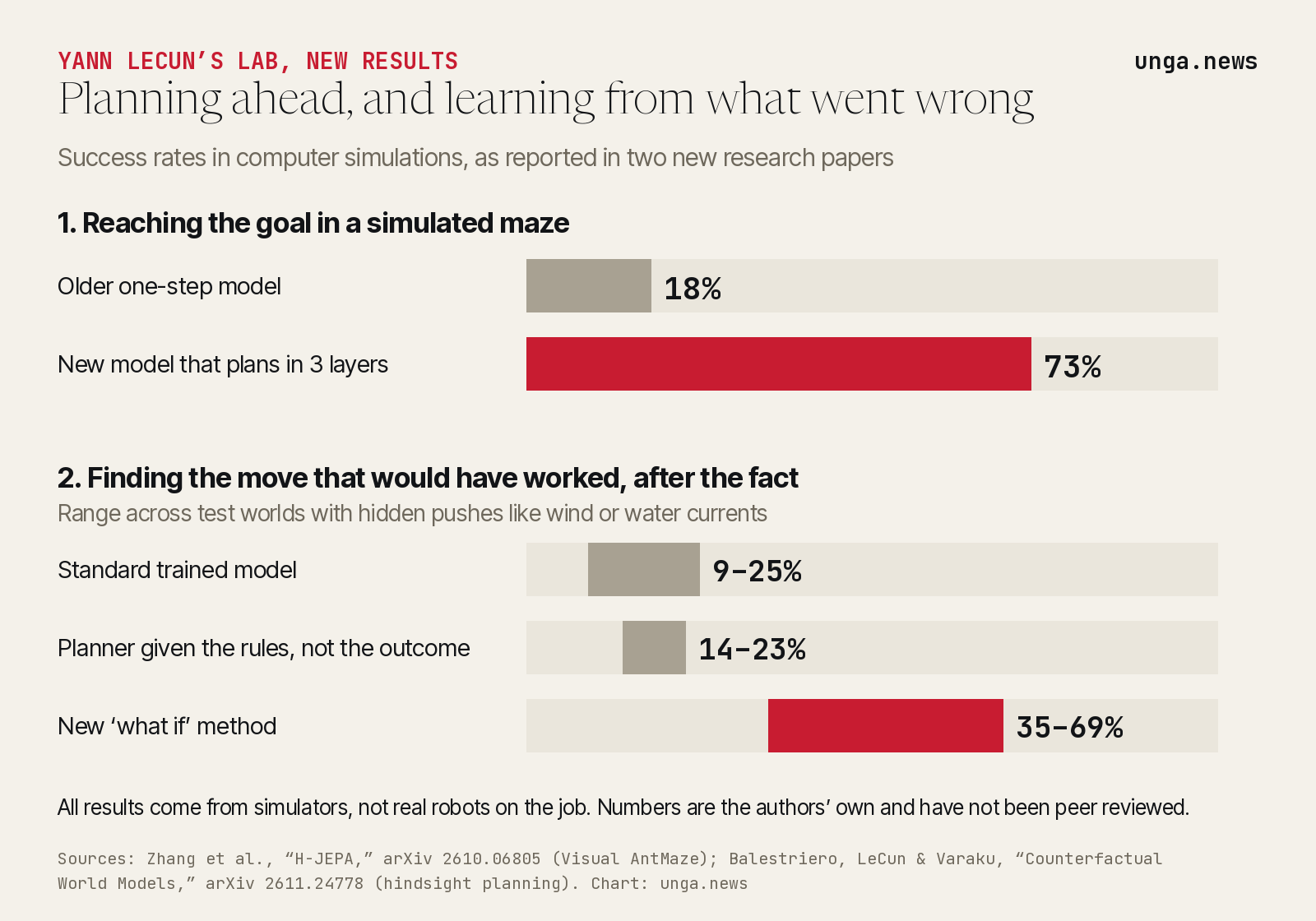
In a simulated maze where a four-legged robot has to walk itself to a goal, the old one-layer version succeeded 18% of the time. A three-layer version succeeded 73% of the time, and the authors say it got there while spending less computing power on planning. They flag one miss themselves: on a block-pushing task, the three-layer model did poorly. They also ran the method on a large library of real robot-arm videos called DROID, where they say the layered version produced more faithful plans with less computing. That was an offline test on recorded footage, not a robot doing chores in a kitchen.
Telling bad luck from a bad decision
The second paper, posted Nov. 18 by Randall Balestriero of Brown and AMI Labs, LeCun and Kerda Varaku, tackles a question every coach, pilot and parent knows. Something went wrong. Was it a bad call, or just bad luck?
The authors use the example of a boat steering while a current it cannot see pushes it off course. A normal world model can only guess where the boat lands on average. Once the boat actually lands somewhere, that miss reveals how hard the current pushed. The question the paper asks is what would have happened with a different heading, in that same current. The authors prove that a model trained only on what actually happened can’t answer that on its own, no matter how much data it gets.
Their fix leans on an old rule of physics they quote in Latin: nature makes no leaps. When the push and the steering act as separate forces over a short moment, the authors show you can estimate the what-if outcome from what actually happened plus the gap between the model’s two predictions. In their words, it costs “two predictor calls and one addition.”
On four simulated test worlds, that lifted their accuracy score for what-if predictions from 38–46% to 86–96%, using the same models. On a fifth, a simulated underwater drone, it reached 90–94% with 16 times more training data. When asked to find, after the fact, the move that would have reached the goal, the method succeeded in 35% to 69% of cases. A planner that knew the simulator’s rules but not what actually happened managed 14% to 23%.
The authors are upfront about where it breaks. Contact and collisions, like a ball hitting a wall or a pusher that may or may not touch a block, throw it off. So do problems that weaken a command instead of adding a separate push, such as a worn motor or braking on ice. The code and a public demo are posted online.
From a maze to your kitchen
Robots that load dishwashers, drones that land in wind, and self-driving systems all need some sense of cause and effect. If LeCun is right, the machines that one day work in warehouses, hospitals and homes will need this kind of internal model, and his lab wants to sell those models to manufacturers and other industries.
LeCun has been candid about how long it took. In a post on 𝕏 last week he quoted his own remarks: “I’ve tried to train models to do video prediction for the better part of the last 20 years, and largely failing for the first 15. Until I realized you had to abandon generative models and use joint embedding predictive architectures (JEPA).”
His long-running argument that machines need far less data to learn the world has also put him in friendly crossfire with Elon Musk, whose Tesla trains its self-driving software on real miles from real cars. When an account on 𝕏 mocked LeCun’s skepticism on Nov. 23, Musk shot back: “I’m honored to have Yann as a reply guy.” It’s a fair jab. Tesla’s cars already drive themselves, with a driver watching, on public roads, while LeCun’s newest results live entirely inside simulators.
That gap is the real scorecard here. Both papers are preprints on arXiv, not yet checked by outside reviewers, and every number above is the authors’ own. Neither paper shows a robot doing a real job, and neither touches chat, coding or anything you can download as an app. What they do show is a $3.5 billion startup putting its theory in writing, with code attached, so anyone can test it.
Silicon Valley keeps pouring money into ever-bigger chatbots. LeCun is betting the next leap comes from machines that can picture the world, plan a few steps ahead, and figure out what went wrong when the plan fails. Some of the homework is turned in. The grade comes when one of these brains has to move something real.
Sources
- arXiv — H-JEPA: End-to-End Learning of Hierarchical World Models for Visual Planning (Zhang, Terver, Rabbat, LeCun, Balestriero; Oct. 5, 2026)
- arXiv — Counterfactual World Models: JEPAs That Reason About “What If” (Balestriero, LeCun, Varaku; Nov. 18, 2026)
- GitHub — galilai-group/counterfactual-WM (code for Counterfactual World Models)
- Reuters — Ex-Meta AI chief Yann LeCun’s AMI raises $1.03 billion for alternative AI approach (March 10, 2026)
- TechCrunch — Yann LeCun’s AMI Labs raises $1.03B to build world models (March 9, 2026)
- The Decoder — Three studies from Meta and AMI Labs back Yann LeCun’s bet on JEPA world models over large language models (Nov. 27, 2026)
- Yann LeCun on 𝕏 — Post quoting his remarks on 15 years of failed video prediction before JEPA (Nov. 24, 2026)
- Elon Musk on 𝕏 — “I’m honored to have Yann as a reply guy” (Nov. 23, 2026)