

Microsoft Is Swapping Out the SI Built Into Windows, and the New One Reads Nine Times More
A smaller, faster model replaces the one hidden inside newer Windows PCs, and it will run on gaming graphics cards too. Test PCs get it Dec. 4.

Most people who own a newer Windows laptop have no idea there’s a small SI model living on it. Microsoft calls it Phi Silica, and it quietly does language work for Windows and Microsoft apps right on the machine, without sending a request out to a data center. Microsoft has now announced it is pulling that model out and putting a new one in its place.
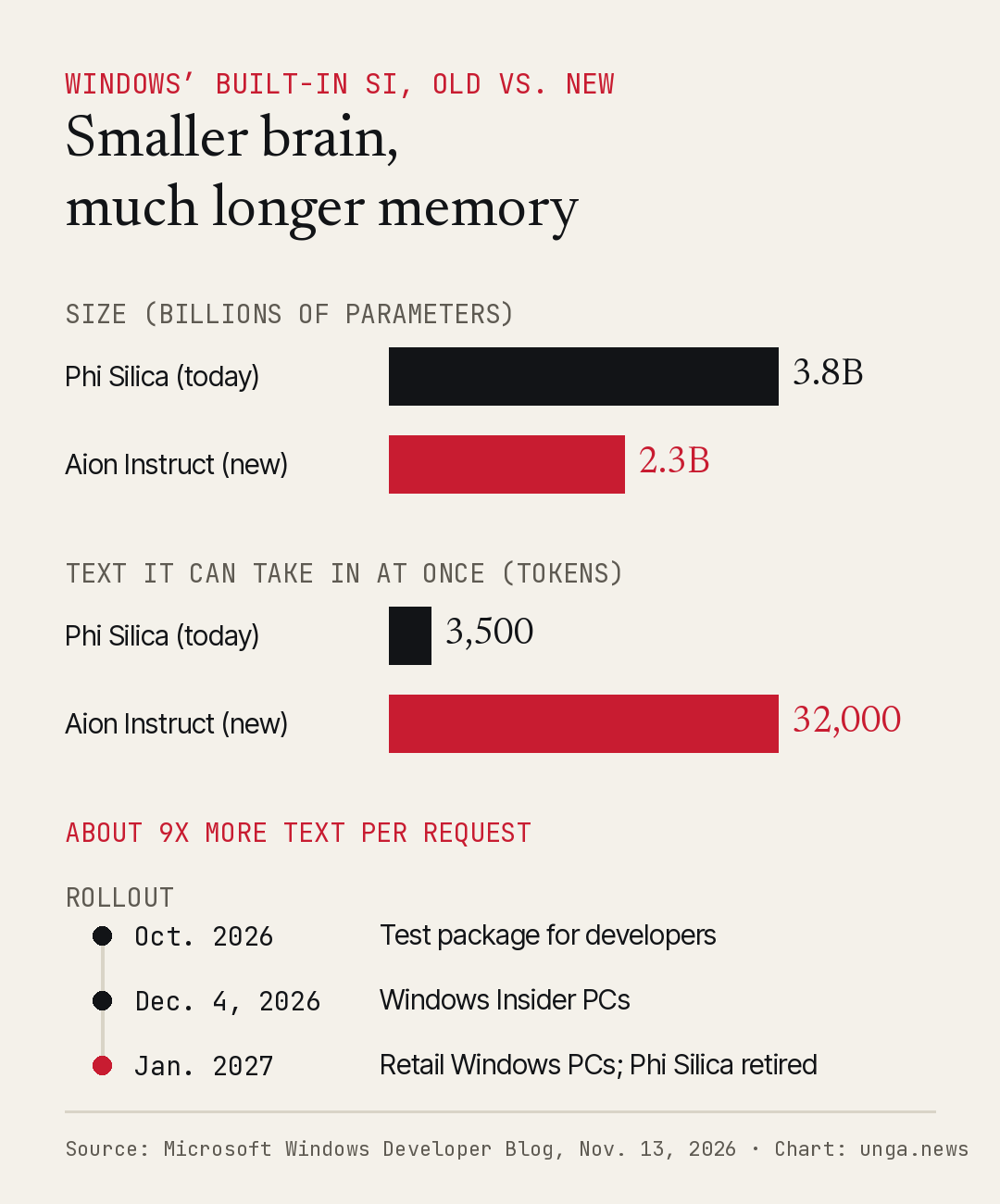
The replacement is called Aion Instruct. In a post on its Windows developer blog, Microsoft laid out the swap: Windows Insider test PCs start getting it on Dec. 4, and regular retail Windows computers are targeted for late January. When that’s done, Phi Silica is gone.
On paper the new model looks like a step backward, because it’s smaller. Phi Silica has 3.8 billion parameters, the internal settings a model learns during training. Aion Instruct has 2.3 billion. But the number that matters more for anyone actually using it went the other direction in a big way. Phi Silica can take in about 3,500 tokens of text in a single request, roughly a few pages. Aion Instruct takes 32,000, a little more than nine times as much.
Why a smaller model can be the better deal
On a phone or a laptop, smaller is usually a feature. A model that runs on your own chip has to share memory, battery and processor time with everything else you have open, from a browser full of tabs to a video call. Microsoft says Aion Instruct was built “to help language model features run efficiently alongside the applications and workflows you already use on Windows,” and it promises “improved performance and use of device resources.”
The longer memory is what makes it more useful. A cap of 3,500 tokens means a built-in feature can only look at a short email or a few paragraphs before it runs out of room. At 32,000 tokens, an app can hand the model a long report, a big email thread or a chunk of a contract and ask for a summary or a rewrite in one pass, all without the text leaving the computer. Microsoft pitches local SI as a way for apps “to deliver responsive experiences while keeping processing on device.”
Those are Microsoft’s own descriptions. The company hasn’t published independent test results yet, and it says a technical report on the model is “coming soon.” Until that lands, the size and the text limit are the only hard numbers on the table.
Gaming PCs get in on it
The other change could matter even more for how many people actually get this. Phi Silica launched for Copilot+ PCs, the class of laptops sold with a dedicated SI chip called an NPU. Microsoft says Aion Instruct will also run on supported graphics cards, naming Nvidia’s RTX series and AMD’s RDNA4 generation.
That’s a huge pool of machines. Plenty of gamers, video editors and people who simply bought a laptop with a decent graphics card don’t own a Copilot+ PC. Microsoft says supporting those cards “greatly increases the number of Windows devices that can benefit,” though it adds that hardware support “will expand in stages” as each setup passes its quality checks. So not every RTX or Radeon owner should expect it on day one.
The invisible stamp
One detail in the announcement will get attention. Microsoft says it has “added invisible watermarking to Aion Instruct to fulfill Text Provenance requirements in specific regions.” In plain English, text the model writes will carry a hidden marker that can later show it came from an SI model. Microsoft doesn’t name the regions, but it frames this as meeting legal rules where they exist, not as tracking users.
The practical effect for most people is nothing they’ll see. For developers it’s a real change: Microsoft warns that apps that pick apart the model’s raw output “due to our new watermarking implementation” may need to be adjusted.
What breaks, and what doesn’t
For the average Windows user, the switch is meant to be invisible. Microsoft says “for most app developers, no action will be required” and that “the change will happen behind the scenes.” Features already built on Windows’ SI tools are expected to keep working on the new model.
There are exceptions. Apps built around highly customized prompts, custom add-on training known as LoRAs, or their own parsing of the model’s answers will need work, and Microsoft says custom LoRAs made for Phi Silica will not carry over. Because Aion Instruct is a different model, its wording and behavior won’t match the old one, so the company is telling developers to test now. A standalone package has been available for testing since October, and Microsoft says the Dec. 4 Insider build will allow “full, end to end validation.” The company’s Phi Silica documentation is where it says updated transition details will live.
Microsoft is also clearing away some red tape for app makers. Today, developers need a special access token, which Microsoft calls an LAF token, to use the on-device model. The company says it plans to drop that requirement, with removal targeted for January.
A bigger bet on SI that stays on your machine
The timing isn’t random. Microsoft is walking developers through Aion Instruct in a session at its Ignite 2026 conference on Tuesday, and the company is clearly trying to make local SI a standard part of Windows rather than a perk for one class of laptop.
There’s a reason that matters to regular people. Every request a cloud chatbot handles costs somebody money and sends your words to someone else’s server. A capable model that lives on the PC you already own can do the everyday stuff, like summarizing, rewriting and sorting text, at no extra cost and without a trip to the cloud. Microsoft calls this “the beginning of the next phase of local AI on Windows.” If the new model performs the way the spec sheet suggests, the most useful SI upgrade a lot of people get this winter may arrive through Windows Update without them ever noticing.
Sources
- Microsoft Windows Developer Blog — Microsoft Aion Instruct: Advancing local AI on Windows and expanding to GPU
- Microsoft Learn — Get started with Phi Silica in the Windows App SDK
- The Tech Signal — Microsoft will replace Windows’ Phi Silica AI model with Aion Instruct