

Microsoft Left a Hole Open for Nearly Four Months. Someone Used It to Grab Customer Data.
Outsiders read the email addresses of the people who run companies’ computer systems, plus private details about their accounts. Microsoft won’t say who did it or how many were hit.
Last week Microsoft had to explain an outage. This week it has to explain something worse: a break-in. The company has started telling business customers that outsiders slipped through a flaw in one of its cloud services and read information about their organizations, including the email addresses of the very people who run their computer systems.
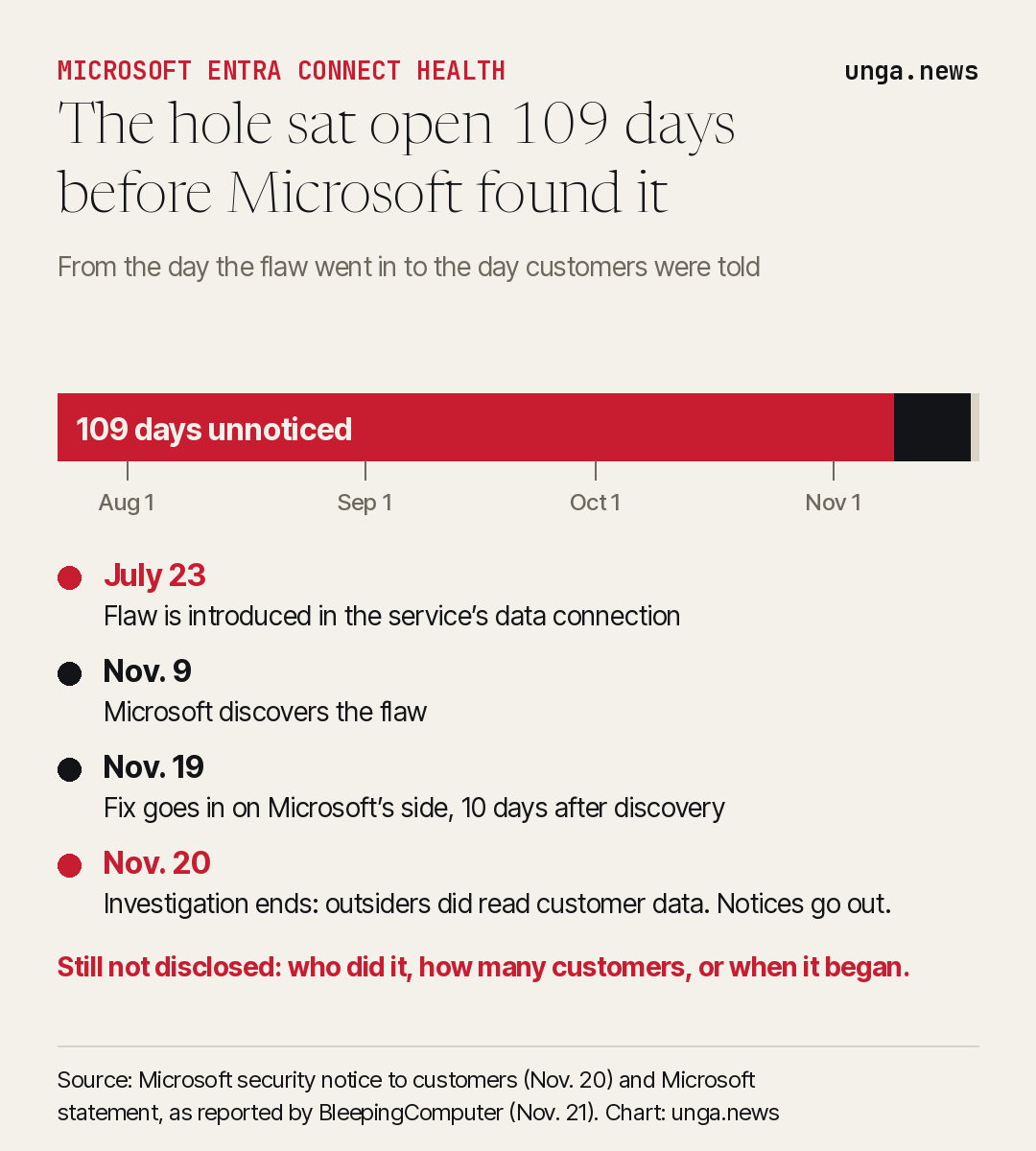
The flaw sat in a Microsoft product called Entra Connect Health, and it was there for a long time. According to the security notice Microsoft sent customers on Nov. 20, which BleepingComputer first reported after admins posted it on Reddit, the bug went in on July 23. Microsoft didn’t discover it until Nov. 9. That is 109 days with the door unlocked.
“On 20 November 2026, we concluded our investigation and determined that unauthorized read-only access to tenant-level metadata associated with your organization had occurred,” the notice says. “We did not identify any unauthorized configuration changes.”
The service that watches the front door
Most people have never heard of Entra, but they use it every workday. Entra is Microsoft’s sign-in system for businesses, schools and government offices. When you log in to your work email, Teams or a company laptop, there is a good chance Entra is checking who you are. Plenty of organizations still keep their own servers in a back room and sync those accounts to Microsoft’s cloud. Connect Health is the dashboard that keeps an eye on that link and warns IT staff when something breaks.
So this wasn’t a random app. It was a tool that sits next to the keys. Microsoft says each organization’s account in its cloud, which it calls a tenant, gave up these details through the flaw:
Who runs it. Email addresses for the organization’s technical contacts and administrator accounts, the people with the most power over its systems.
Who it is. The tenant ID, the organization’s display name, its starting web domain, its country code and region.
How it’s set up. Which Entra license tier it pays for, whether its office servers sync with the cloud, and when they last did.
The attackers also pulled an old security certificate that Microsoft once used to register monitoring software with an internal service it shut down in late 2024. Microsoft says the certificate had expired and was no longer in use, but it was still sitting in storage and still being handed out by the flawed system.
No passwords, but a perfect phishing list
Microsoft says the hole did not expose passwords, scrambled password files, sign-in tokens, working encryption keys, maps of a customer’s internal network, or Azure billing and subscription details. That is the good news, and it is real. Nobody walked away with a skeleton key.
But think about what a crook actually holds now. He has the names of real organizations, the exact email addresses of the people who can unlock everything inside them, and details only an insider would normally know, like their license level and the last time their servers synced. That is the raw material for the most convincing fake “Microsoft security alert” anyone has ever received. One click on a phony login page by the wrong person and the damage is no longer read-only.
Microsoft is saying as much itself. It told customers to warn their security teams about targeted phishing and social engineering aimed at the exposed addresses, to make sure top administrators use phishing-resistant two-step login, and to comb through their Entra sign-in and audit logs for anything strange. It also posted a set of scripts on GitHub so admins can see what kinds of information their account holds. The catch is that the scripts show today’s settings, not what the intruders actually saw.
Customers don’t have to install anything. The fix went in on Microsoft’s side on Nov. 19, 10 days after discovery, and the company finished its investigation the next day.
The questions Microsoft won’t answer
Here is what Microsoft hasn’t said. It hasn’t said who did this. It hasn’t said how many organizations were hit. And it hasn’t said when the snooping started, which matters a lot when the hole was open for nearly four months before anyone noticed.
“We identified and addressed a security issue affecting Microsoft Entra Connect Health that could have resulted in unauthorized access to tenant-level contact and configuration metadata,” a spokesperson told BleepingComputer, adding that the company had notified affected customers through its Azure Service Health alerts. Microsoft declined to give more details.
Notice the gap. The public statement says the bug “could have resulted” in access. The private notice to customers says access “had occurred.” Both can be true, since only the customers who got notices were confirmed victims. But the softer wording is the one the public hears.
The size is not small, either. More than a dozen administrators reported getting the notice in a single Reddit thread, and some companies that manage IT for other businesses said they received separate warnings for several of their clients, hours apart. Each of those clients is its own organization, with its own staff, and its own admins whose email addresses are now in somebody else’s hands.
A rough week to ask for trust
The timing makes this sting. Last week Microsoft’s Outlook went down and snarled offices around the world, part of a string of outages that also hit JPMorgan Chase, the FAA and Apple. Plenty of people suspected hackers. The administration looked hard and said no. “This is not cyberattack, and this is not a coordinated effort by a nation state,” Director of National Intelligence Jay Clayton told CNBC on Nov. 17.
Nothing in Microsoft’s notice ties this breach to those outages, and nobody should pretend otherwise. The administration called the outages right. This is a different problem: a real intrusion, through a real hole, that went unnoticed through the whole summer and most of the fall.
Microsoft runs the sign-in system for a huge share of American workplaces, schools and government agencies. When a company that size leaves a door open for 109 days, its customers deserve more than a list of tips. They deserve to know who came in, when they came in and how many others they visited. So far Microsoft is keeping that to itself.
Sources
- BleepingComputer — Microsoft Entra Connect Health flaw exploited to steal tenant data (Nov. 21, 2026), quoting Microsoft’s Nov. 20 customer notice and statement
- Microsoft (GitHub) — Entra Connect Health reference scripts (aka.ms/ConnectHealth/scripts)
- Microsoft Learn — What is Microsoft Entra Connect and Connect Health
- CNBC — Widespread outages hit banks, air travel, the NSA and Apple (Nov. 17, 2026)