

Microsoft Says Its New SI Codes Almost as Well as the Best for a Fraction of the Price
At Ignite, Microsoft rolled out seven homegrown models built to undercut OpenAI and Anthropic, from coding helpers to the system writing up 10 million doctor visits a month.
Microsoft wants to be the store-brand option in SI, the one that does almost the same job for a lot less money. At its Ignite conference on Tuesday, the company’s in-house lab, Microsoft AI, released seven new models it built itself, and the pitch for every one of them was price.
The headliner is MAI Code 2, a coding model now built into GitHub Copilot, the programming assistant used by millions of developers. Microsoft says it delivers 96% of the coding quality of Anthropic’s top Claude model for just 5% of the price, and 98% of the quality of OpenAI’s flagship coder for about 40% of the price.
“Frontier performance. A fraction of today’s prices. Built to run 24/7,” the lab posted on 𝕏.
Microsoft AI announcing its seven new models at Ignite.
— @MicrosoftAI View on 𝕏
Almost as good, for a lot less
Those numbers are Microsoft’s own, so they deserve a careful read. The company averaged four everyday coding tests and ran three of them on its own internal testing platform. The fine print on its release page also says MAI Code 2’s cost is shown at a 50% promotional price, which means the gap will narrow when the promotion ends.
Microsoft is upfront about the limits, too. It says the coding models are “explicitly not yet tuned for harder problems, like fundamental science research and very long horizon agentic work.” In plain terms, these are built for the bread-and-butter work most programmers do all day: fixing bugs, editing files, explaining code and building dashboards. In a blind side-by-side test of website and app front ends, Microsoft says developers picked MAI Code 2 over one of OpenAI’s flagship models 64% of the time.
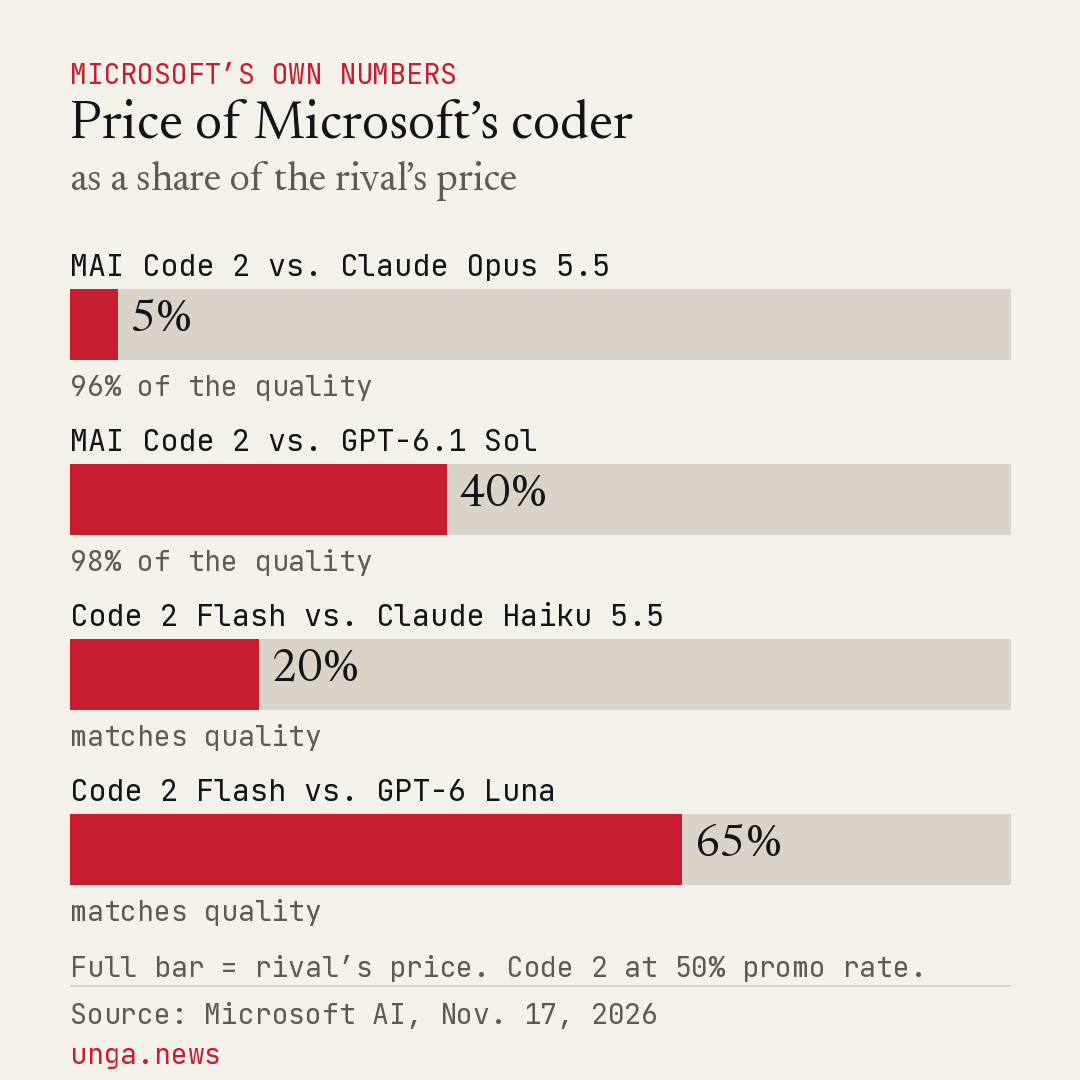
A smaller sibling, MAI Code 2 Flash, is aimed at quick, high-volume jobs. Microsoft says it matches Anthropic’s Claude Haiku 5.5 at 20% of the price and OpenAI’s GPT-6 Luna at 65%.
Why price is suddenly the whole game
The timing isn’t an accident. Companies are no longer paying for a chatbot to answer a few questions. They are running SI agents that work around the clock, writing code, scanning networks and handling paperwork, and the bills add up fast. “As token spend skyrockets,” Microsoft wrote, customers want models “at a price point that lets you run agents 24-7 doing real engineering work.”
That is the opening Microsoft is chasing. For years it leaned on its partnership with OpenAI. Now it is building its own models and pricing them to undercut the very companies it partners with.
The security model makes the case most directly. Microsoft says MAI Cyber 2 Flash matches OpenAI’s GPT-6 Astra on a cyber defense test at less than 2% of the cost per task, so companies can leave a guard dog running in the background all day instead of calling in an expensive expert now and then. “Our national cyber defense will fall behind if we can’t run security agents 24/7,” the lab posted.
Doctors, pictures and phone calls
The rest of the lineup reaches well beyond programmers. MAI Image 2.7 took the No. 1 spot for photo editing on Artificial Analysis, an independent leaderboard, beating OpenAI’s best image model at one fifth of the price, according to Microsoft. A faster version generates images for roughly $10 per 1,000.
MAI Realtime 1 is Microsoft’s first model that listens and talks back in real time, the kind of thing behind customer service lines and voice assistants. Pricing starts at a penny per audio minute.
The one regular patients may already have met is Dragon Copilot Transcribe, which listens to doctor visits and writes up the notes. Microsoft says it now handles every conversation transcribed through Dragon Copilot, about 10 million patient visits a month, and is used by a third of U.S. physicians. The company says it cut error rates in half when patients and doctors switch between languages.
Rounding out the list is Decision 1.1, which decides which model a task actually needs so the pricey ones are only called when necessary. Microsoft says 4,000 customers use it. The company also said its second-generation homegrown SI chip, Maia 200, is now running its largest models and squeezes 1.7 times more output from each watt of power.
For businesses, Microsoft is also offering to hand over the weights of a frontier model so a company can train it on its own data and run it inside its own Azure account. AT&T built a custom model for 5G network analysis, and Microsoft says it beat OpenAI’s flagship at a fiftieth of the cost.
For everyone else, the takeaway is simpler. The price of having a computer do skilled work is falling fast, and the biggest software company in the world just made it fall a little faster.
Sources
- Microsoft AI — Seven new world class models at scalable price-performance, Nov. 17, 2026
- Microsoft AI — MAI Code 2 and Code 2 Flash: Everyday coding at scalable prices
- Microsoft AI — MAI Image 2.7: Frontier quality at a fraction of the cost
- Microsoft AI on 𝕏 — Microsoft AI on 𝕏 — Meet the new MAI models
- Microsoft AI on 𝕏 — Microsoft AI on 𝕏 — Our national cyber defense will fall behind…