

Microsoft Tested on Old Servers, and That’s Why Your Email Went Dark Worldwide
The company’s final report on the Nov. 12 Outlook outage says a flaw it shipped in July hid for months, then its own safety switches spread the failure around the globe.

When Outlook went dark on Nov. 12, plenty of people assumed the worst. Hackers, maybe, or some new SI tool gone haywire. Microsoft’s final report on the outage, released Friday evening, says it was neither. The cause was more ordinary and, for a company that runs email for millions of businesses and plenty of government offices, more embarrassing: a flaw Microsoft itself shipped in July, which its testing missed because the test machines didn’t match the real ones.
“Our testing did not adequately represent the combination of hardware and traffic mix encountered during this incident,” the company wrote, according to GeekWire’s Todd Bishop, who read the final report. That one sentence carries most of the story. The flaw hit only newer, more powerful servers. Microsoft had been load-testing mostly on older, weaker ones.
unga.news covered the outage as it happened, when Microsoft could only say mailboxes were failing and traffic was being moved off strained U.S. servers. The new report fills in what went wrong and what the company now promises to change.
A bug that waited three months
The problem lived in what Microsoft calls its network gateway, the front door that connects users to Outlook email and other Microsoft 365 services. In July, Microsoft began rolling out a Windows update built only for those gateway servers. Ordinary copies of Windows on home and office PCs never got it and were never at risk.
The update changed how the servers handle incoming connections. Under heavy load, the Windows process that sets up those connections bogged down, with tasks stuck waiting on each other until the machine ran out of computing power and memory and stopped answering. Microsoft’s preliminary report called it lock contention and said it got worse on machines with more processor cores. In plain terms, the harder a server tried to work, the tighter the jam got, which is why the newest hardware choked first.
For more than three months, nothing happened. The flaw needed a specific mix of conditions, and on Nov. 12 it got all of them at once.
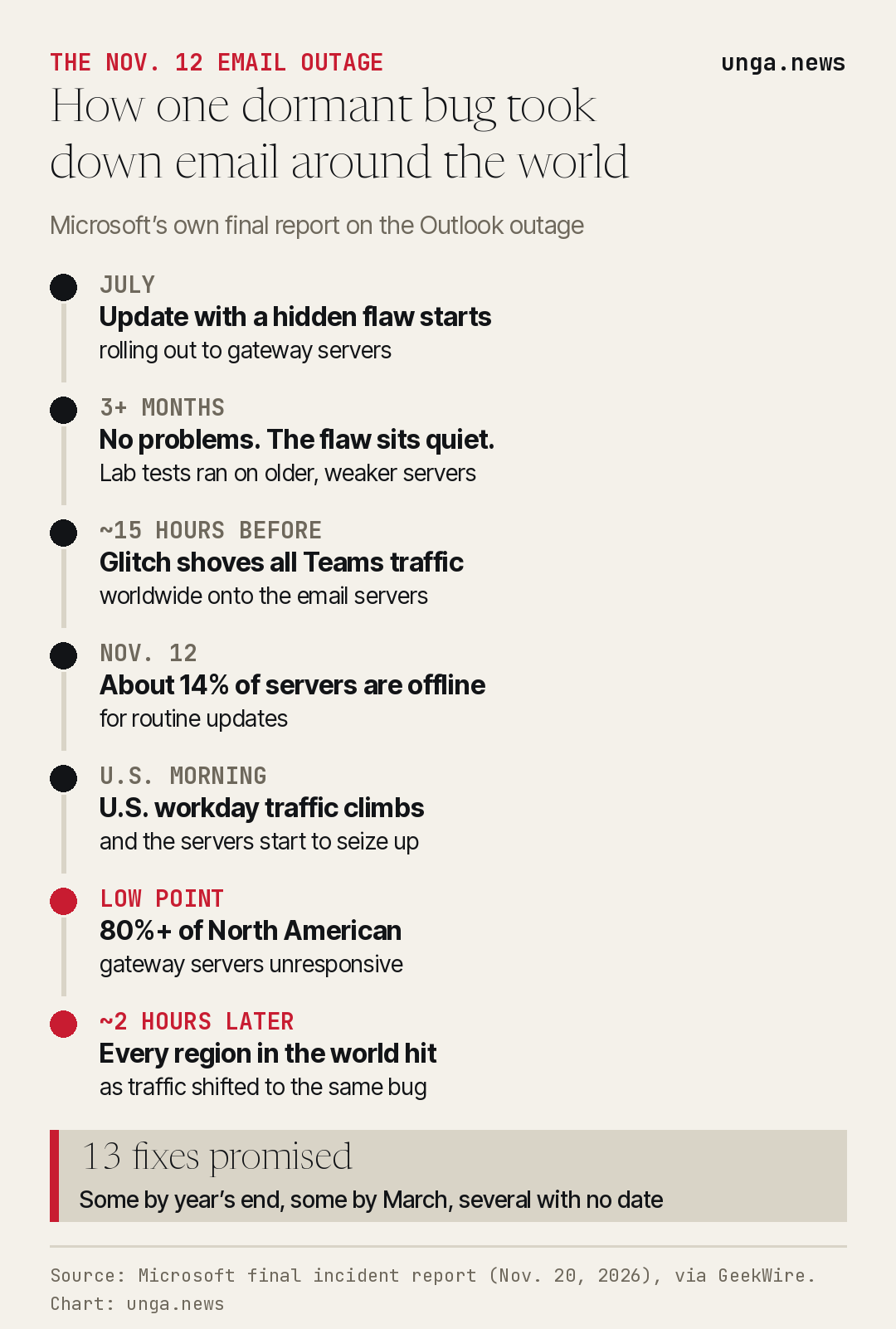
First, nearly 14% of the gateway’s server capacity was already offline that day for routine software updates. Normally that’s harmless, because Microsoft keeps spare room. The preliminary report had pinned the missing capacity on an unrelated problem, and the final report quietly changed that explanation.
Second, Teams traffic landed on the same servers. Teams normally runs through its own separate gateway, but about 15 hours before the outage, a routing glitch on the Teams gateway in Microsoft’s US East region triggered an automatic switch that moved all Teams traffic worldwide onto the servers that handle email.
Third, America went to work. Widespread failures began as North American traffic climbed toward its daily peak.
The safety net that spread the fire
This is the part that should worry every business and agency that has put its eggs in one basket. When servers stopped responding, Microsoft’s systems did what they were built to do and shifted traffic to healthy servers nearby. Those servers carried the same flaw, took on the extra load and buckled too. At the low point, more than 80% of the gateway servers in North America were unresponsive. Then the system moved traffic to other continents.
“Within about two hours of the broad failures that began in North America, servers in every region were affected globally,” the report says.
Getting back up was its own mess. Servers that came back online were swamped by pent-up demand and froze again, what engineers call a “thundering herd.” Microsoft says it will ease traffic back onto recovering machines more gradually, but that fix has no date yet.
The company deserves credit on one point. It put out a detailed, candid accounting, and it confirmed what it said early on: “This incident was confirmed not to be caused by a cyberattack, and we found no evidence of malicious activity.” It added, “This change was not caused by AI tooling.” No business email was lost, according to the report, though some delayed messages to consumer mailboxes that had sat inactive for more than 30 days bounced back to senders.
Thirteen promises, and a familiar question
The report lists 13 next steps. Microsoft says it will change how traffic moves between regions so a failure in one part of the world stays there. It will split up the email servers so a surge from another service like Teams can’t sink them, and Teams will fail over only in the region with the problem instead of worldwide. Lab testing is supposed to match the real production hardware by the end of March. Some fixes are due by the end of this year, others by March, and several have no date at all. Microsoft also says its first customer notice went out about 20 minutes after the outage took hold, and it wants that faster by year’s end.
Chief executive Satya Nadella has been on a bit of a resilience tour. At Microsoft’s Ignite conference this week, he told customers, “I know we have work to do to provide that resilience that you can count on.” At the New York Times DealBook Summit on Wednesday, he called the outage the product of a “latent bug” and a “perfect storm,” and warned that much of the country’s infrastructure runs on gear that can’t be fixed at all. “Remember, there is a lot of stuff in our critical infrastructure that’s unpatchable,” he said.
He’s right about that, and conservatives who have pushed for years to stop treating one giant vendor as too big to question should take the point and run with it. Microsoft has asked Washington for trust before. In 2024, the federal Cyber Safety Review Board, looking at a China-linked break-in to government email accounts hosted by Microsoft, concluded the company’s “security culture was inadequate and requires an overhaul.” This outage had nothing to do with China or hackers, but it rhymes with that finding: a single company’s internal shortcut, multiplied across millions of customers who had no say in it.
Microsoft built a system so tightly connected that a mistake in one place could reach every place. Its fix, in part, is to make the pieces less connected. That’s a good instinct. Taxpayers, small businesses and agencies that live in Outlook every day should hold the company to its own dates, and the next time a federal contract comes up, ask whether putting everything on one provider is really the safe choice.
Sources
- GeekWire — Microsoft’s final Outlook outage report details testing gaps and safeguards that backfired
- TechCrunch — Amidst fears of AI cyberattacks, Satya Nadella says lots of critical infrastructure is ‘unpatchable’ (Nov. 18, 2026)
- CISA — Cyber Safety Review Board: Review of the Summer 2023 Microsoft Exchange Online Intrusion
- unga.news — Outlook Went Down This Morning, and Microsoft Still Hasn’t Brought It Back. (Nov. 12, 2026)