

Microsoft Wants SI That Can Change What a Speaker Says on a Livestream Before You Hear It
A Microsoft patent filing describes swapping a live speaker’s words based on who’s watching, then redrawing the lips so nobody can tell.
Picture watching a live speech, a ballgame press conference or your favorite podcaster streaming in real time, and the words coming out of the speaker’s mouth aren’t the words he actually said. The lips match. The voice matches. You’d never know. That is the system Microsoft describes in a patent application now making the rounds on 𝕏, and it deserves a hard look from anybody who has watched Big Tech decide what Americans are allowed to hear.
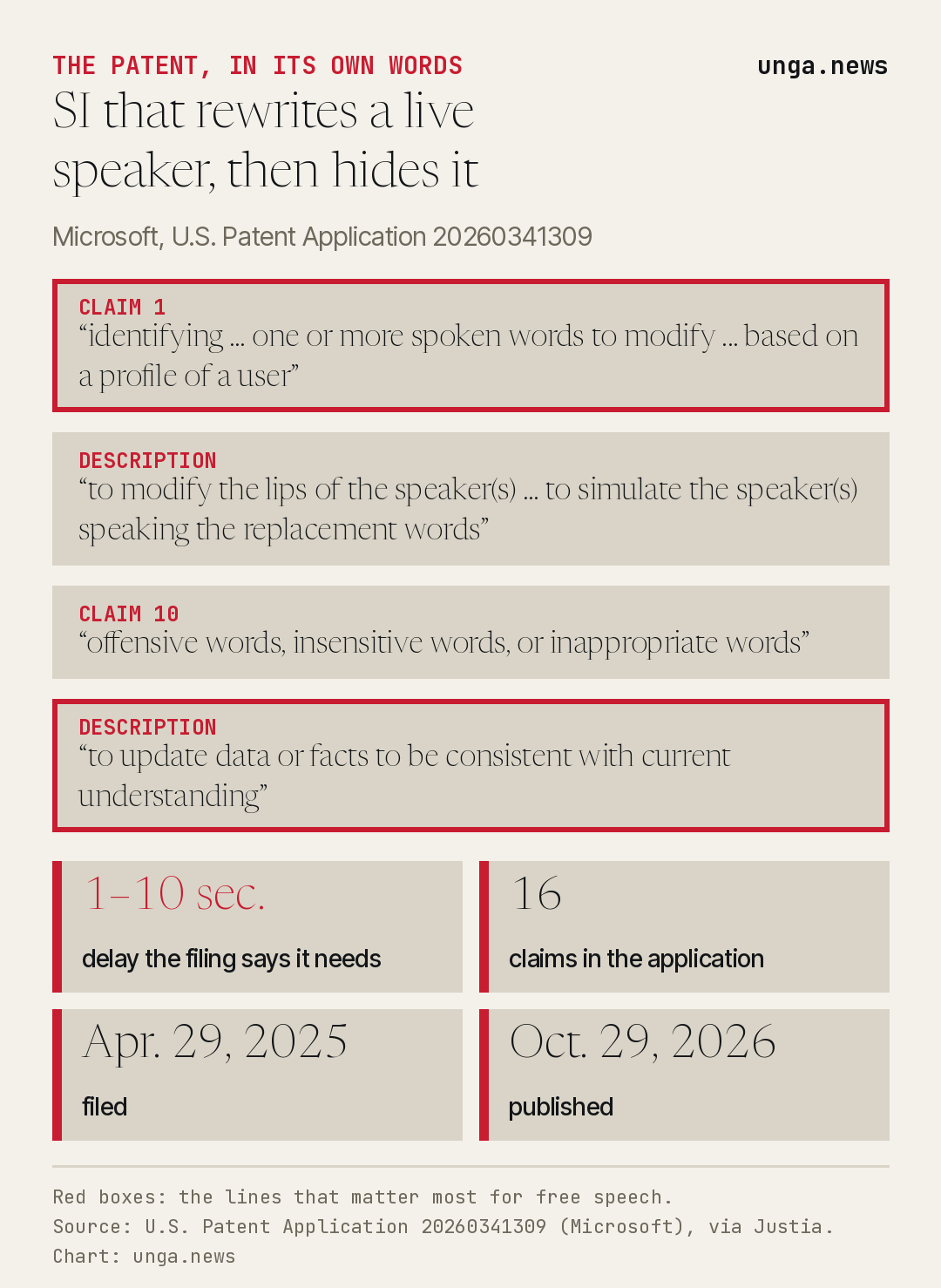
The filing is U.S. Patent Application No. 20260341309, titled “Near real-time artificial intelligence (AI) enhancement of video or augmented reality (AR) presentations of live events.” Microsoft filed it on April 29, 2025, and the government published it on October 29, 2026. It drew wide attention this weekend after the trade site TechSpot wrote it up and posts about it spread across 𝕏.
Swapping the words, then redrawing the mouth
The first claim lays out the whole machine in one sentence. An SI agent scans “a live video recording and a corresponding live audio recording of one or more individuals speaking.” It picks out “one or more spoken words to modify according to a first set of parameters and based on a profile of a user.” Then a generative SI system swaps in “replacement words” in both the audio and the video, smooths the moments before and after, and shows the result to the viewer, all in near real time.
The application spells out what near real time means: “within a few seconds (e.g., 1-10 seconds(s)),” about the same as the broadcast delay networks already use to bleep a curse word. The difference is that a bleep is honest. You hear that something was cut. This system is built to hide the seam. The application says the video frames get changed “to modify the lips of the speaker(s) in the video frames to simulate the speaker(s) speaking the replacement words instead of the original spoken words.”
Who decides which words go?
Microsoft pitches this as cleanup. The application talks about speakers at presentations, lectures and concerts who use filler words, mumble or misspeak, and it lists fixes like removing “uh,” correcting mispronunciations and translating a speaker into the viewer’s language. Nobody minds losing a stutter, and live translation with matching lips would be a genuinely useful tool for travelers and international meetings.
The trouble is in the other targets. Claim 10 lists words the system can replace or remove, and alongside mumbled and misspoken words it names “offensive words, insensitive words, or inappropriate words,” with the rules for what counts “based on the profile of the user.” TechSpot reads the first claim as covering profile details such as a viewer’s age, location and native language. So two people watching the same live event could hear two different versions of what the speaker said, depending on what a computer has decided about each of them.
Then there’s the fact-checking. The application says the system can “update data or facts to be consistent with current understanding and latest information.” Claim 11 says replacement words can come from “an Internet search or a database search of general information regarding a topic of discussion.” Conservatives lived through the years when “current understanding” meant whatever the platforms and their hired fact-checkers said it meant, on COVID’s origins, on Hunter Biden’s laptop, on plenty more. A tool that quietly rewrites a speaker’s words to match the approved version of the facts is the dream of every content moderator who ever slapped a warning label on a true story.
The record stays, but who gets to see it?
Microsoft did include a safeguard of sorts. Claim 14 says the live recording “as originally recorded” is “stored as ground truth for future reference.” That’s better than nothing, but it doesn’t say who gets that record, the viewer or the company. As TechSpot points out, the filing also doesn’t say whether viewers would be told an edit was made, or why. A record locked on a company server does nothing for the person who already watched the edited version and believed it.
To be fair to Microsoft, a patent application is not a product. Big companies file thousands of them to stake out ideas, many never ship, and this one hasn’t even been granted. Microsoft hasn’t announced any plan to put it in Teams, Xbox, LinkedIn or anywhere else. The filing also has plenty of harmless uses, from cleaning up a nervous presenter to making a recorded lecture easier to follow.
But the capability is the story. Generative SI can already clone a voice from seconds of audio and move a face convincingly. Once a big platform can change a live speaker’s words before you hear them, with lips that match, the only thing standing between a viewer and an invisible rewrite is the company’s own policy. Americans have seen how fast those policies shift under pressure from governments, activists and advertisers.
If Microsoft ever builds this, the minimum should be simple. Every changed word gets flagged on screen, viewers can switch the edits off, and the original stays one click away for anyone who wants it. Speakers should have to opt in before their own mouth gets redrawn. Anything less turns “live” into a word that no longer means what it used to.
Sources
- U.S. Patent and Trademark Office (via Justia) — Patent Application 20260341309: Near real-time artificial intelligence (AI) enhancement of video or augmented reality (AR) presentations of live events (Microsoft; filed Apr. 29, 2025; published Oct. 29, 2026)
- TechSpot — Microsoft patent filing describes AI that rewrites what people say in livestreams in real time (Nov. 7, 2026)
- Dexerto — New Microsoft patent could use AI to alter speech and lip movements in real time (Nov. 8, 2026)