

Millionaires Can Get Food Stamps in 41 States. Trump’s Team Wants to Close That Door.
JB Pritzker called the president a “lowlife” over a food stamp rule. USDA’s own numbers say it targets households above the legal limits, and 97% of affected kids still qualify for cheap or free lunch.
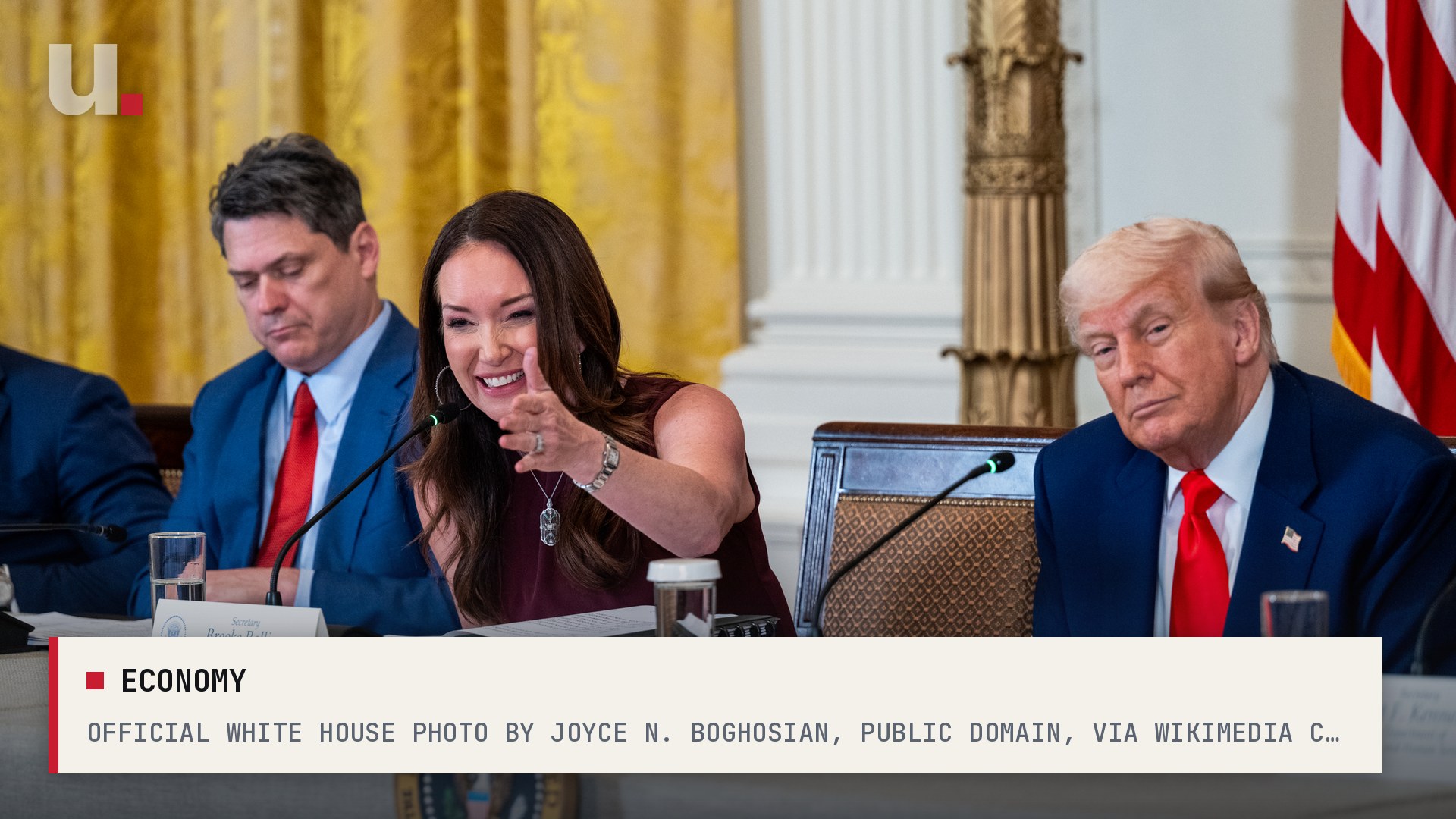
JB Pritzker had a one-line review on Sunday for the Trump administration’s plan to tighten food stamp eligibility. “What kind of lowlife tries to take away school meals from kids? This President,” the Illinois governor posted, linking a story that said the change threatens free school meals for 1.7 million children.
That is a heavy charge. It is also not what the rule says. The proposal, which the Agriculture Department published in the Federal Register on Nov. 10, goes after a quiet loophole that lets states hand food stamps to households earning more than the law allows, and in most of the country, to households with no limit at all on what they have sitting in the bank. By USDA’s own estimate, nearly every child Pritzker is worried about still gets a free or cheap lunch when it’s done.
A pamphlet and a phone number
Congress set the rules for SNAP a long time ago. A family without an elderly or disabled member has to earn no more than 130% of the poverty line before deductions, and there are limits on savings and other assets. Back in 1985, lawmakers created a shortcut called categorical eligibility. If a family already qualified for cash welfare, the old AFDC program, it could skip the SNAP paperwork. The two programs served the same poor families, so it made sense.
Then welfare reform in 1996 replaced AFDC with a block grant called TANF, and states started stretching the shortcut. Under what is known as broad-based categorical eligibility, a state can count almost any TANF-funded “benefit” as the ticket into SNAP. The USDA’s proposed rule quotes the Obama-era guidance that encouraged states to use things of “nominal value,” such as “an informational pamphlet or an 800-number to call to locate TANF-funded services.” Hand someone a brochure, and the federal income and asset limits no longer apply.
The department says that guidance came in 2009, explicitly “to increase SNAP participation.” It worked. As of December 2025, 46 states were using the workaround. Thirty-seven of them set income limits above what the law allows, as high as 200% of the poverty line. Forty-one have no asset limit at all.
That last number is where the rule gets blunt. “In States with no resource limit, a household with a million dollars or more in available resources but no regular income could apply for and be eligible to receive SNAP benefits,” USDA wrote. “The Department is aware of instances where millionaires have received SNAP benefits. It is irresponsible to Congress and the taxpayer to support regulations that permit this practice.” The footnote points to a CBS Minnesota report on a Waite Park millionaire who signed up for food stamps to prove the loophole was real.
The share keeps climbing
The numbers in the rule show how far the program has drifted from what Congress wrote. In fiscal 2010, about 4% of SNAP participants lived in households with income or savings above the federal limits, meaning they qualified only because of the workaround. By 2013 it was 8%. It hit 10% in 2018. USDA now puts it at 17.6% of participants, more than one in six.
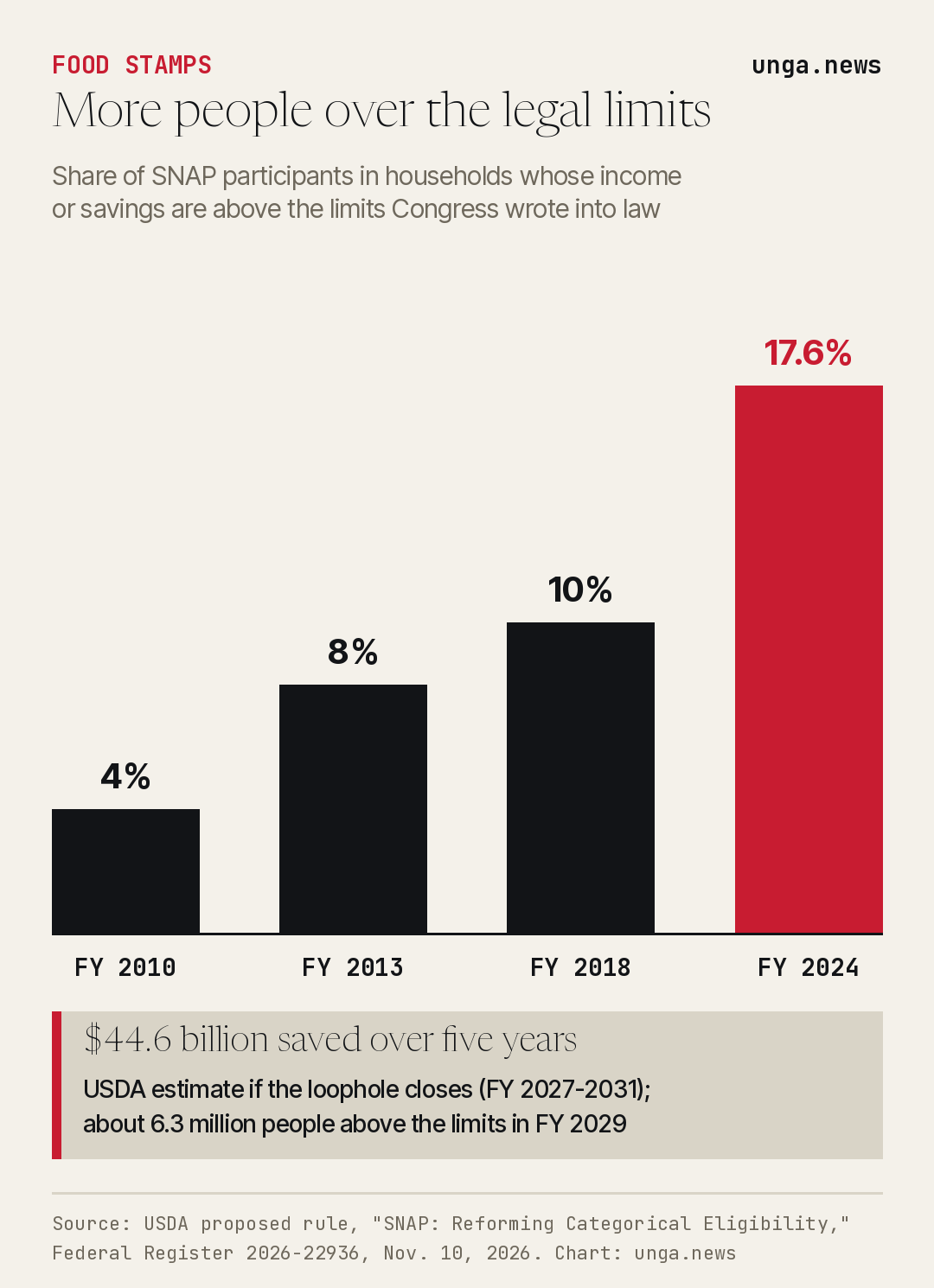
The department estimates 11.5% of SNAP households, about 2.5 million households and 5.4 million people, have more savings than the SNAP limit, and another 5.4% have incomes over the federal cap. Closing the workaround, it projects, would take 3.2 million households and 6.3 million people off the rolls in fiscal 2029, the first full year. The savings in federal food stamp spending come to about $44.6 billion over five years.
Those 6.3 million people are not the poorest in the program. They are, by definition, the ones whose income or assets are above the lines Congress drew. The rule doesn’t lower those lines. It just asks states to follow them, and it limits the shortcut to families actually getting TANF cash assistance, the kind of help Congress had in mind in 1985.
What it means for the lunch line
This is the part Pritzker skipped. Kids whose families get SNAP are signed up for free school meals automatically. If a family leaves SNAP, that automatic link goes away. USDA says about 1.78 million children would lose it, but “almost all such children (approximately 97 percent) would still retain eligibility for free or reduced price school meals based on their household income.”
Here is the department’s breakdown. About 1.66 million of those kids would still get free meals; their parents would fill out the regular school form instead. About 93,000 would move from free to reduced-price meals. About 28,000 would pay full price, and USDA says that is because of their households’ resources. Schools would process an estimated 197,000 more applications, at a cost of roughly $2 million in the 2028-29 school year, spread across a program that serves about 30 million children a year.
Critics are not wrong that paperwork costs something. The Food Research & Action Center called the plan another attack on hungry families, and USDA itself acknowledges “some level of increased administrative burden on states.” Some families that still qualify will miss a form. That is a fair point to raise in the comment period. It is a long way from “taking away school meals from kids.”
Second try
This fight isn’t new. USDA proposed a narrower version of the fix in July 2019, during President Trump’s first term. The Biden administration withdrew it in June 2021, before it ever took effect. This time the department, under Secretary Brooke Rollins, is going further, tying categorical eligibility to real cash assistance instead of a brochure.
Republicans have argued for years that a safety net works best when people trust that it goes to the people it was built for. A rule that keeps millionaires out of the food stamp line, saves taxpayers tens of billions and still leaves 97% of the affected kids eligible for subsidized lunch is a strong place to make that case.
The public can weigh in. Comments are open on Regulations.gov under docket FNA-2026-0661 until Dec. 10. Pritzker has already filed his, on social media, in 14 words.
Sources
- U.S. Department of Agriculture, Federal Register — Supplemental Nutrition Assistance Program: Reforming Categorical Eligibility (proposed rule, Nov. 10, 2026)
- USDA Food and Nutrition Administration — Proposed Rule: SNAP - Reforming Categorical Eligibility (comments due Dec. 10, 2026)
- Gov. JB Pritzker on Bluesky — “What kind of lowlife tries to take away school meals from kids? This President.” (Nov. 22, 2026)
- CBS Minnesota — Waite Park millionaire and the food stamps loophole (cited in the USDA rule)
- Food Research & Action Center — FRAC statement on the proposed BBCE rule (Nov. 2026)