

Minnesota Already Paid Out $112 Million in Medicaid Claims. Washington Just Refused to Cover It.
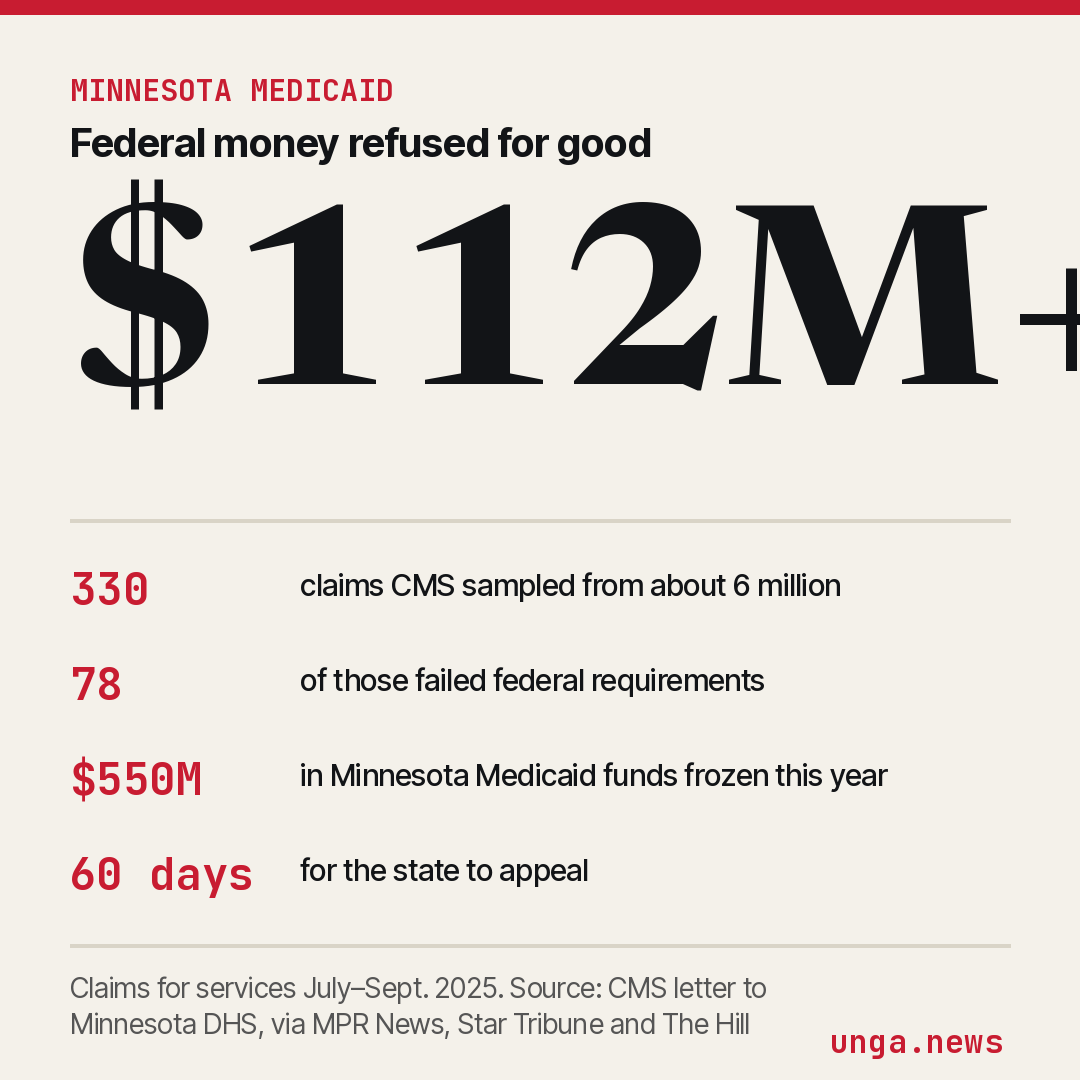
Federal reviewers checked 330 high-risk claims and 78 failed. CMS used that rate to permanently deny Minnesota more than $112 million, with another $350 million still frozen.

For most of this year, Washington has been telling Minnesota the same thing about its Medicaid program: show us the paperwork. On Friday, the federal government stopped asking.
The Centers for Medicare and Medicaid Services, run by Dr. Mehmet Oz, sent Minnesota a formal notice refusing to reimburse more than $112 million in Medicaid spending, according to the letter described by MPR News and Bloomberg Law. This isn’t a pause. In Medicaid language it’s a disallowance, which means the federal share of that money is gone unless Minnesota wins an appeal.
And here’s the part that will sting Minnesota taxpayers. The state already paid those claims out to providers. If Washington won’t cover its share, the state either eats the cost or tries to claw the money back from the people it paid.
A small sample with a big price tag
CMS didn’t pull that number out of the air. Reviewers took 330 claims from a quarter in which Minnesota submitted roughly 6 million claims for services the agency considers high-risk for fraud. Seventy-eight of those 330 failed to meet the requirements for federal reimbursement, the Star Tribune reported. CMS then used that failure rate to calculate the $112 million figure for the whole quarter.
The problems federal reviewers flagged were the kind any auditor looks for first. Missing records of assessments and treatment plans. Provider notes that didn’t match the service dates on the bill. Provider agreements nobody signed.
The money in question covers services from July through September 2025. It traces back to a $259 million deferral CMS slapped on the state in February. Since then the agency has frozen two more batches, $91 million and $199 million, for a total of $550 million in Minnesota Medicaid money sitting on hold. The first of those freezes has now turned into a permanent no. The other two, worth about $350 million, are still waiting on a decision.
The state calls it paperwork
Minnesota’s Department of Human Services isn’t taking it quietly. Temporary Commissioner John Connolly, who also serves as the state’s Medicaid director, told his department leaders Tuesday that the state expected to lose something, but the amount denied was roughly 1,000 times bigger than the claims it had first identified.
“While we have been bracing for some sort of disallowance, this amount is deeply concerning for the more than 1 million Minnesotans who depend on Medicaid,” Connolly wrote, according to the Star Tribune.
His main argument is that the failures were about forms, not crime. “CMS’s findings indicate the basis for the disallowance is administrative paperwork deficiencies, including issues with signatures, signoffs, dates and addresses in billing, as well as other supporting documentation,” he wrote. He also questioned CMS’s “extrapolation methodology” and how it picked 330 claims out of more than 6 million.
That’s a fair point as far as it goes. A missing signature isn’t proof somebody stole money, and CMS’s letter doesn’t say fraud was proven on these claims. But that cuts both ways. Medicaid is taxpayer money, and the rule for getting reimbursed has always been simple: if you can’t document the service, you don’t get paid for it. When nearly 1 in 4 sampled claims can’t clear that bar in a program already flagged as high-risk, the burden is on the state, not the taxpayer.
Connolly also complained that CMS has “not responded to multiple requests for transparency, partnership and a path to resolution,” and said the state is “bracing for the possibility” of more deferrals. Minnesota has 60 days to appeal, according to The Hill, and DHS hasn’t said yet whether it will.
Why Washington is squeezing this state
None of this came out of nowhere. Minnesota has been at the center of the administration’s fraud crackdown for months. On Oct. 30, FBI Director Kash Patel stood in St. Cloud and announced four arrests and a 26-count indictment tied to more than $41 million in alleged Medicaid fraud. At the same event, Oz said that when Washington made Minnesota recheck its high-risk Medicaid providers, roughly one in three turned out not to be allowed to provide services at all.
So when the state says the latest problem is just paperwork, federal officials have reason to want to see the paperwork. That’s the whole point of a documentation rule in a program where fraud has already been charged in court.
The fight is also showing up in Congress. A bill called the PROOF Act, from Rep. Jeff Van Drew of New Jersey, would require state agencies running Medicaid, SNAP, unemployment insurance, COVID-era relief funds and other federal programs to hand the attorney general records like identity checks, payment logs and provider billing statements when he requests them for a fraud case. It passed the House 217 to 207 back on Sept. 16, with 210 Republicans and six Democrats voting yes. It has gone nowhere in the Senate, and it lit up 𝕏 again this week as people connected it to the Minnesota news.
With Democrats taking over the Senate in January, that bill’s odds aren’t getting better. Which means the tools that actually work right now are the ones CMS already has: freeze the money, check the claims, and refuse to pay for what can’t be backed up.
Minnesota lawmakers are already bracing for what comes next, KSTP reported, because if the state loses the appeal or skips it, somebody has to cover the hole. The other $350 million in frozen money is still sitting there. And CMS just showed what it does when the files come back empty.
Sources
- MPR News — Minnesota Medicaid reimbursements totaling more than $112M denied by Trump administration (Nov. 10, 2026)
- Star Tribune — Feds block nearly $113 million MN Medicaid money
- The Hill — CMS blocks $112M in Medicaid funding to Minnesota (Nov. 10, 2026)
- Bloomberg Law — Trump Pulls $112 Million From Minnesota in Medicaid Fight
- KSTP — Minnesota lawmakers, providers brace for impact of feds denying $112M in Medicaid funding
- U.S. House Clerk — Roll Call 310: H.R. 10326, PROOF Act, passed 217-207 (Sept. 16, 2026)
- GovInfo — H.R. 10326 (Engrossed in House), PROOF Act text
- The White House (Rapid Response 47) on 𝕏 — Dr. Oz: one in three high-risk providers not allowed to provide services (video, Oct. 30, 2026)