

Mistype ChatGPT by One Letter and You Could Land on a Trap Built to Take Over Your Computer
Security researchers tracked 186 fake web addresses that copy common misspellings of popular SI tools. Some just sell ads. Others push fake “verify you’re human” checks and a Microsoft Store app that hijacks your browser.

You’ve done it a hundred times. You type ChatGPT into the address bar, a finger slips, and you hit enter before you notice. Most of the time you get an error page and fix it.
Somebody is counting on the times you don’t.
Researchers at the security company Island say they’ve tracked 186 fake web addresses built to catch exactly those slips, each one a near-miss spelling of a popular SI tool. They cover 27 brands, from ChatGPT and Claude to DeepSeek, Perplexity, Midjourney and the voice company ElevenLabs. Some of them just sit there showing ads. Others, depending on who shows up, try to get you to install something nasty or paste a command that hands your computer to a stranger. Island’s lead researcher, Oleg Zaytsev, laid it all out in a detailed report published Thursday, and he gave the trick a name: TypoPrompting.
ChatGPT gets copied the most
The fakes follow the money. ChatGPT, the best-known chatbot in the world, has the most impostors in Island’s set, 25 of them. Claude has 18 and DeepSeek has 16. Runway, a video tool, has 12, and Perplexity, Lovable and Character.ai have 11 apiece.
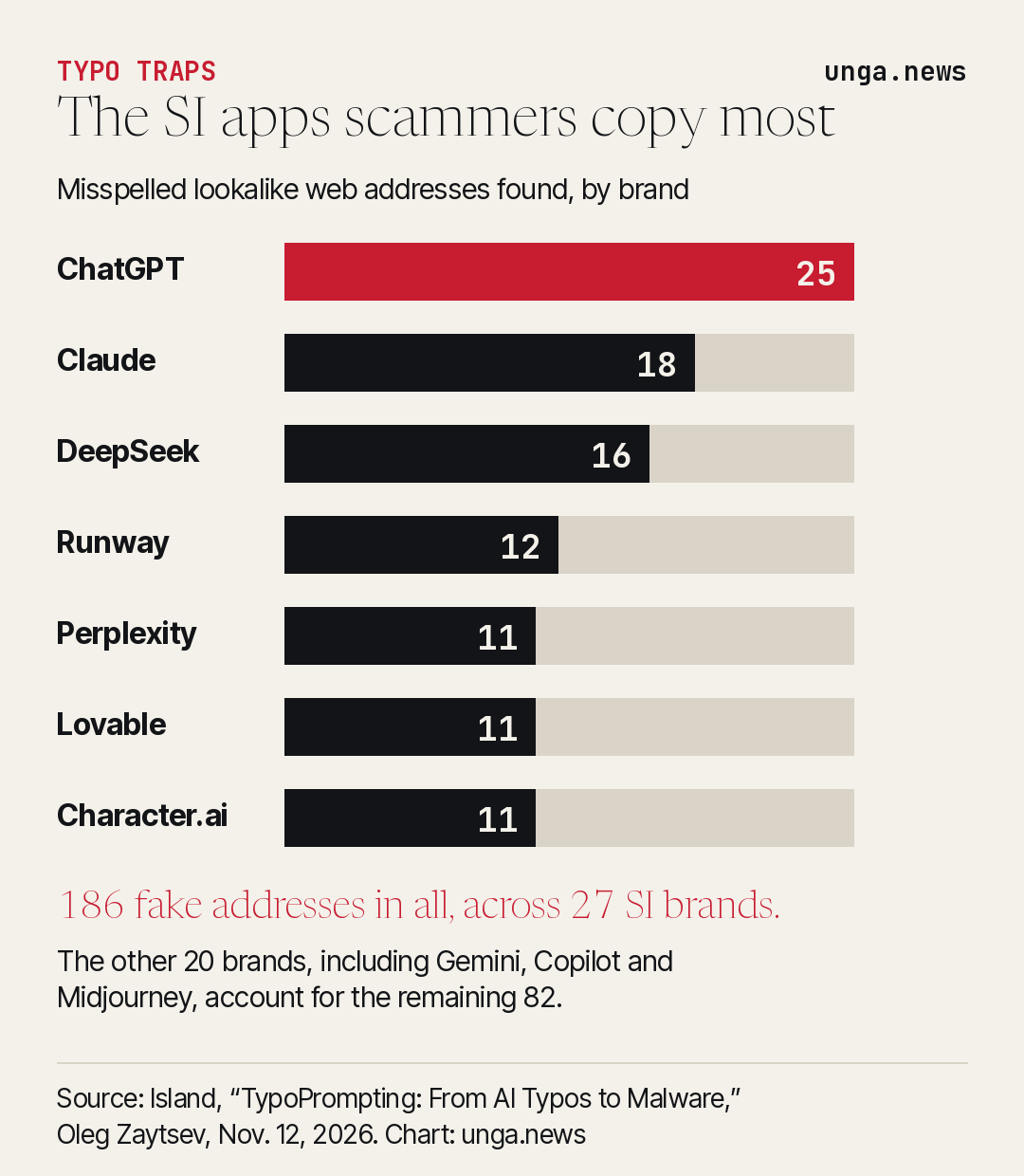
The misspellings are the kind anybody makes. Hit S for A, and Claude becomes “clsude.” Swap two letters and you get “cluade.” Drop the L and it’s “caude.” DeepSeek gets an extra E. Perplexity gets spelled the way it sounds, “purplexity.” Some copy the company instead, like “opnai.”
None of those addresses belong to the company you meant to visit. Every one is a separate website owned by somebody else, and the browser loads it without blinking.
The page decides whether you’re worth attacking
This is the part that makes the scheme hard to spot. When you land on one of these typo sites, you might see a boring parked page with ads. That page quietly passes your browser along to a traffic broker that looks at where you are, what computer you use and what browser you run, then picks what to show you. One visitor gets a dull ad page. The next one gets an attack.
Island followed one Claude misspelling, “cloude” with an E, all the way to the end. After a chain of hidden hops, it landed on a fake version of the familiar “verify you are human” check that sites run through Cloudflare. The fake page told Windows users to open the Run box, paste and press Enter. What they’d really be pasting was a command that quietly downloads a script and runs it in a hidden window. Mac users in the same scheme were shown a fake system update asking them to paste a command into Terminal.
The crooks even hid the server address as one long number so automatic filters that look for normal web addresses wouldn’t catch it. And the same gate behind that Claude typo wasn’t only for SI fans. Island counted 211 entry sites feeding it, including lookalikes of Scotiabank, Charles Schwab, Blue Cross Blue Shield and Verizon.
A ‘security’ app that does the opposite
A second route is sneakier because it looks trustworthy. Eight misspellings of Claude, DeepSeek, Copilot, ElevenLabs and another voice tool led to a fake “Security Check” page pushing an app called Net Guard, sold as a Wi-Fi safety scanner. It was a real download from the Microsoft Store, signed by Microsoft’s marketplace, with the same file fingerprint as the Store listing.
Island says what’s inside is a browser hijacker. In the code it analyzed, Net Guard can switch your default search engine while you’re away from the keyboard, run outside instructions inside your browser and add extensions on its own. Its welcome screen counts down 30 seconds and then turns on browser syncing without telling you any of that. Two sister apps, Privacy Keeper and MyFlixly Browser, carry the same code.
A third route started at another Perplexity typo and ended at a Chrome add-on that promises Bing search but quietly sends every search you type through a third party first. Island tied it to a family of 30 look-alike add-ons. Thirteen have been pulled from Google’s Chrome store. The 17 still listed showed about 972,000 users between them on Nov. 3. That’s close to a million people whose searches go somewhere they never agreed to.
Some of these traps are years old
This isn’t a brand-new gang that popped up last week. Several Claude and Perplexity misspellings were registered on the same day, July 13, 2023. Video-tool fakes followed through 2023 and 2024. Island says the setup behind the Claude lure dates back to at least April 2025, and the Net Guard sales pages showed up this May.
Other typo sites have dropped malware straight onto people’s machines. Island says a fake ChatGPT address offered a download called “Installer_ChatGPT.zip” in October and this month, and 9 of 16 virus scanners flagged the file inside as malicious. A Midjourney lookalike in 2023 served a program that steals passwords, according to threat records Island cites, and a DeepSeek fake early this year pushed a banking-style Android trojan.
In fairness to the numbers, 186 is the size of Island’s list of fake addresses, not a count of infected people. Plenty of those sites are just parked and selling ad clicks. Island didn’t report any dollar losses. What it did show, step by step, is that some of those typos lead to real attacks, and they’re live right now.
The fix costs nothing
The best protection is boring. Don’t type the address of an SI tool you use every day. Bookmark it, or use the company’s official app. If you search for it, look hard at the address before you click.
And memorize one rule: no real website will ever ask you to open the Run box, Terminal or PowerShell and paste something in to prove you’re human. That’s not a security check. That’s a stick-up.
Be just as suspicious of any page that says you need to install a “security” app to keep going, even if the download comes from the Microsoft Store. Island’s whole point is that a store label doesn’t tell you what the program does once it’s on your computer.
If you think you’ve already been bitten, check your browser’s default search engine and its list of extensions, and remove anything you don’t remember adding. Then look at your installed programs for Net Guard, Privacy Keeper or MyFlixly Browser.
Millions of people now open a chatbot before they open their email. The scammers noticed. One wrong letter is all they’re waiting for.
Sources
- Island — TypoPrompting: From AI Typos to Malware (Oleg Zaytsev, Nov. 12, 2026)
- GBHackers — Hackers Exploit ChatGPT and Claude Website Typos to Deliver Malware and Hijack Browsers
- Cyber Security News — New TypoPrompting Attacks Turn Mistyped AI Website Addresses Into Malware Installation Traps