

MIT Admits Women at Nearly Twice Men's Rate. It Rejected Trump's Sex-Blind Admissions Pledge
Nearly two of every three MIT applicants were men, yet women got 638 offers to men's 632 for the class that started in 2025. When the Trump administration asked elite schools to stop weighing sex and publish the numbers, MIT was the first to say no.

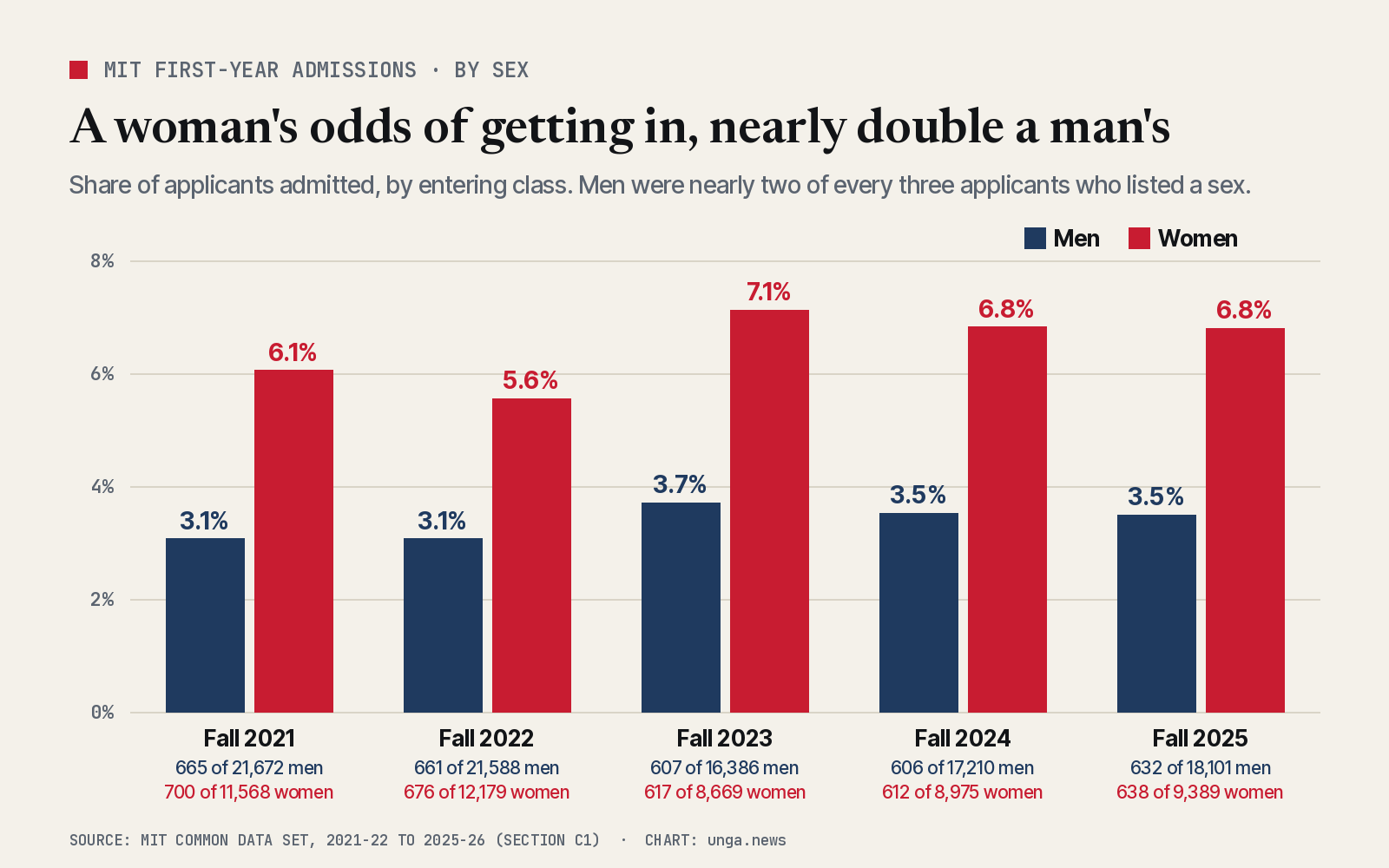
MIT's own numbers tell the story. For the class that started in fall 2025, 18,101 men applied and 632 got in, an admit rate of 3.5%. Of 9,389 women who applied, 638 got in, or 6.8%. Nearly twice as many men applied. More women were admitted.
Those figures come straight from the Common Data Set MIT publishes every year, the standard report colleges file on who applies, who gets in and who enrolls.
It isn't a one-year blip. In each of the last five entering classes, a female applicant's odds of admission ran 1.8 to 2 times a male applicant's. Men made up nearly two of every three applicants who listed a sex. Yet every year, the admitted class came out almost exactly half women, between 50% and 51%.
What MIT says
MIT's answer is that its female applicants are a stronger, more self-selected group. Stu Schmill, who has long led MIT's admissions office, made that case to MIT researchers for a 2017 paper on gender balance in engineering. "When we admit students, the metrics are the same, right. So male/female, there isn't a difference," he said.
He added: "We're not trying to control that number [female to male undergraduate ratio]. I mean, if we were really trying to control it, we would just do it. Just get 50%." The paper reports that Schmill found "the female applicants in some ways self-select at a higher rate than their male counterparts do."
The same paper describes how hard MIT works to recruit young women. In that interview, Schmill said admissions officers go talk with students in the girls-only Women's Technology Program on campus. "Not that we give an advantage to those students," Schmill said, "but we know that students who went through that program have demonstrated some type of interest."
The math pipeline leans male
MIT is a math-heavy school, and it requires the SAT or ACT. The middle half of its fall 2025 class scored 780 to 800 on SAT math.
Top math scores skew male nationally. In the College Board's 2025 report, 12% of male test takers scored 700 to 800 on the math section, compared with 7% of female test takers. That's roughly 119,000 young men and 70,000 young women, about 1.7 to 1. The College Board doesn't break out the sexes above 700, so there's no official count at MIT's 780-and-up level.
So the national pool of top math scorers leans heavily male, and so does MIT's applicant pool. MIT's admitted class doesn't.
What equal odds would look like
Here's a simple what-if. If MIT had admitted men and women at the same 4.6% rate in its latest cycle, about 836 men and 434 women would have gotten offers. That's roughly 200 seats moving from women to men.
MIT would say that math assumes the two pools are equally strong, which it disputes. The problem is nobody outside MIT can check. Its public reports don't break out test scores or grades by sex.
Trump asked. MIT said no first.
In October 2025, the Trump administration sent MIT and eight other universities the Compact for Academic Excellence in Higher Education. Its very first section said "no factor such as sex, ethnicity, race, nationality, political views, sexual orientation, gender identity, religious associations, or proxies for any of those factors shall be considered, explicitly or implicitly, in any decision related to undergraduate or graduate student admissions or financial support."
It also asked schools to "publicly report anonymized data for admitted and rejected students, including GPA, standardized test score, or other program-specific measures of accomplishments, by race, national origin, and sex."
On Oct. 10, 2025, MIT became the first of the nine to publicly turn it down. President Sally Kornbluth wrote that "MIT prides itself on rewarding merit" and that "the people of MIT gladly compete with the very best, without preferences." She said other parts of the compact "would restrict freedom of expression and our independence as an institution."
Why it's legal
Title IX, the 1972 law against sex discrimination in schools, has a gap most people don't know about. On admissions, it applies "only to institutions of vocational education, professional education, and graduate higher education, and to public institutions of undergraduate higher education." MIT is a private college, so Title IX doesn't reach its undergraduate admissions at all.
That's why the administration's other move matters. On Aug. 7, 2025, Trump ordered the Education Department to expand the admissions data colleges must report, writing that "Greater transparency is essential to exposing unlawful practices." His memo focused on race, but the survey the department built breaks results out by race and sex together, and by test-score quintile, going back to 2020-21.
In a Sept. 14 Federal Register notice, the department said it intends to produce school-level admission odds for families, such as "the likelihood of admission for a student in a specific race-sex pair in a specific admissions test score quintile."
Seventeen Democrat-led states, led by Massachusetts, sued to stop it in March. The Association of American Universities, whose members include MIT, and the Association of Independent Colleges and Universities in Massachusetts joined the case. In April, U.S. District Judge F. Dennis Saylor IV blocked the survey for the plaintiff states, while acknowledging the government's general authority to collect such data. The case is ongoing. The department says nothing will be published until its privacy review board clears it, and no school-by-school results are out yet.
MIT says its women earn every seat, and they may. But Kornbluth set the standard herself: competition "without preferences." The simplest way to prove it is the one Trump offered. Publish the scores.
Sources
- MIT Institutional Research — 2025-26 Common Data Set (Section C1, fall 2025 entering class)
- MIT Institutional Research — 2024-25 Common Data Set
- MIT Institutional Research — 2023-24 Common Data Set
- MIT Institutional Research — 2022-23 Common Data Set
- MIT Institutional Research — 2021-22 Common Data Set
- MIT Office of the President — Regarding the Compact, Sally Kornbluth's letter to Education Secretary Linda McMahon (Oct. 10, 2025)
- U.S. Department of Education — Compact for Academic Excellence in Higher Education (Oct. 2025)
- The White House — Ensuring Transparency in Higher Education Admissions, presidential memorandum (Aug. 7, 2025)
- Federal Register — IPEDS Admissions and Consumer Transparency Supplement (ACTS), revised notice (Sept. 14, 2026)
- College Board — 2025 Total Group SAT Suite of Assessments Annual Report
- ASEE Annual Conference (2017) — Getting to Gender Parity in a Top-Tier Mechanical Engineering Department: A Case Study (Xu, Wendell, Walsh, MIT)
- Cornell Law School, Legal Information Institute — 20 U.S. Code § 1681, Sex (Title IX)
- U.S. District Court, District of Massachusetts — Commonwealth of Massachusetts v. U.S. Department of Education, No. 1:26-cv-11229 (docket)