

Murder Victims’ Families Sue to Stop Newsom From Erasing All 548 California Death Sentences
Families and prosecutors told the California Supreme Court the governor broke the law by commuting every death sentence at once, without notifying district attorneys or reviewing a single case.
Juries in California sentenced 548 people to death. On Nov. 5, Gov. Gavin Newsom changed every one of those sentences with a single letter. Now the families of murder victims and the prosecutors who tried those cases are asking the state’s highest court to stop him.
The Criminal Justice Legal Foundation filed the suit Sunday at the California Supreme Court on behalf of victims’ families and district attorneys. It asks the justices to block Newsom and the state corrections department from carrying out the commutations, and to order them to explain why the court shouldn’t grant permanent relief.
“This lawsuit is about protecting the constitutional rights of victims, defending the rule of law and ensuring that no governor is above the law,” said Anne Marie Schubert, the foundation’s president and CEO. “The governor’s clemency power does not authorize mass commutations that disregard constitutional safeguards, legally required procedures or victims’ rights.”
One letter, 548 sentences
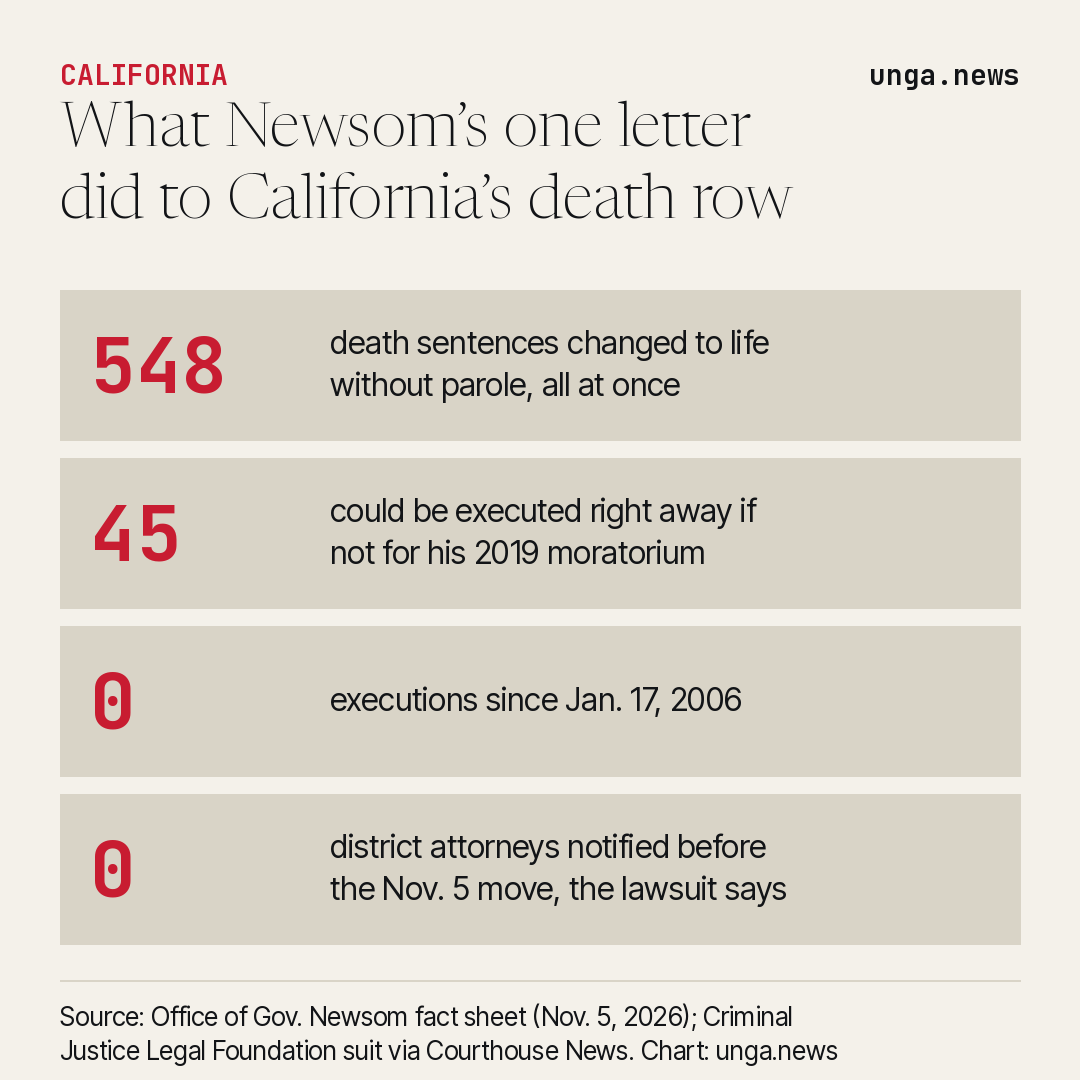
Newsom announced on Nov. 5 that he would change every death sentence in California to life in prison without the possibility of parole. According to his office’s fact sheet, the 548 people on death row include 529 men and 19 women, and 45 of them could be executed right away if not for the moratorium Newsom imposed in 2019. California hasn’t carried out an execution since Jan. 17, 2006.
The governor’s office stresses that nobody walks free. The fact sheet says no one is released or made eligible for parole, and the convictions and restitution orders stay in place. In his letter, Newsom said state-sanctioned killing conflicts with California’s values. “I follow the moral leadership of past presidents, including our Founding Fathers, and governors across America, from all political parties, who used their executive authority to commute death sentences,” he said.
Newsom leaves office in January after two terms, so the move came in the final weeks of his time as governor. Many of the cases took juries, judges and families decades to see through.
The case against him
The suit’s core argument is about process. California law gives crime victims a chance to be heard before a governor commutes a sentence, the plaintiffs say, and requires notice to the district attorneys who prosecuted the cases. No district attorney got that notice before the announcement, according to the suit. Newsom’s position, the plaintiffs say, is that the notice rule didn’t apply because his decision was unilateral.
The plaintiffs don’t buy that. They point to the stack of documents that came with the announcement as proof the move took a long time to prepare, plenty of time to notify the people the law says must be told.
They also say the governor never looked at the cases one by one. “Instead, the governor made a categorical determination that every death sentence should be commuted based upon his general opposition to capital punishment,” the filing says. It also says Newsom skipped referring the cases to the Board of Parole Hearings for investigation.
The plaintiffs put the stakes bluntly. “Thousands of jurors and hundreds of judges set aside their personal views on the merits of the death penalty to render judgments based on the evidence and the law,” they wrote. “Governor Newsom decided his personal views should override all those who actually participated in the process, followed and applied the law.”
A list with mistakes
There is a second check built into the state constitution. When the person getting clemency has been convicted of a felony twice, the governor needs a recommendation from at least four justices of the California Supreme Court. Newsom’s office says it submitted the matter to the court as that process requires.
But the plaintiffs say his list already has errors. They found at least one inmate with two or more felony convictions who appears on the list with only one, which would wrongly skip the court review. They want time to go through court records and catch any others.
Newsom’s own numbers show how stuck the system had become. His fact sheet says 376 people on death row are still waiting for state habeas lawyers, and 139 have waited 20 years or more. Voters passed Proposition 66 a decade ago to speed those appeals up, but the fact sheet says only five people have been appointed counsel since then.
What comes next
The California Supreme Court now has two jobs: ruling on the victims’ request to stop the commutations, and reviewing the cases that need its sign-off. Asked about the suit, the governor’s office pointed Courthouse News to Newsom’s Nov. 5 statement.
For the families, the question is simpler than the legal fight. They sat through the trials, watched juries hand down the sentences and waited years for the law to be carried out. The suit asks whether one governor, on his way out the door, can wipe all of that away without even telling them first.
Sources
- Courthouse News Service — Victims, prosecutors sue over California death row commutations (Nov. 16, 2026)
- Office of the Governor of California — Fact sheet: California Commutations (Nov. 5, 2026)
- Office of the Governor of California — Governor Newsom releases letter to California on the death penalty (Nov. 5, 2026)
- California Courts Newsroom — Newsom moves to commute all California death sentences to life in prison without parole (Nov. 5, 2026)