

Musk Says Brazil's Math Doesn't Add Up. Lula Won 3 of Every 4 Votes in Play
Lula's runoff gain beat every eliminated candidate's votes combined. The totals balance only with a turnout surge Brazil hadn't seen since 1989, rivals' endorsements that went the other way, and polls that missed in one direction.
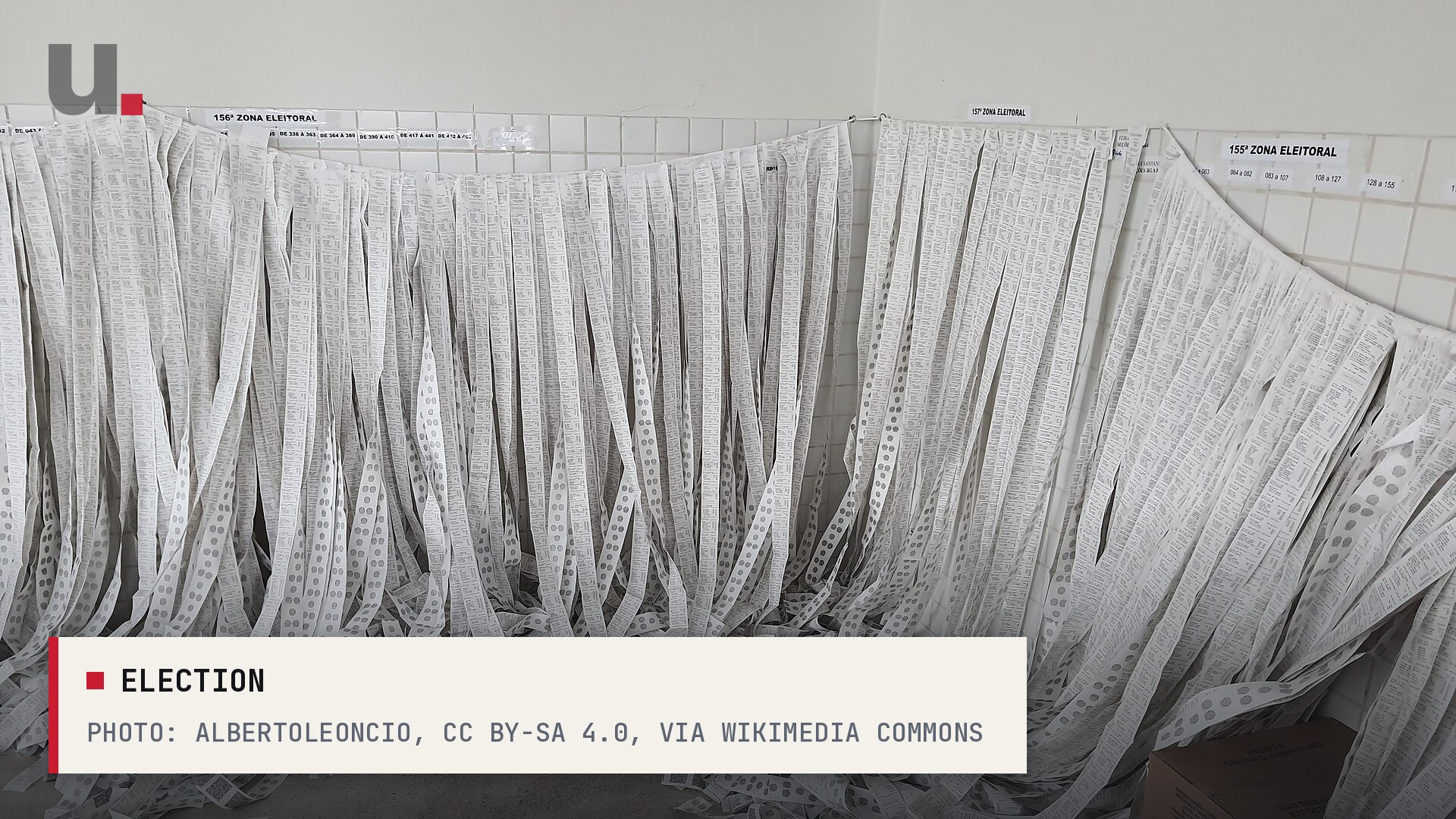
One minute after Brazil's polls closed on Sunday, Supreme Court Justice Cristiano Zanin, Lula's former personal lawyer, ordered two more hours of voting on a petition from Lula's own coalition. By night's end the electoral court, the TSE, had declared Lula the winner of a runoff he entered in second place. On Monday morning, Elon Musk looked at the totals and gave his verdict in four words.
Post by @elonmusk
— @elonmusk View on 𝕏
Musk was quoting a post that set the first-round and runoff tallies side by side. Lula went from about 53.9 million votes to 64.3 million. Flávio Bolsonaro went from 56.1 million to 59.8 million. And all ten candidates knocked out in the first round had about 9.3 million votes between them.
That last number is the heart of it. Lula's gain was bigger than every eliminated candidate's votes put together. Even Globo's g1 spelled it out: "even if all the voters of the defeated candidates had migrated to Lula, those votes would not be enough to explain the increase."
So we pulled the official TSE totals for both rounds and did the math line by line. Here's what the numbers show, what they don't, and the questions nobody in Brasília has answered yet.
The official result
First, the record. With every polling station counted, the TSE gave Lula 64,256,232 votes, or 51.79% of valid votes, to Flávio's 59,826,041, or 48.21%. That's a margin of about 4.4 million. In the first round on Oct. 4, Flávio led 56,104,503 to 53,879,538, or 47.03% to 45.16%.
Per g1, it's the first time in Brazil's history that a presidential candidate won a runoff after finishing behind in the first round. It's also the most votes any Brazilian presidential candidate has ever received.
Flávio has refused to concede. "It's impossible to recognize the election result in the context of how these things happened," he said Sunday night, and he said his lawyers will ask for the election to be annulled.
Where 14.1 million votes came from
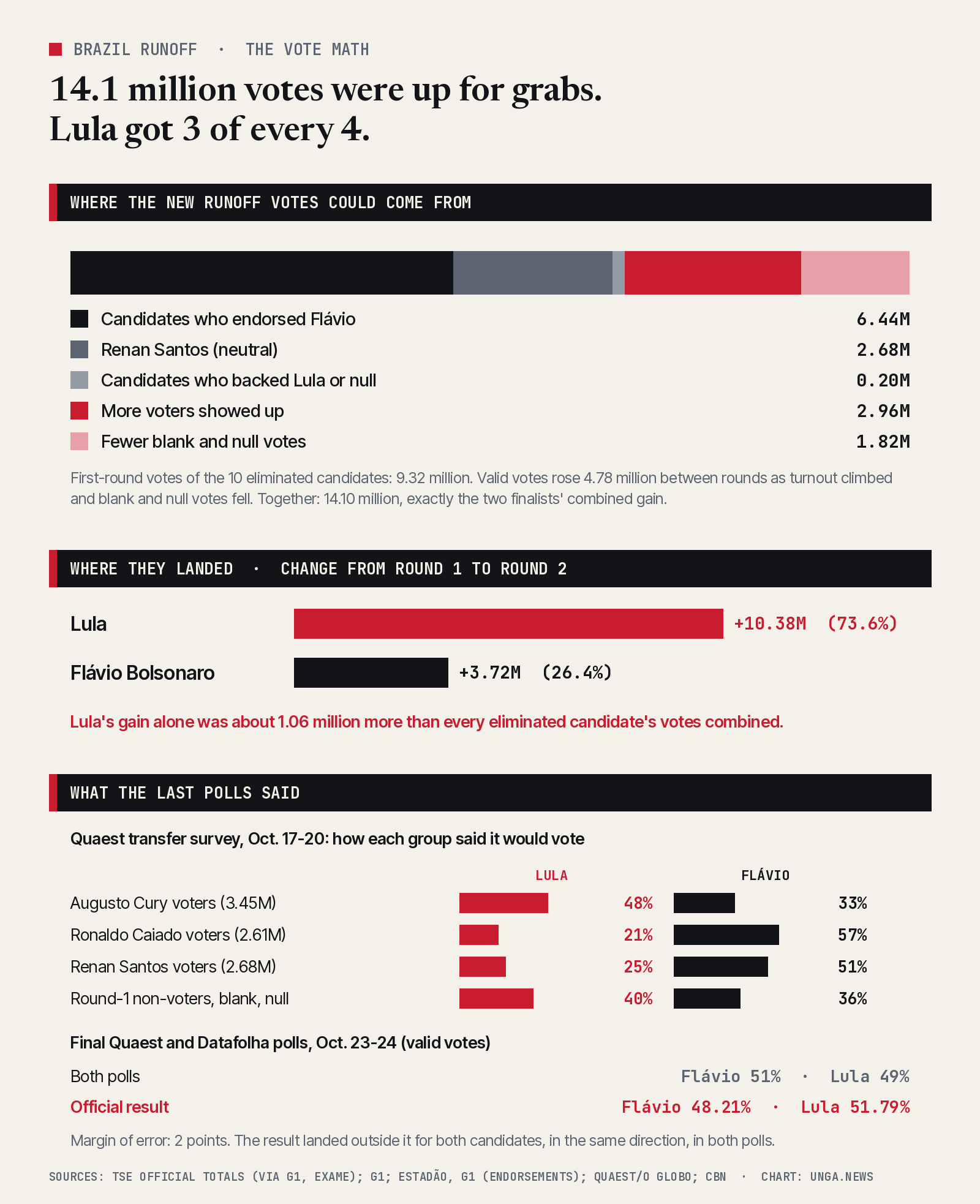
Between the two rounds, Lula gained 10,376,694 votes and Flávio gained 3,721,538. Together that's 14.1 million votes the two finalists didn't have in round one. On the TSE's national totals, they came from three places:
- The eliminated candidates: 9,316,747 first-round votes. - More voters: turnout rose from 125,275,835 to 128,236,074, about 2.96 million more people. - Fewer blank and null ballots: they fell from about 5.98 million to 4.15 million, freeing up about 1.82 million votes.
Add those up and you get 14,098,232, exactly the finalists' combined gain. So the totals balance as a sum. The problem is the split. Lula took 73.6% of the votes in play. Flávio took 26.4%.
The endorsements pointed the other way
Here's why that split raises eyebrows. Most of the votes freed up by the first round didn't belong to Lula's side. Ronaldo Caiado, Romeu Zema and Augusto Cury, who together had about 6.4 million votes, all endorsed Flávio, Estadão and g1 reported. Minor candidate Clariana Barão backed him too, and Wilson Grassi said he'd vote for him. Renan Santos, the MBL co-founder who drew 2.68 million, stayed neutral, though he'd said on election night, "I don't vote for crooks."
The three far-left candidates who endorsed Lula had about 189,000 votes combined.
Endorsements aren't orders, and voters don't move in blocs. But the last survey of where those voters were heading shows the problem. In Quaest's poll for Globo, taken Oct. 17 to 20, Caiado voters favored Flávio 57% to 21%, and Renan Santos voters favored him 51% to 25%, O Globo reported. Only Cury voters leaned Lula, 48% to 33%.
Run those Quaest numbers against the first-round totals and Flávio picks up roughly 4 million votes from those three candidates alone, while Lula picks up about 2.9 million. Flávio's actual gain nationwide was 3.7 million. And Lula would still need another 7.5 million from somewhere. The new voters, the former blank and null voters and the remaining minor candidates add up to only about 5.4 million. So for the official totals to work, those three candidates' voters had to break far more toward Lula than Quaest found a week earlier, or Flávio had to lose some of his own first-round voters, or both. (These are net figures. Nobody can trace an individual ballot.)
That same Quaest poll asked those exact people. Among Brazilians who sat out the first round or voted blank or null, Lula led Flávio 40% to 36%. That's an edge, not a landslide. It's a long way from the lopsided haul the totals require.
None of that proves anything about the count. Polls are snapshots, a week is a long time in a campaign, and the Quaest figures were moving toward Lula among Cury voters. But that's the gap Musk was pointing at, and it's a fair one to ask about.
A turnout surge Brazil has never seen
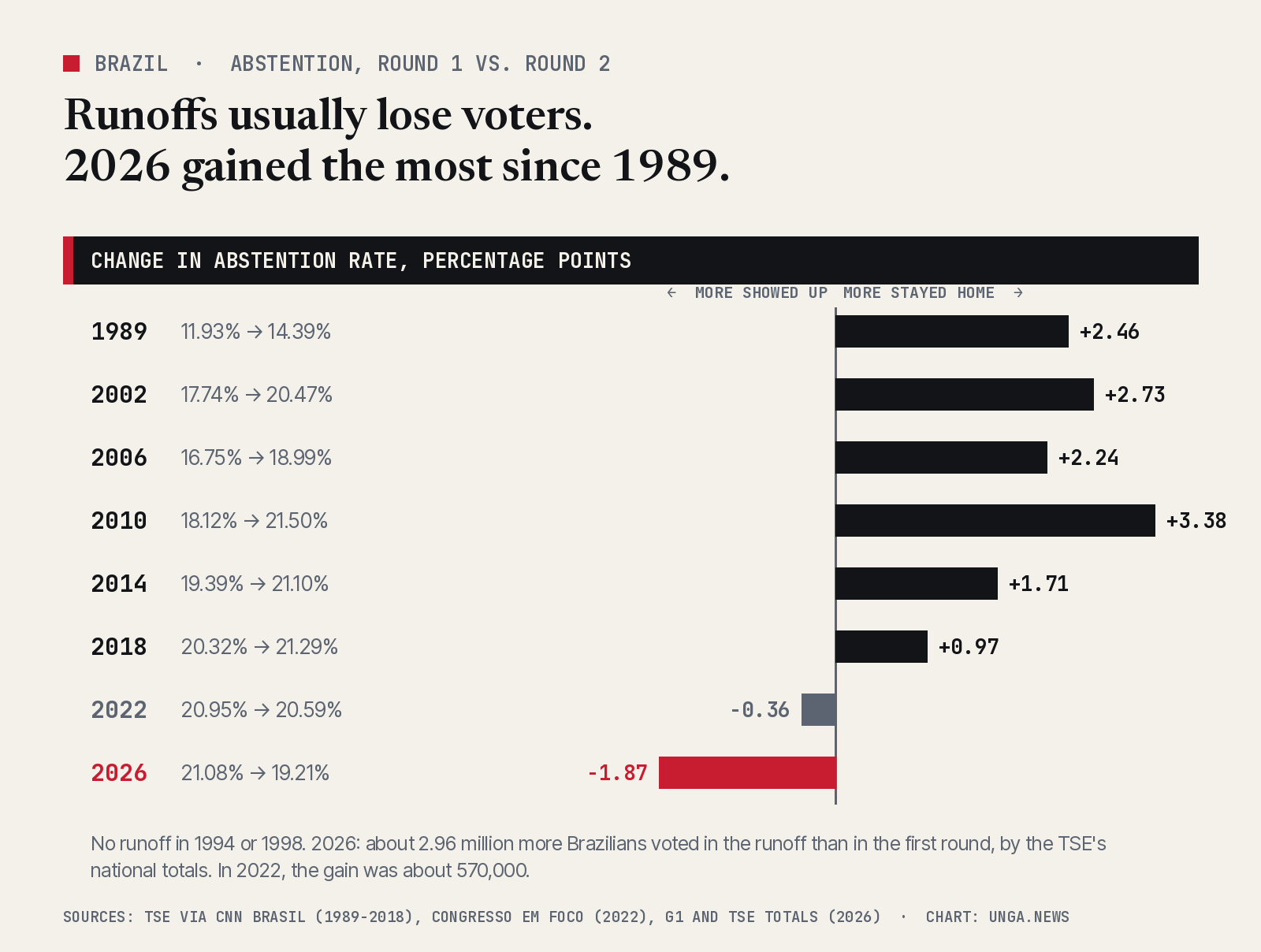
The biggest single piece of the puzzle is turnout. In Brazil, runoffs almost always lose voters. Abstention rose between rounds in every presidential election from 1989 through 2018, CNN Brasil found in TSE data. In 2022, it dipped for the first time, by 0.36 points, or about 570,000 voters.
This year, abstention fell from 21.08% to 19.21%, a drop of 1.87 points, the lowest rate in 20 years, per g1. By the TSE's national totals, about 2.96 million more Brazilians voted in the runoff than in the first round, roughly five times the 2022 gain.
Where did they show up? Turnout rose in 4,858 of Brazil's 5,570 municipalities, and the rise was "practically uniform" in the South, Southeast, Center-West and the northeastern coast, "precisely where some of the largest swings in Lula's favor are," g1 found. Lula improved his margin in 5,410 municipalities, about 97% of the country, and in all 27 states.
Flávio, meanwhile, finished with fewer votes than in the first round in six states and 939 municipalities. A candidate who just collected the endorsements of three of his four main rivals lost ground in nearly one in six Brazilian towns.
In São Paulo alone, Lula went from 9,505,413 votes to 12,119,274, a gain of 2.6 million in the home state of Flávio's ally, reelected Gov. Tarcísio de Freitas. Across the Southeast, Lula's vote rose 24.95%. Flávio's rose 7.81%.
There's an innocent explanation on offer. Lula's campaign spent the runoff chasing first-round non-voters, and on Election Day it complained to the courts that São Paulo was running about 60% of its buses despite a court order for the full fleet. A get-out-the-vote push can move numbers. But it's fair to ask how a push big enough to produce the largest runoff turnout gain since 1989 didn't show up in the final polls.
The polls missed in one direction
On the eve of the vote, Quaest and Datafolha both had the race at Flávio 51%, Lula 49% in valid votes, with a two-point margin of error, CBN reported. The result was Lula 51.79%, Flávio 48.21%.
That's a miss of 2.79 points on each candidate, outside the stated margin of error, in both of Brazil's top polls, in the same direction. Polls miss. But when the two biggest pollsters miss together, the same way, on the night a justice rewrote closing time, people are going to ask questions.
What the extension does and doesn't explain
Zanin's order is the reason many Brazilians don't trust Sunday's result, and it's still unexplained. The TSE's own president, Kassio Nunes Marques, said no rule allowed it and nothing like it had ever happened in the court's history. He also conceded that "it wouldn't be possible, in a few hours, to be certain that no side effect, especially on the technology side," would affect the count. Our report has his full remarks.
To be precise about the numbers: the extension itself doesn't account for the swing. The TSE hasn't published an official count of votes cast after 5 p.m. But g1's review of the voting machines' own logs found 35,521 presidential votes confirmed after 5 p.m. nationwide, and a programmer's analysis cited by Metrópoles found about 5,000 in stations that stayed open late. Either figure is a rounding error next to a 4.4 million margin.
What the extension did do is freeze Brazil's results for two hours on the night of a presidential runoff, on the order of a justice who used to be Lula's lawyer, under no rule the election chief could name. That's a trust problem whatever the final number.
What to watch
- The annulment request. Flávio has said he'll ask for the election to be annulled. TSE justices told g1 they don't expect it to succeed, and two Supreme Court justices allied with Zanin told Folha the Constitution fixes the runoff date. - Station-level data. The TSE publishes every voting machine's tally sheet and log files as open data. Independent analysts are already working through them. That's where questions about the turnout surge can actually be answered, one section at a time. - The pollsters. Quaest and Datafolha owe the public an explanation of how both missed outside their margins, in the same direction. - Zanin. Senator-elect Marcel van Hattem has said he'll file for Zanin's impeachment over the order. Whether Brazil's Senate takes it up will say a lot about whether anyone answers for Sunday night.
Musk's four words got 1.4 million views in a few hours. The TSE could settle a lot of this with one thing it still hasn't released: a full official accounting of who voted late, where, and how turnout jumped more than in any runoff since 1989. Until then, the questions stand.
Sources
- Elon Musk on X — "Math doesn't add up" (Oct. 26, 2026)
- g1 — Mais eleitores, menos votos brancos e nulos: a virada de Lula (Oct. 26, 2026)
- g1 — Lula avança em 97% das cidades e comparecimento sobe; veja mapas (Oct. 26, 2026)
- g1 — 35 mil votos foram registrados após as 17h (Oct. 26, 2026)
- Exame (TSE data) — Resultado Presidente 2026, 1º turno: apuração total (TSE)
- O Globo / Quaest — Quaest: Lula avança entre eleitores de Cury; Flávio cresce entre apoiadores de Renan e Caiado (Oct. 2026)
- CBN — Quaest e Datafolha: Flávio Bolsonaro tem 51% dos votos válidos contra 49% de Lula (Oct. 24, 2026)
- Estadão — Caiado, Zema e Cury declaram apoio a Flávio Bolsonaro no 2º turno; Renan libera apoiadores
- g1 — Veja quem Cury, Renan Santos e outros candidatos apoiam no 2º turno (Oct. 22, 2026)
- CNN Brasil — Abstenção cresceu entre 1º e 2º turno em todas as eleições presidenciais desde 1989
- Congresso em Foco — Abstenção chega a 21%; 2022 sugere pouca mudança no 2º turno
- Metrópoles — Urnas registraram só 5 mil votos após as 17h, mostram dados do TSE
- TSE open data — Resultados 2026: Boletim de Urna