

Musk Says Future SI Compute Will Be 'Overwhelmingly in Space.' His Math Rounds Up to 100%
Elon Musk wrote Monday that anyone who can't see it is "an utter moron." Days earlier he said the compute added in orbit each month would probably pass what goes up on Earth around the end of 2028. For now, all 1.7 gigawatts SpaceX counted at the end of September sit on the ground.
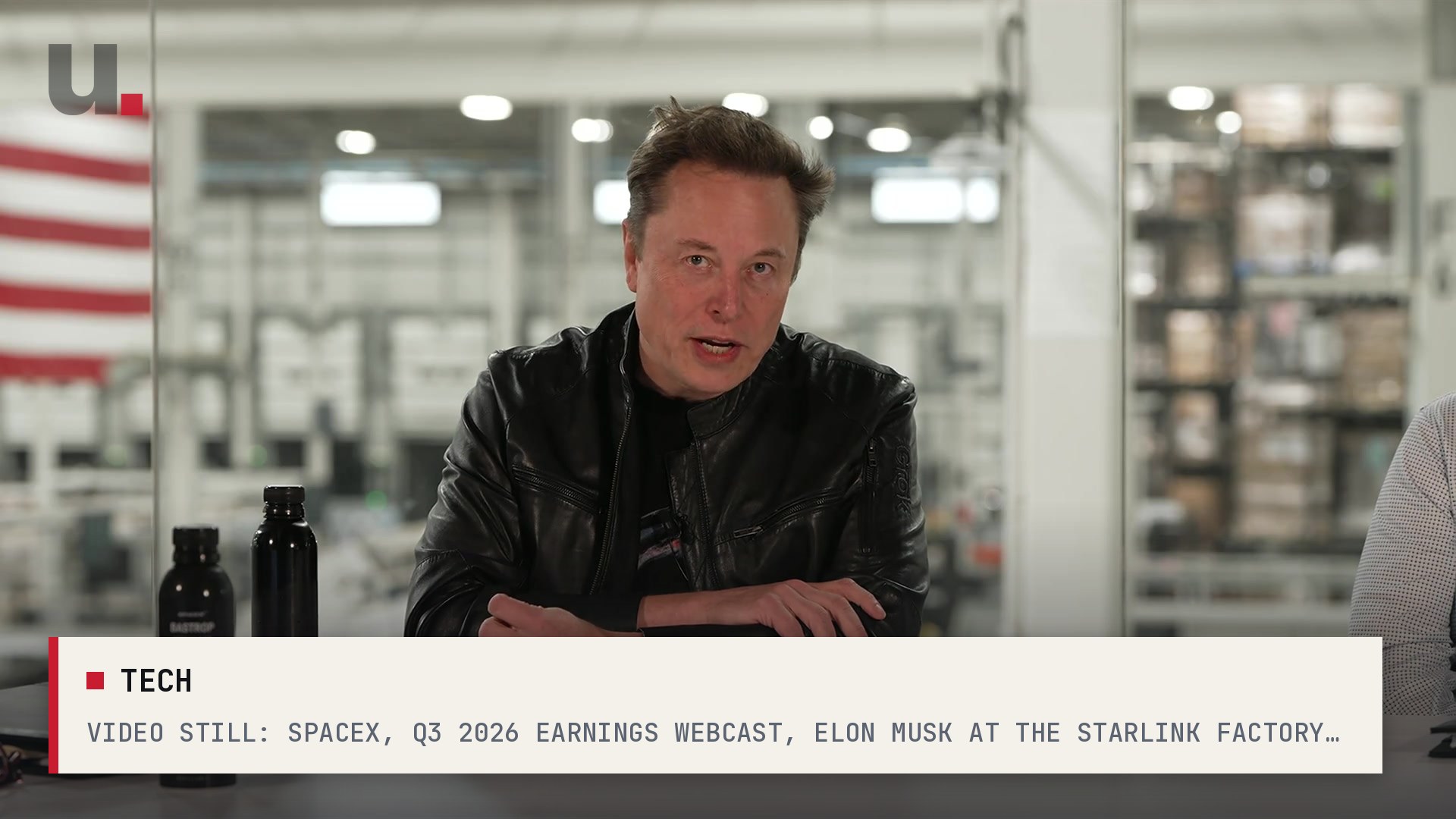
Elon Musk says the future of super intelligence won't run on Earth. "Future super intelligence compute will obviously be overwhelmingly in space," he wrote on X Monday morning. "By 'overwhelmingly', I mean that it will round up to 100%!" Then he added: "You have to be an utter moron not to realize this."
Musk was jumping into a debate over a SpaceX financial model built by Shaun Maguire, the Sequoia Capital partner who led the firm's investments in the company. A stock analyst had questioned how much of the model rides on renting chips in data centers on Earth. Maguire answered that SpaceX is "the low-cost producer for compute (initially terrestrial which becomes orbital)." Musk's reply went straight to where he thinks it ends.
Elon Musk on X: "Future super intelligence compute will obviously be overwhelmingly in space." Nov. 2, 2026
— @elonmusk View on 𝕏
Why Musk looks up
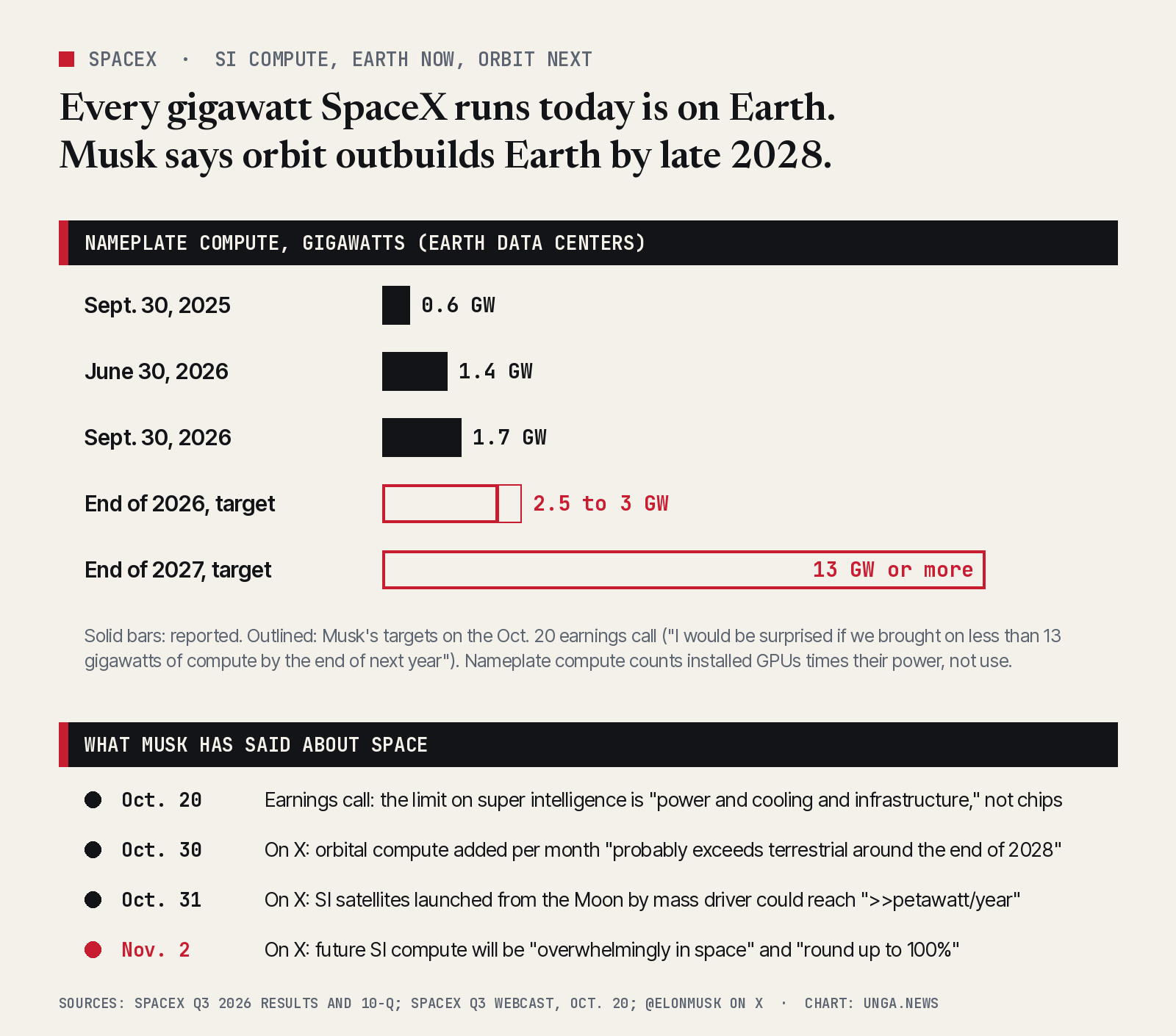
Musk has been laying out the case for weeks, and it starts with a problem on the ground. On SpaceX's Oct. 20 earnings call, he said chips aren't what's holding SI back. "The constraint on deployment of super intelligence is more in power and cooling and infrastructure than it is in chips," he said. In the right orbit, a satellite gets near-constant sunlight for power and the cold of space to shed heat, the two things every data center on Earth fights for.
SpaceX also owns the road to get there. On the same call, Musk said SpaceX carries "almost 90% of all mass to orbit of Earth," with China at roughly 6% and the rest of the world, the rest of the U.S. included, at about 4%. "This is a bit like the New York Yankees playing in Little League," he said. "It's not fair."
The timeline he's put on it
Oct. 30. Answering a post on X, Musk wrote that "terrestrial compute will be peanuts compared to orbital compute." His timing: "Orbital compute deployed per month probably exceeds terrestrial around the end of 2028 and then far exceeds it in 2029."
Oct. 31. He went bigger. "Launching super intelligence satellites into deep space with a mass driver on the Moon can achieve >>petawatt/year capability, which would far exceed the best case value of Earth's economy," he wrote. A mass driver is an electric launcher that flings cargo off the Moon without a rocket. A petawatt is a million gigawatts.
Nov. 2. "Round up to 100%."
Where SpaceX stands today
Right now, every watt of SpaceX's SI compute is on the ground. The company counted 1.7 gigawatts of nameplate compute on Sept. 30, up from 0.6 a year earlier, in its third-quarter results, as it built out its Colossus II supercomputer around Memphis. Musk said on the call he expects roughly 2.5 to 3 gigawatts by year's end and "would be surprised if we brought on less than 13 gigawatts of compute by the end of next year."
That ground game pays the bills. SpaceX's SI business brought in $7.6 billion in the quarter, up 830% from a year earlier, out of $14.6 billion in total revenue, according to the release.
The rocket that would carry compute up in bulk is Starship. It reached orbit for the first time on Flight 14 and dropped off 26 Starlink V3 satellites, about 10 times the downlink capacity a Falcon 9 Starlink launch adds, the company said. On Flight 15, SpaceX plans to try catching both the booster and the ship. President Gwynne Shotwell said the company will try refueling in orbit early next year.
The idea is getting tested
SpaceX isn't the only one betting on it. Google said Oct. 30 that four of its TPU chips, sent into orbit on Oct. 1, had turned on, processed a prompt and beamed the answer back to Earth. "This milestone brings us one step closer to understanding if space-based compute is possible," the company posted on X, adding that two more TPU-equipped satellites go up in 2027.
Maguire, who says Sequoia's big SpaceX stake leaves him "extremely biased," left orbit out of his 2028 numbers altogether. "We didn't even talk about Orbital Compute as that really shows up starting in 2029," he wrote.
Musk didn't put a year on "100%," and SpaceX hasn't published what a gigawatt in orbit would cost next to one on the ground. But the company that already flies almost 90% of the world's mass to orbit is the one making the call.
Sources
- Elon Musk on X — "Future super intelligence compute will obviously be overwhelmingly in space." (Nov. 2, 2026)
- Elon Musk on X — "Terrestrial compute will be peanuts compared to orbital compute." (Oct. 30, 2026)
- Elon Musk on X — Super intelligence satellites launched with a mass driver on the Moon (Oct. 31, 2026)
- SpaceX — Q3 2026 Financial and Operational Results, live webcast (Oct. 20, 2026)
- SpaceX (SEC) — SpaceX Reports Third Quarter 2026 Results (Oct. 20, 2026)
- U.S. SEC (SpaceX) — SpaceX Form 10-Q, quarter ended Sept. 30, 2026
- Shaun Maguire on X — "SpaceX is the low-cost producer for compute (initially terrestrial which becomes orbital)" (Nov. 2, 2026)
- Shaun Maguire on X — People don't understand SpaceX (Oct. 30, 2026)
- Google on X — "Our TPUs just phoned home... from space." (Oct. 30, 2026)