

Musk Says Ukraine Broke Starlink's No-Weapons Rule and Points to Zelenskyy's Own Words
SpaceX's terms have ruled out weapons use for years. Musk says Kyiv got around them and SpaceX shut the door. Kyiv says it couldn't have, but Zelenskyy said on Oct. 16 that Ukraine used Starlink for strikes.
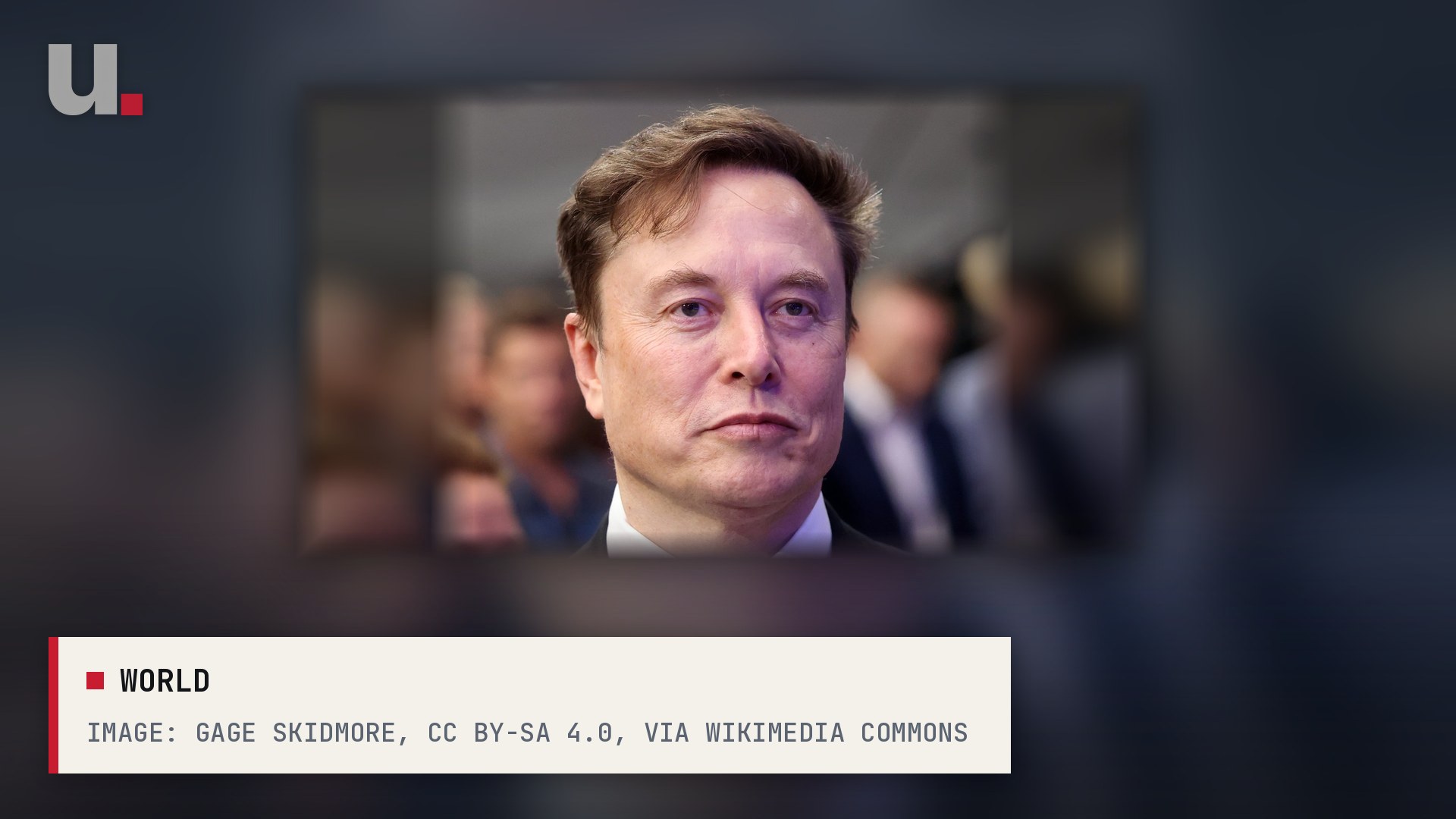
Elon Musk has now given his own account of the two-week Starlink fight with Ukraine, and it isn't the one Kyiv and its allies in Congress have been telling. SpaceX didn't turn on Ukraine, he says. It enforced rules it has stated publicly for years.
"Using Starlink, a civilian commercial service, for offensive drone strikes to kill people has never been allowed, nor should it be," Musk wrote on 𝕏 Saturday. "Ukraine military violated Starlink terms of service and used it for offensive drone strikes to kill people. That loophole was closed last week."
That evening he spelled out what SpaceX did. "We simply enforced our terms of service when they were bypassed," he wrote. "There has been no change to our terms of service." His Saturday post passed 8 million views.
Elon Musk on Starlink and Ukraine, Oct. 24, 2026.
— @elonmusk View on 𝕏
Update, Sunday: Musk points to Zelenskyy's own words
Kyiv pushed back Saturday afternoon. Serhii Beskrestnov, a defense technology adviser to President Volodymyr Zelenskyy, wrote on Telegram that it was "very strange" that Musk "does not know about the restrictions on Starlink's operation in Ukraine." Since winter 2026, he wrote, every Starlink terminal over Ukraine, including occupied areas, has been capped at movement speeds of 70 to 90 km/h, about 43 to 56 mph, and Starlink does not work over Russia. "So we PHYSICALLY CANNOT USE COMMERCIAL STARLINK for deep strikes and mid-range strikes" (our translation from Ukrainian). Serhii Sternenko, a former drone adviser to Ukraine's Defense Ministry, wrote that since February, any terminal working on the move "had to be added to a special list and connected to the military Starshield system," so "using civilian Starlink for drone missions was technically impossible. All drone missions that required satellite communication could only be carried out using Starshield." He added: "We are very grateful to the United States and SpaceX for access to critically important satellite communications."
On Sunday morning, Musk answered with Zelenskyy himself. "For the fools out there, Zelensky himself posted about using Starlink for offensive drone strikes, which has always been against Starlink's terms of service," he wrote, attaching a screenshot of a post the Ukrainian president made on Oct. 16.
Elon Musk posts Zelenskyy's Oct. 16 remarks, Oct. 25, 2026.
— @elonmusk View on 𝕏
Here is what Zelenskyy wrote that day, from remarks to reporters in Brussels: "We don't use Starlink for our responses inside Russia. We use Starlink to intercept jet-powered 'shaheds' that attack our civilians and kill families." Then: "We also use Starlink for mid-range strikes against enemy military targets in our temporarily occupied territories. We couldn't do that when the restrictions were in place."
Volodymyr Zelenskyy on Starlink, Oct. 16, 2026.
— @ZelenskyyUa View on 𝕏
What the two sides are really arguing about. Beskrestnov's rebuttal is about strikes inside Russia and about the commercial terminals. Musk never said the strikes were inside Russia, and Zelenskyy's post doesn't separate Starlink from Starshield. What it does say, in the president's own words, is that Ukraine used the network to hit targets and that it couldn't once the limits went on. That is the use Musk says the terms forbid, and the limits are the fix he says SpaceX made.
What the terms actually say
Starlink's terms of service call the kits and service "commercial communication products." They say plainly: "Starlink is not designed or intended for use with or in offensive or defensive weaponry or other comparable end-uses." Modifying the gear for military use, the terms warn, can turn it into a product controlled under U.S. arms-export rules, and SpaceX may cut off support or end the agreement.
On paper, then, the rule is stricter than Musk's own line. The written terms rule out weapons use of any kind. Musk has allowed more. "Usage of Starlink is limited to civilian or defensive activities and cannot be used for offensive military action, as doing so would be inappropriate for a commercial company," he wrote on Oct. 14, as the slowdowns became public. Overnight Saturday he put it more simply: Starlink "can be used for infrastructure that is military, but it cannot be used for unequivocally offensive strikes that make it fair game to be struck back."
That last point is the one most coverage skipped. "An adversary blowing up Starlink satellites would create a domino effect of destruction that would generate a vast field of debris making space unusable," Musk wrote. Russia has already shown it can destroy a satellite in orbit. It shot down one of its own in November 2021, and the debris forced the International Space Station crew to shelter in their docked spacecraft. A network that households, airlines, ships, schools and hospitals rely on can't also be a target.
Two systems, two bosses
Musk draws a hard line between the two networks. Starlink is SpaceX's commercial service. Starshield is the military-grade version built for governments. "Starshield systems are owned and controlled by the US government. Any limits on speed or usage are decided by the US military and ultimately POTUS," he wrote on Oct. 14, replying to Mykhailo Fedorov, the Ukrainian official who first asked him for Starlink in 2022. "Starshield use is a decision of the US government. End of story," he repeated Saturday.
Secretary of State Marco Rubio drew the same line. "These are two separate programs, okay?" he told reporters in Mumbai on Oct. 21, according to the State Department's transcript. "Starlink is a private company. They have a contract. They have contractual terms upon how that technology can be used. The important point is we cannot direct a private company as to the decisions they make or not make."
SpaceX has said this since 2022
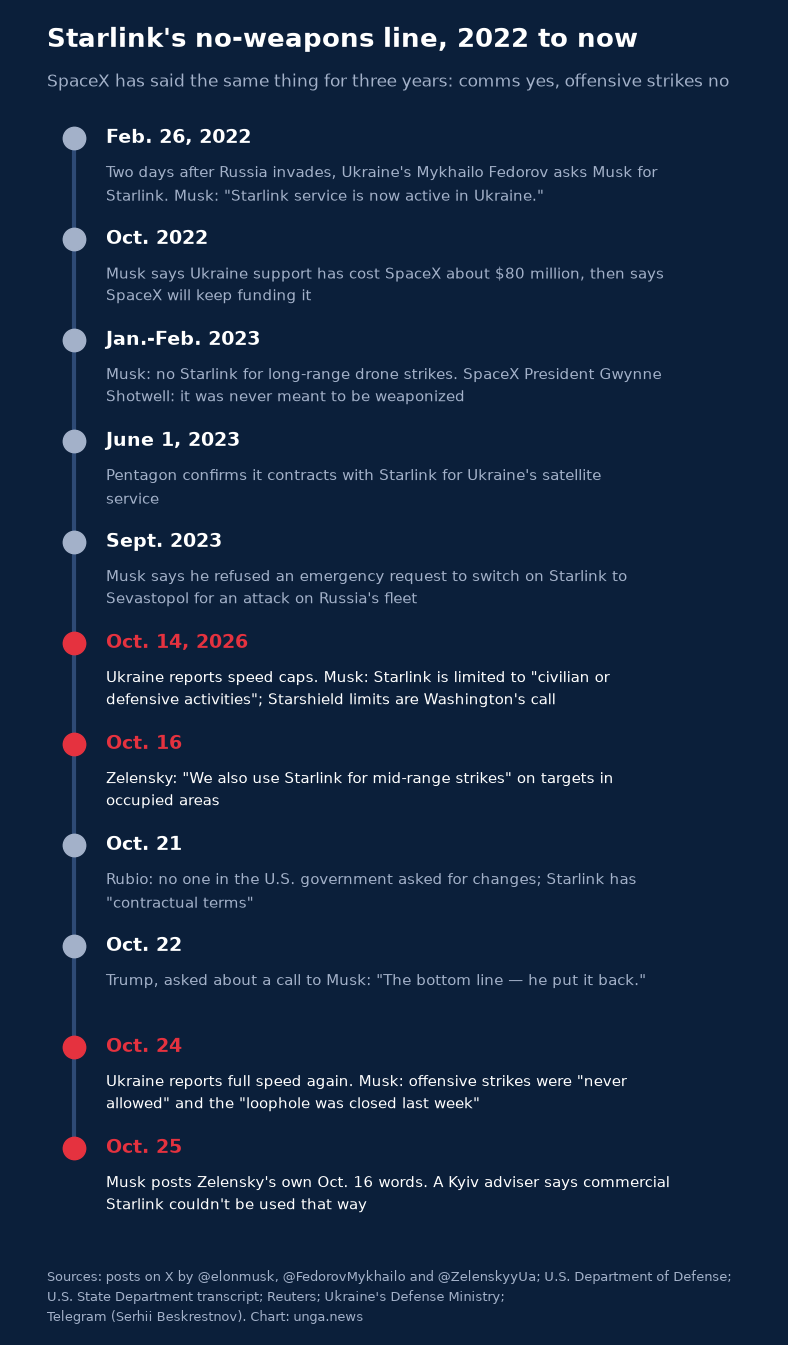
It started with a favor. Two days after Russia invaded, Fedorov publicly asked Musk for Starlink. Later that day Musk replied: "Starlink service is now active in Ukraine. More terminals en route." By that October, Musk said the effort had cost SpaceX about $80 million and would top $100 million by year's end. He wrote that only "a small percentage" of the terminals and service had been paid for. SpaceX kept paying anyway. Musk wrote that "we'll just keep funding Ukraine govt for free."
The line was drawn early. "We are not allowing Starlink to be used for long-range drone strikes," Musk wrote in January 2023. In February 2023, SpaceX President Gwynne Shotwell said Starlink was never meant to be weaponized and that Ukraine had "leveraged it in ways that were unintentional and not part of any agreement," Reuters reported. "We know the military is using them for comms, and that's ok," she said. "But our intent was never to have them use it for offensive purposes."
Washington started paying. On June 1, 2023, the Pentagon confirmed that "the department contracts with Starlink" for Ukraine's satellite service, after Bloomberg first reported the deal, Reuters reported. It wouldn't give the price or terms.
Sevastopol. In September 2023, Musk said he had turned down "an emergency request from government authorities to activate Starlink all the way to Sevastopol," the Russian naval base in Crimea. "The obvious intent being to sink most of the Russian fleet at anchor," he wrote. "If I had agreed to their request, then SpaceX would be explicitly complicit in a major act of war and conflict escalation." Two days later he added: "Our terms of service clearly prohibit Starlink for offensive military action, as we are a civilian system."
The fix, and who made the call
The administration has denied from the start that it ordered any slowdown. "We haven't pulled anything back," War Secretary Pete Hegseth said on Oct. 20, in video posted by CBS News. "Nothing's changed from our view. We haven't made any directives or anything like that." He added that "there are terms of service that ultimately need to be complied to." The Wall Street Journal reported on Oct. 20 that Musk had made the call, and on Oct. 22 that Trump had phoned him to ask that the limits be lifted.
Trump wouldn't say who made the call. Asked on Oct. 22 about the Wall Street Journal's report that he called Musk, he said: "Yeah, I don't want to comment on it. You know, whether I called or whether somebody else called doesn't make any difference. I guess the bottom line, he put it back" (White House video, transcript). On Saturday in Palm Beach a reporter asked whether he had spoken to Musk about it. "I have, yeah," Trump said. Asked to say more: "No, I can't" (transcript).
Kyiv says the problem is solved. Ukraine's Defense Ministry said Saturday that Starlink and Starshield terminals are again holding stable links at speeds above 400 km/h, about 250 mph. "The speeds are now where they need to be," Zelenskyy wrote, thanking "members of Congress, senators, all the media, the State Department, and the President."
Musk says SpaceX isn't walking away. "Starlink remains critical to the defense of Ukraine, as it is the only system that cannot be jammed or blown up, at least for now," he wrote Saturday. "Were Starlink to be turned off, the Ukrainian front line would collapse immediately. This is NOT a threat, it is simply a statement of fact." He added that "SpaceX has done more to defend Ukraine than any private company on Earth BY FAR."
What happens next
Democrats want more. Sen. Adam Schiff of California wrote that "Elon Musk should be compelled to testify before Congress and under oath." Sen. Michael Bennet of Colorado wrote that "Congress must find new partners to ensure Elon Musk and SpaceX do not execute a veto over U.S. national security," and Sen. Richard Blumenthal of Connecticut said he is "demanding answers from the Department of Defense & SpaceX." Kyiv is hedging its bets too. On Oct. 22, Nokia and the Finnish satellite firm ICEYE announced a letter of intent with Ukraine's Defense Ministry to explore "sovereign satellite communications" (Nokia on 𝕏). It is a letter of intent, not a network, and nothing on the market today does what Starlink does.
Musk's rule for what comes next is short. "Starlink's terms have remained consistent as a civilian system, not a means of killing. Violation of those terms will result in end of service," he wrote.
Why it matters. A company that builds a network for civilians gets to decide whether it becomes a weapon. A government that wants a weapon has its own system, Starshield, and makes its own call. The man Schiff wants under oath is the same one who switched Ukraine on two days into the war, paid for it out of pocket and has said for three years exactly where the line is. By Zelenskyy's own account, Ukraine's military used the network for strikes anyway.
Sources
- 𝕏 (@elonmusk) — Using Starlink, a civilian commercial service, for offensive drone strikes to kill people has never been allowed (Oct. 24, 2026)
- 𝕏 (@elonmusk) — We simply enforced our terms of service when they were bypassed (Oct. 24, 2026)
- 𝕏 (@elonmusk) — Zelensky himself posted about using Starlink for offensive drone strikes (Oct. 25, 2026)
- 𝕏 (@elonmusk) — Starlink must remain a civilian operation (Oct. 25, 2026)
- 𝕏 (@elonmusk) — Starlink's terms have remained consistent as a civilian system (Oct. 24, 2026)
- 𝕏 (@elonmusk) — Starshield systems are owned and controlled by the US government (Oct. 14, 2026)
- 𝕏 (@ZelenskyyUa) — We also use Starlink for mid-range strikes (Oct. 16, 2026)
- 𝕏 (@ZelenskyyUa) — Starlink and Starshield operations have been restored (Oct. 24, 2026)
- 𝕏 (@DefenceU) — Ukraine's Defense Ministry: Starlink/Starshield stable above 400 km/h (Oct. 24, 2026)
- 𝕏 (@FedorovMykhailo) — Starlink connectivity at speeds of up to 160 km/h is being restored (Oct. 14, 2026)
- Telegram (Serhii Beskrestnov) — Ukrainian presidential adviser on Starlink restrictions (Oct. 24, 2026, in Ukrainian)
- Starlink — Starlink Terms of Service
- U.S. State Department — Secretary of State Marco Rubio Remarks to the Press, Mumbai (Oct. 21, 2026)
- 𝕏 (@SenatorBennet) — Congress must find new partners (Oct. 23, 2026)
- 𝕏 (@elonmusk) — Starlink service is now active in Ukraine (Feb. 26, 2022)
- 𝕏 (@FedorovMykhailo) — We ask you to provide Ukraine with Starlink stations (Feb. 26, 2022)
- 𝕏 (@elonmusk) — This operation has cost SpaceX $80M (Oct. 7, 2022)
- 𝕏 (@elonmusk) — We'll just keep funding Ukraine govt for free (Oct. 15, 2022)
- 𝕏 (@elonmusk) — We are not allowing Starlink to be used for long-range drone strikes (Jan. 31, 2023)
- 𝕏 (@elonmusk) — Emergency request to activate Starlink all the way to Sevastopol (Sept. 7, 2023)
- 𝕏 (@elonmusk) — Our terms of service clearly prohibit Starlink for offensive military action (Sept. 9, 2023)
- Reuters — SpaceX curbed Ukraine's use of Starlink internet for drones -company president (Feb. 2023)
- Reuters — SpaceX's Starlink wins Pentagon contract for satellite services to Ukraine (June 2023)
- 𝕏 (@CBSNews) — Hegseth: "We haven't pulled anything back" (video, Oct. 20, 2026)
- 𝕏 (@WSJ) — Breaking: Elon Musk ordered the Starlink slowdown that blindsided Ukraine (Oct. 20, 2026)
- 𝕏 (@sternenko) — Using civilian Starlink for drone missions was technically impossible (Oct. 24, 2026)
- 𝕏 (@SenAdamSchiff) — Elon Musk should be compelled to testify before Congress and under oath (Oct. 20, 2026)
- 𝕏 (@SenBlumenthal) — I'm demanding answers from the Department of Defense & SpaceX (Oct. 23, 2026)
- Nokia — ICEYE and Nokia partner with the Ministry of Defence of Ukraine to develop sovereign satcom capability (Oct. 22, 2026)
- 𝕏 (@nokia) — Nokia and ICEYE announce partnership with Ukraine's Ministry of Defence
- The White House — President Trump gaggles with press upon departure, Oct. 22, 2026 (video)
- Roll Call Factba.se — Transcript: Trump press gaggle before Marine One departure, Oct. 22, 2026
- Roll Call Factba.se — Transcript: Trump press gaggle after early voting in Palm Beach, Oct. 24, 2026