

Musk’s Brain Chip Wins the Green Light for Its Final Test Before It Can Reach Paralyzed Patients
Neuralink can now run the big trial the government uses to decide whether a brain implant can be sold. Twenty people with ALS will try controlling computers with their thoughts, and if it works, the company files to bring it to market.
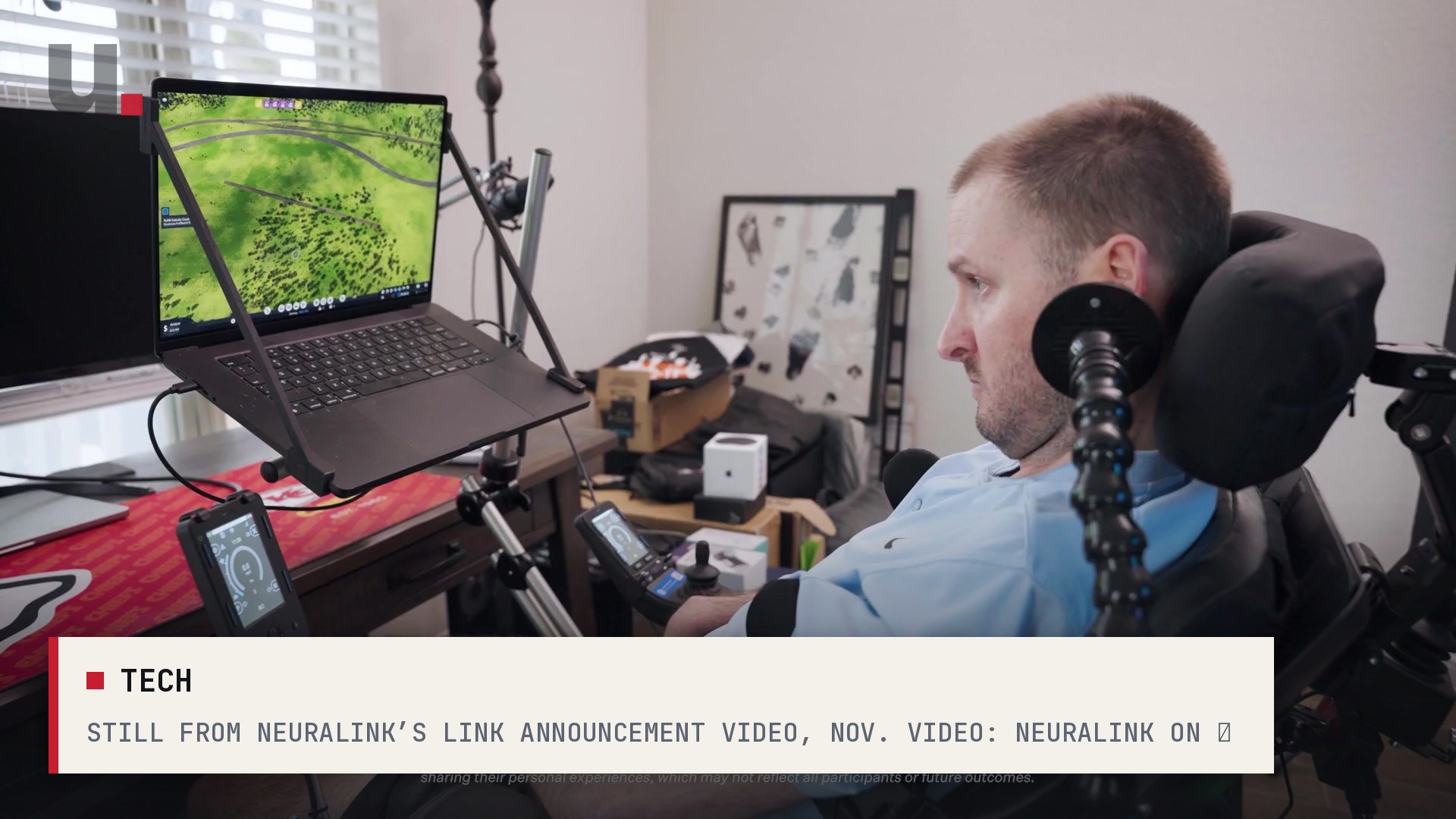
For a man who can’t move his hands, a computer mouse might as well be on the moon. Elon Musk’s Neuralink has spent almost three years proving that a coin-sized chip in the brain can put that mouse back in reach. On Wednesday, the government told the company it can run the test that decides whether everyone else with that problem gets the same shot.
Neuralink announced that the Food and Drug Administration approved the LINK Pivotal Study, which the company calls “the first pivotal trial for an implantable brain-computer interface in the United States.” The study is for adults with severe paralysis from ALS, the disease that slowly kills the nerves that run a person’s muscles, and enrollment is already open.
Neuralink on 𝕏 — Nov. 25, 2026: “We’ve received FDA approval to launch LINK, the first pivotal trial for an implantable brain-computer interface in the US. This builds off of our work with 30+ participants with Neuralink to date. Those with ALS may be eligible.”
— @neuralink View on 𝕏
The trial that counts
Medical devices don’t go through the Phase 1, 2 and 3 ladder that drugs do. They start with small “feasibility” studies that answer two basic questions: is it safe, and does it work at all? Neuralink has been running those since its first human implant in January 2024. A pivotal study is the big one. Its results are the evidence the FDA weighs when it decides whether a device can be sold as a real treatment instead of living only inside research.
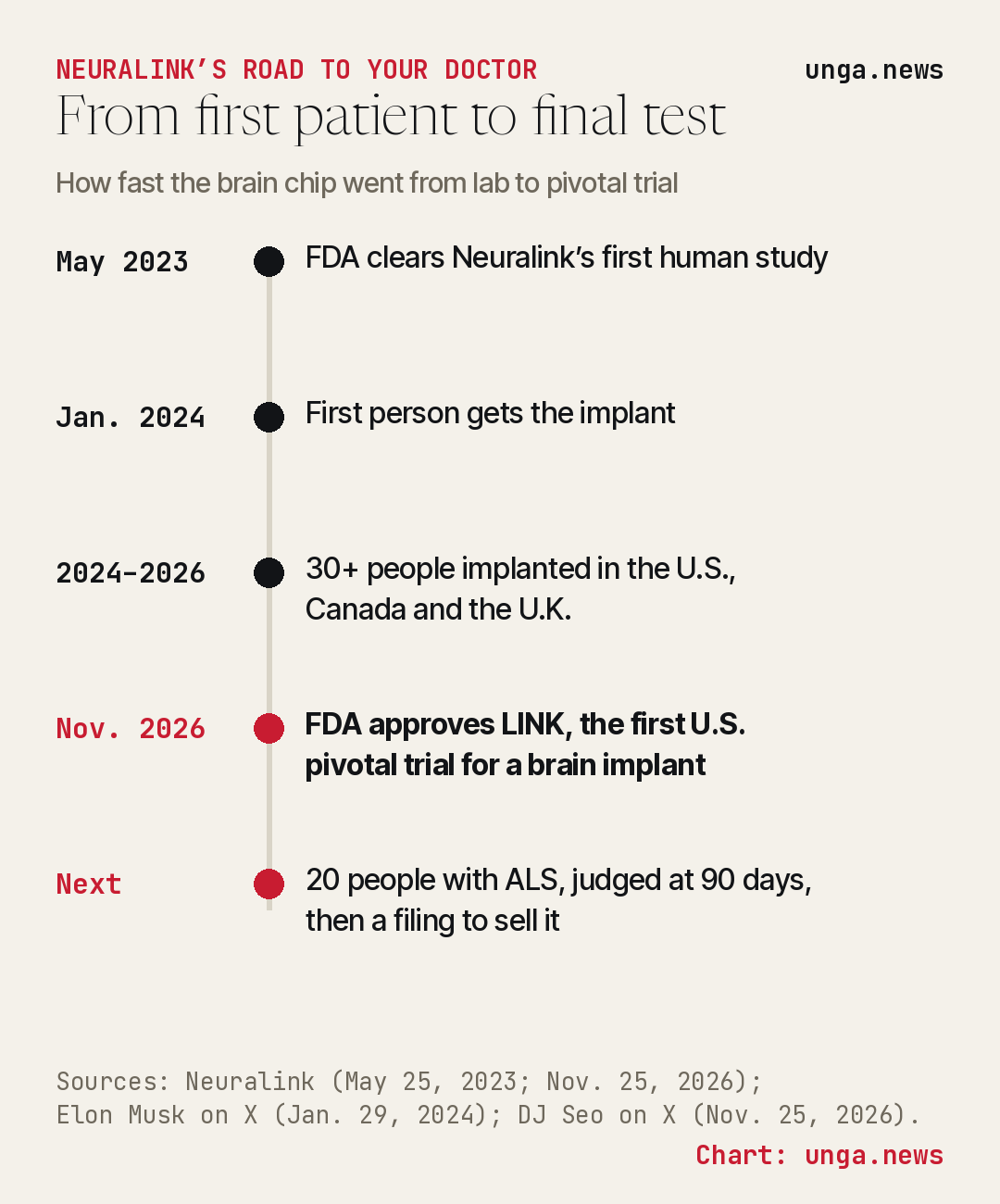
Neuralink president DJ Seo laid out the shape of it on 𝕏 a few hours after the announcement. The trial will enroll 20 people. Each one is judged on the main goals at 90 days, so a participant’s core test lasts about three months. Once the 20th person hits that mark, Neuralink plans to file for premarket approval, the FDA’s green light to put the device on the market.
DJ Seo on 𝕏 — Nov. 25, 2026: “More details to come on clinical trials gov posting, but here you go: 20 trial participants. Primary endpoints evaluated at 90 days (i.e., 3 month trial). We plan to submit PMA (market submission) once 20th participant hits the primary endpoints.”
— @djseo View on 𝕏
Seo added that the FDA review itself “takes months,” and that he believes the approval “will help accelerate future indications.” In plain English: get the device cleared for ALS first, and it gets easier to bring it to people with spinal cord injuries, strokes and other conditions later.
Neuralink hasn’t named the hospitals that will do the surgeries or given a date for the first LINK implant. Seo said more details are coming when the study posts on ClinicalTrials.gov, the government’s public registry of medical studies.
What the chip actually does
The implant, called the N1, sits in the skull, with hair-thin threads reaching into the part of the brain that plans hand movement. A surgical robot Neuralink built, the R1, places those threads. The person imagines moving a hand, and the system turns those signals into cursor moves and left, right and middle clicks. According to Neuralink’s trials page, participants usually go home about a day after surgery.
The new trial will measure how well people control digital devices through thought, “with a focus on functional outcomes that improve independence in daily life,” and it will keep tracking long-term safety and reliability across several sites. Follow-up checks run for two years after surgery, at roughly 10 days, 45 days, three months, six months, one year and two years.
That isn’t a science-fair promise anymore. Neuralink says more than 30 people in the United States, Canada and the United Kingdom have used the implant for thousands of hours of real life. They’ve gone back to school, made art, played video games and talked with their families. Noland Arbaugh, the first patient, is quoted on the company’s trials page: “Neuralink has given me back parts of my life that I thought were lost forever.”
A fast track the critics said wasn’t coming
Remember how this started. When Neuralink first asked to put its device in people in early 2022, the FDA said no, Reuters reported in 2023, raising safety questions about the battery, whether the threads could move in the brain, and how the implant could be taken out. A lot of commentators treated that as proof Musk was overselling. Neuralink answered the questions, got clearance for its first human study in May 2023, and has now gone from its first patient to a pivotal trial in under three years.
That’s the kind of speed Washington usually says can’t be done with brain surgery. It’s also a sign of a regulator in Trump’s government that is willing to say yes when a company brings the data, rather than letting a promising American device sit in a drawer while rivals overseas, China included, work on brain chips of their own.
For ALS families, the clock matters more than any of the politics. The ALS Association says about 5,000 Americans are diagnosed every year, and most patients live two to five years after diagnosis. Many lose the use of their hands and their voice long before the end. A system that lets someone answer an email, text a grandchild or run a speech program on a laptop is not a gadget for them. It’s a way to stay in the conversation.
The approval doesn’t let Neuralink sell anything yet, and the company says so plainly by calling the device investigational. Twenty people still have to go through surgery and three months of testing, and the FDA still has to review the results. But the path from a lab prototype to a treatment a doctor can offer now has a finish line on the map, with numbers attached.
People with ALS, or caregivers of someone who has it, can check whether they qualify and join the patient registry on Neuralink’s site. The company asks for adults 18 or older with little or no use of both hands and arms and a steady caregiver, and says being on a ventilator doesn’t rule anyone out.
Sources
- Neuralink — Neuralink Receives FDA Approval to Launch LINK Pivotal Study (Nov. 25, 2026)
- Neuralink on 𝕏 — Neuralink on 𝕏 — FDA approval to launch LINK, the first U.S. pivotal brain-implant trial
- DJ Seo on 𝕏 — DJ Seo on 𝕏 — 20 participants, 90-day endpoints, market filing after the 20th
- Neuralink — Telepathy device-control trials and eligibility
- Reuters — Elon Musk’s Neuralink wins FDA approval for human study of brain implants (May 2023)
- ALS Association — About ALS: about 5,000 new U.S. cases a year, two to five years average life expectancy