

NASA Smashed a Spaceship Into an Asteroid on Purpose. New Photos Show a Stadium-Sized Crater
Four years after NASA’s test crash, Europe’s Hera probe got the first close look. The asteroid’s face is flattened, it’s tumbling wildly, and hundreds of boulders are circling it. Both ships rode SpaceX rockets.
Sixty-six million years ago, a rock from space wiped out the dinosaurs. In 2022, NASA tried something the dinosaurs never got the chance to try. It flew a spacecraft the size of a vending machine straight into an asteroid at full speed, just to see if humans could shove one off course.
It worked. Telescopes on Earth proved that much within weeks. What nobody could see from millions of miles away was what the hit actually did to the rock. Now we know, and the answer is a lot.
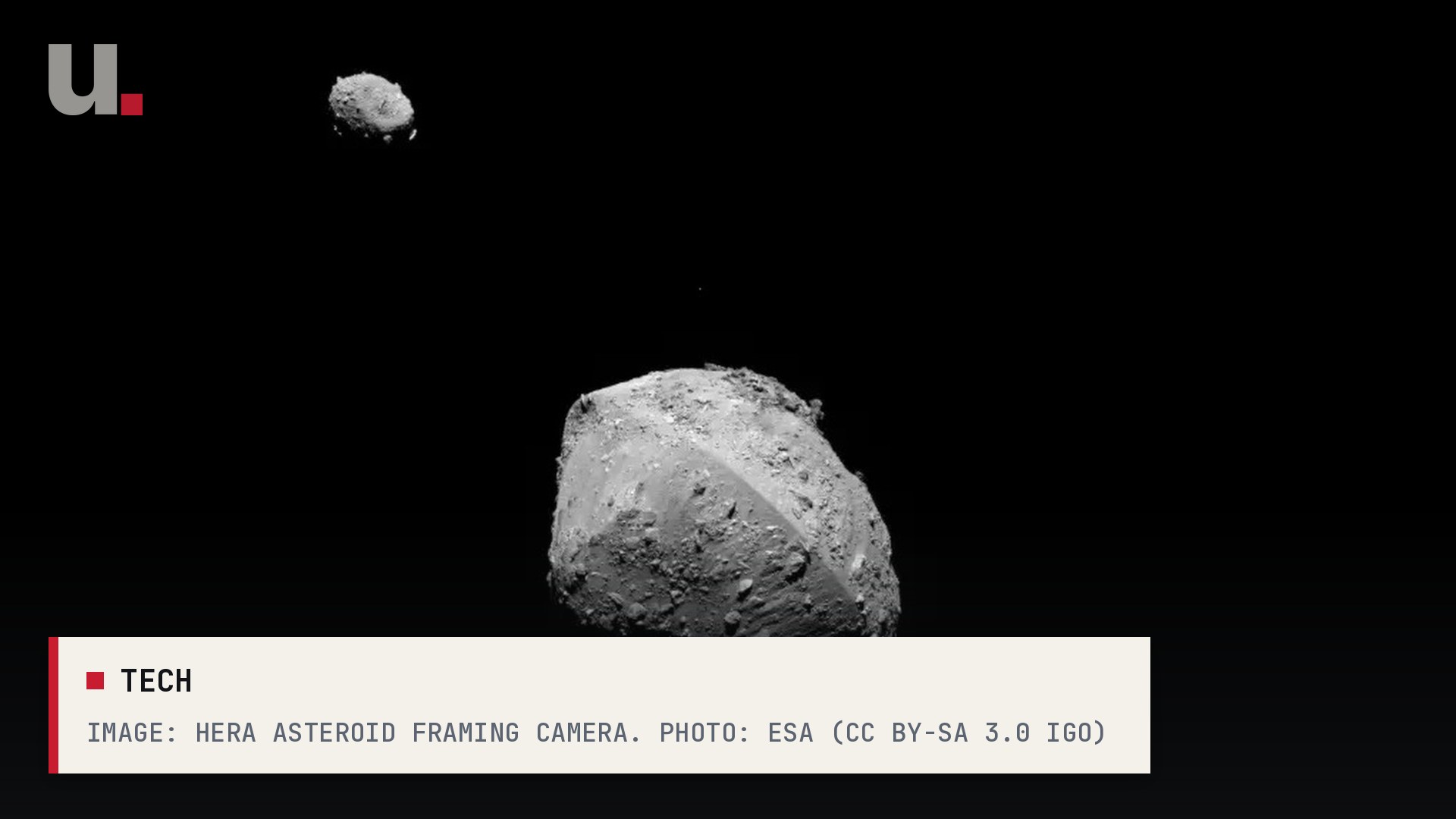
The European Space Agency’s Hera spacecraft, which arrived at the pair of asteroids this month, sent home its first close-up pictures. ESA released them at a briefing held, fittingly, in the dinosaur hall of Berlin’s natural history museum. The little asteroid NASA hit, called Dimorphos, now has one whole side mashed flat into a crater the size of a sports stadium.
“Scientists debated whether Dimorphos had sustained an impact crater, changed its shape or stayed the same,” said Patrick Michel, the French scientist who leads Hera’s science team. “Much to our surprise the answer turns out to be all three at once! The face struck by DART has been flattened into an impact crater the size of a sports stadium, which extends across the asteroid’s entire width.”
A rock knocked into a spin
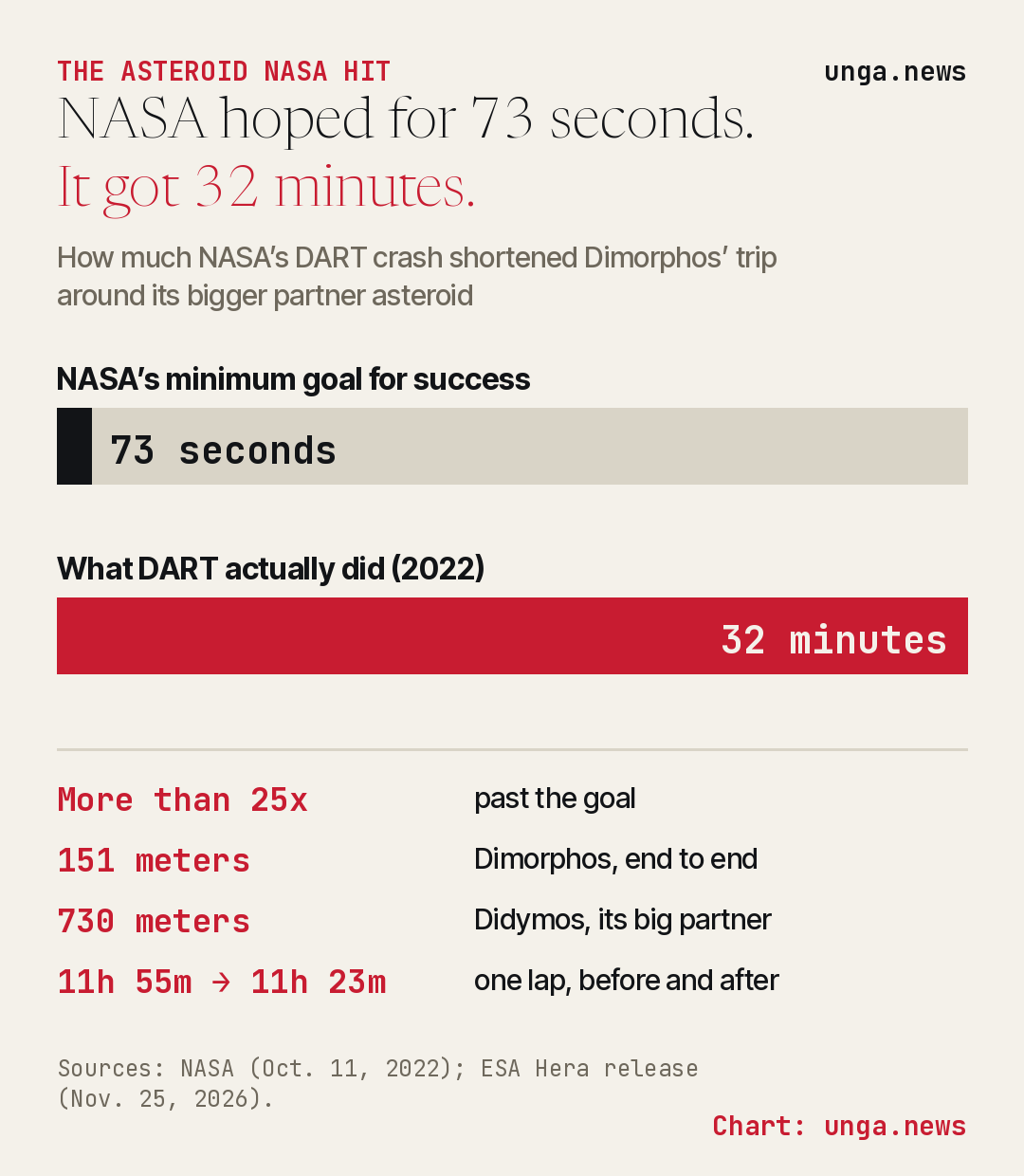
Some quick scale. Dimorphos is about 151 meters across, roughly a football field and a half. It circles a bigger asteroid, Didymos, which is about 730 meters wide, at a distance of around a kilometer. The two are flying around the sun together, currently about 120 million miles from Earth. Neither one has ever been a danger to us. That’s exactly why NASA picked them for target practice.
Hera lined up its camera to match the angle of the last picture DART snapped before it hit. Side by side, the difference jumps out. The bigger asteroid looks the same as it did in 2022, down to its boulder fields and the ridge around its middle. The small one’s rounded face is gone.
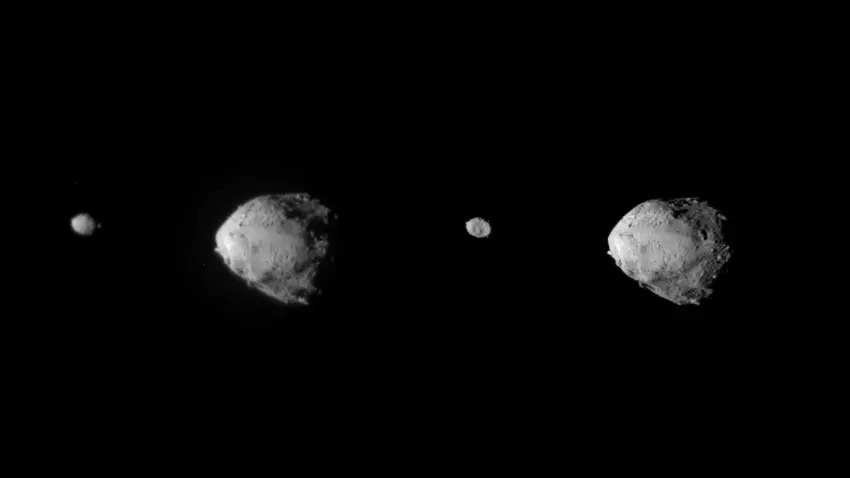
ESA says the crater stretches across the asteroid’s entire width and has some odd shapes inside it, including what the agency describes as a cigar-shaped structure right in the center. The rest of Dimorphos looks untouched, with the same boulder fields DART photographed on its way in.
The bigger surprise is how the rock is moving. “As Hera returned more images, it became clear that the DART impact has left Dimorphos tumbling wildly in its orbit,” said Michael Kueppers, ESA’s mission scientist. Scientists had expected it to keep one face toward its partner, the way our moon does with Earth. Instead it’s flopping around.
Then there are the boulders. Long-exposure shots show hundreds of rocks, each only a few meters across, circling the two asteroids. Nobody knew they were there. Kueppers said the team will have to account for them as Hera creeps closer in the coming weeks.
Better than NASA asked for
None of this takes away from what NASA pulled off. Before DART flew, the agency said it would call the test a win if the crash shortened Dimorphos’ trip around its partner by 73 seconds. The real number came in at 32 minutes. One lap that used to take 11 hours and 55 minutes now takes 11 hours and 23 minutes, according to NASA’s 2022 confirmation. That beat the goal by more than 25 times. ESA’s new release puts the change at about 33 minutes.
Why did it move so much more than expected? That’s the question Hera was built to answer. A crater means rock and dust blasted off the back side, and that spray works like a rocket nozzle, pushing the asteroid harder than the spacecraft alone could. Understanding exactly how much push you get, from what kind of rock, is the difference between a cool experiment and a tool you could count on if a real threat ever showed up.
Ian Carnelli, Hera’s mission manager, said as much in Berlin. “NASA’s DART mission demonstrated that we can change an asteroid’s orbit. Hera is now revealing what happened to the asteroid itself,” he said. “By combining these two missions, humanity is taking a decisive step towards making asteroid deflection a reliable tool for protecting our planet.”
Two missions, two SpaceX rides
Both halves of this experiment got to space on American rockets built by Elon Musk’s company. A SpaceX Falcon 9 launched DART from California in November 2021. Another Falcon 9 launched Hera from Cape Canaveral on Oct. 7, 2024, on the 23rd and final flight of a booster that had already carried astronauts and 10 batches of Starlink satellites. The world’s first planetary defense test, start to finish, rode reusable American hardware.
Hera itself is about the size of a small car and was built by a group of 18 European countries led by Germany’s OHB, with a heat-sensing camera from Japan’s space agency. It’s now hovering 25 to 30 kilometers from the asteroids, crawling along at about 12 centimeters a second, slower than a person walks.
The close work is still ahead. In December, Hera is set to move in to about 13 kilometers. In January, it plans to release two shoebox-sized satellites. One, called Juventas, carries the smallest radar ever flown in space and will try to see inside an asteroid for the first time before attempting a landing. The other, Milani, will study what the rocks are made of and the dust around them.
After that comes a real-world test of a different kind. On Friday, April 13, 2029, an asteroid called Apophis will pass about 32,000 kilometers above Earth, closer than some of our own satellites. It won’t hit us. ESA and Japan are building a mission called Ramses to watch it fly by.
For a holiday about counting blessings, here’s one worth adding to the list. If a rock ever does come for us, we won’t be stuck watching like the dinosaurs. An American spacecraft already proved we can knock one sideways, and now we’re learning exactly how hard to hit it.
Sources
- European Space Agency — Hera reveals stadium-sized asteroid crater from spacecraft impact (Nov. 25, 2026)
- European Space Agency — Pre- and post-DART impact comparison of the Didymos system (Nov. 25, 2026)
- European Space Agency — Revealing Hera’s first images of asteroid Dimorphos, Berlin briefing video (Nov. 26, 2026)
- NASA — NASA Confirms DART Mission Impact Changed Asteroid’s Motion in Space (Oct. 11, 2022)
- SpaceX — Hera Mission launch (Oct. 7, 2024)
- European Space Agency — Hera asteroid mission launch highlights (Oct. 7, 2024)