

Nearly 200 Countries Spent Two Weeks on a Climate Deal and Walked Away With Nothing
The UN’s big climate summit in Turkey ran two days into overtime, then collapsed when Europe refused a text that never mentioned oil, gas or coal. America wasn’t even in the room.
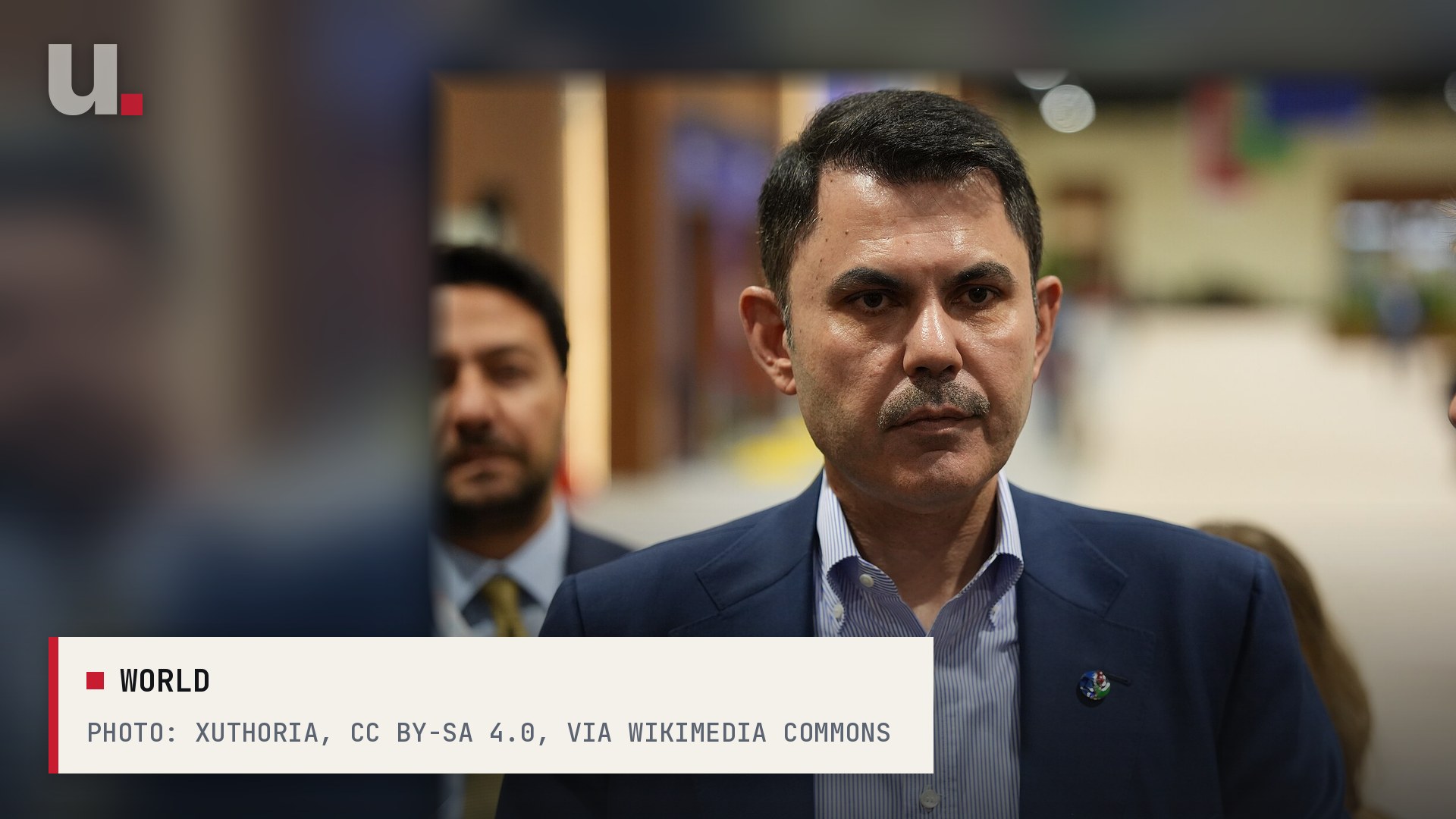
For two weeks and two extra days, negotiators from nearly 200 countries met in Antalya, Turkey, trying to write one more global climate promise. On Sunday they gave up. The United Nations climate summit known as COP31 ended without a final agreement, the first time one of these gatherings has failed to adopt its main deal since Copenhagen in 2009.
“There is nothing to do. We did all that we could,” Turkey’s environment minister Murat Kurum, the summit’s president, told the closing session, according to Reuters. He said he would not put forward any new text. Then he walked off the stage while delegates were still giving speeches.
It was the longest summit on record, and it produced nothing it could call a deal.
Europe walked out over two words
The fight came down to fossil fuels, and in a sense to two words. The final draft from Turkey and Australia, the summit’s co-hosts, never mentioned oil, gas or coal, and it never repeated the 2023 Dubai pledge to transition away from them. The European Union refused to sign.
“It is unconscionable that we would have a climate act that makes no reference to fossil fuel, no reference to transitioning away from fossil fuels,” said Ireland’s environment minister Darragh O’Brien, who spoke for the bloc. EU climate chief Wopke Hoekstra told reporters after walking out that the omission was “not acceptable.” “We do that with a heavy heart with many other countries,” he said, “but we simply cannot accept this.”
Europe had company. Panama said governments have a duty “not to negotiate the minimum threshold, but to act.” The Marshall Islands said signing would amount to a betrayal of its people and dismissed parts of the text as “false solutions,” according to the UN’s own closing report.
On the other side sat the countries that actually pump the oil. Saudi Arabia, speaking for the Arab League, defended the draft’s language on carbon capture and storage, the technology that pulls carbon out of smokestacks or the air. It rejected the charge that this was greenwashing and said every workable tool should stay on the table.
Kurum’s own frustration spilled onto his 𝕏 account a few hours before the final gavel. In Turkish, he wrote that the presidency had worked for results from day one, and that jamming up the whole process over a single word dashes the hopes of people waiting for good news. “A system that can’t make decisions,” he wrote, “does nobody any good.”
Murat Kurum on 𝕏 — The COP31 president, in Turkish: getting stuck on one word and blocking the process breaks the hope of people waiting for good news; “a system that can’t make decisions is of no use to anyone.” (Nov. 22, 2026)
— @murat_kurum View on 𝕏
That is a remarkable thing for the host of a UN climate summit to say. He wasn’t describing the skeptics. He was describing the system.
What the text would have asked of everyone
The failed deal wasn’t a small document. It formally admitted the world is on course to blow past the 1.5 degree warming target from the 2015 Paris accord, and it called for faster development of carbon removal to claw some of that back. It called for tripling the money rich countries send poorer ones to cope with climate change, without saying tripled from what. And it carried Turkey’s signature goal: pushing electricity’s share of all the energy the world uses from about 23% today to 35% by 2035.
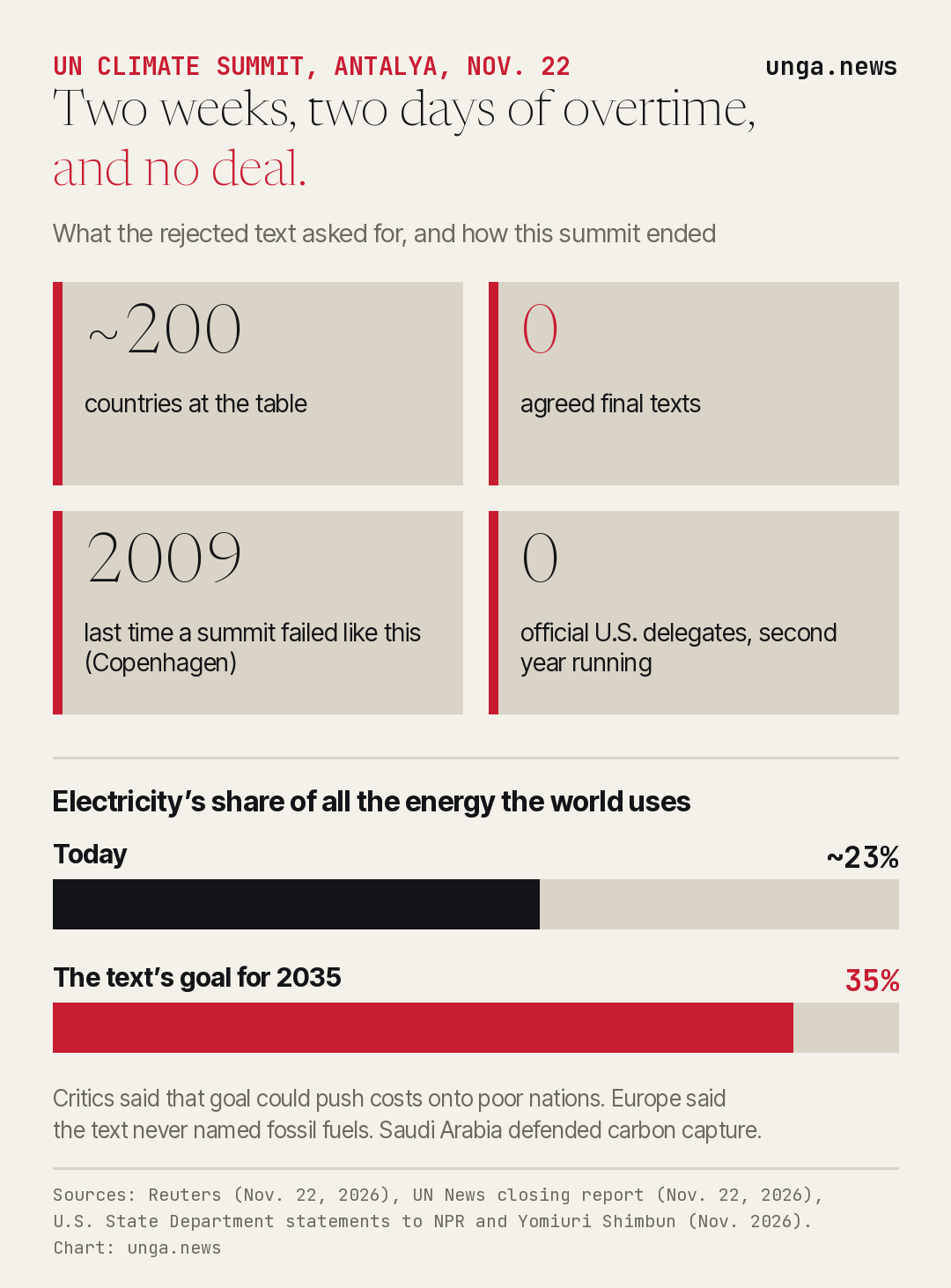
That last number means swapping out gas furnaces, stoves and cars on a global scale in about nine years. Critics told Reuters it could push more costs onto poor nations without giving them a clear path off fossil fuels. Ghana, speaking for the African Group, said the section on a “just transition” got “a single generic sentence,” though it said Africa would not block a deal.
So the wealthy countries said the text was too weak, the poor countries said it was too vague, and the oil countries said it was fine as long as nobody touched their oil. That is the consensus model in action. Under UN rules, one holdout can sink the whole thing, and on Sunday several did.
The seat America left empty
There was no official American delegation in the room. For the second year in a row, the State Department declined to send negotiators. It told Japan’s Yomiuri Shimbun that its policy in any international agreement is to put the interests of the United States and the American people first. It argued that pacts like Paris put the U.S. at an economic disadvantage, raised costs for Americans and sent taxpayer money to countries that don’t need or deserve it. The U.S. left the Paris agreement again in January, and its exit from the underlying UN climate treaty takes effect in February, according to the same report.
Plenty of Democrats went anyway, including California Gov. Gavin Newsom and former Secretary of State John Kerry, who argued that the midterms were a vote for climate action, as unga.news reported at the time. None of them had a vote on the text. Two weeks later, the countries that did have one couldn’t agree with each other.
Critics of the administration spent the summit treating America’s absence as the problem. Sunday’s ending makes that a hard argument to keep making. The U.S. wasn’t there to block anything, and the deal collapsed anyway, over a fight between Europe and the oil states that had nothing to do with Washington.
Guterres says try again in Ethiopia
UN Secretary-General António Guterres called the result a “deeply disappointing” setback. “There may be no consensus in the negotiating room. There is no ambiguity in the science,” he said, and he urged activists to “keep turning up the heat.”
Hoekstra went further than either of them. He told Bloomberg News that multilateralism is in “dire straits” and that progress may have to come from deals outside the UN process altogether. When Europe’s top climate negotiator starts talking about working around the UN, the annual summit has a problem nobody in Antalya solved.
Nothing from earlier agreements gets erased, Reuters noted. The next summit, COP32, goes to Addis Ababa, Ethiopia, carrying every question Antalya couldn’t answer: how fast to quit fossil fuels, who pays, and whether nearly 200 governments can still agree on anything at all.
For the families paying the heating bills this winter, the more useful lesson may be simpler. Two weeks of talks, a record overtime and a walkout produced no new rules on what they burn or what it costs. Whatever happens to energy prices next will be decided closer to home.
Sources
- Reuters — COP31 climate talks collapse as EU and others reject deal, by Peter Hobson, Lewis Jackson and Ezgi Erkoyun (Nov. 22, 2026)
- UN News — COP31 ends without climate pact as UN chief warns there is ‘no ambiguity in the science’ (Nov. 22, 2026)
- NPR — Climate change talks fall apart in final hours over fossil fuels (Nov. 22, 2026)
- Bloomberg News — EU Rejected UN Climate Deal Due to Backsliding on Fossil Fuels, by John Ainger (Nov. 22, 2026)
- NPR — U.N. climate talks begin today. Here are 3 things to know (Nov. 9, 2026)
- Yomiuri Shimbun — Trump administration sends no official delegation to COP31 (Nov. 8, 2026, in Japanese)
- Murat Kurum on 𝕏 — Murat Kurum on 𝕏 — “A system that can’t make decisions is of no use to anyone” (Nov. 22, 2026, in Turkish)
- António Guterres on 𝕏 — António Guterres on 𝕏 — Deeply disappointed COP31 ended without consensus (Nov. 22, 2026)