

Nearly 8 in 10 Web Browsers Run on Google’s Code. A Tiny Nonprofit Just Built a Rival From Scratch
Ladybird, a donor-funded browser with its own engine and no search-engine deals, released its first download for Mac and Linux this week. It’s rough around the edges, but early testers say YouTube, Google Maps and GitHub already work.

Open a web browser on almost any computer or phone in America and there’s a good chance Google wrote most of the code doing the work. Chrome is Google’s. Microsoft’s Edge, Opera and Samsung’s phone browser are all built on Google’s Chromium code. Add them up and those four carried about 78% of the world’s web browsing in October, according to StatCounter. Apple’s Safari has most of the rest. Firefox, the old underdog, is down to under 3%.
That’s why a quiet release on Monday matters more than its size. Ladybird, a browser built by a small nonprofit, put out its first downloadable alpha for Mac and Linux. It isn’t another copy of Chrome with a new logo. The engine underneath, the part that actually reads a web page and draws it on your screen, was written from scratch.
“Ladybird is a browser with a new engine,” project leader Andreas Kling wrote. “The engine is our own, built from the ground up, and not a fork. The browser around it is modest, but functional.”
Ladybird on 𝕏 — Ladybird is now in alpha 🐞 Downloads for macOS and Linux available on our website.
— @ladybirdbrowser View on 𝕏
The post announcing it has been seen nearly a million times on 𝕏. Until this week, anyone who wanted to try Ladybird had to build it themselves from raw code. Now it installs like any other app and updates itself.
Three engines run the whole web, and Google owns the biggest
Nearly every browser you’ve heard of sits on one of three engines: Google’s Blink, Apple’s WebKit and Mozilla’s Gecko. Brave, Edge, Opera, Vivaldi and dozens of others are Chrome underneath. On iPhones in America, Apple makes every browser use its own engine, so Chrome on an iPhone is really Safari’s engine wearing Chrome’s clothes.
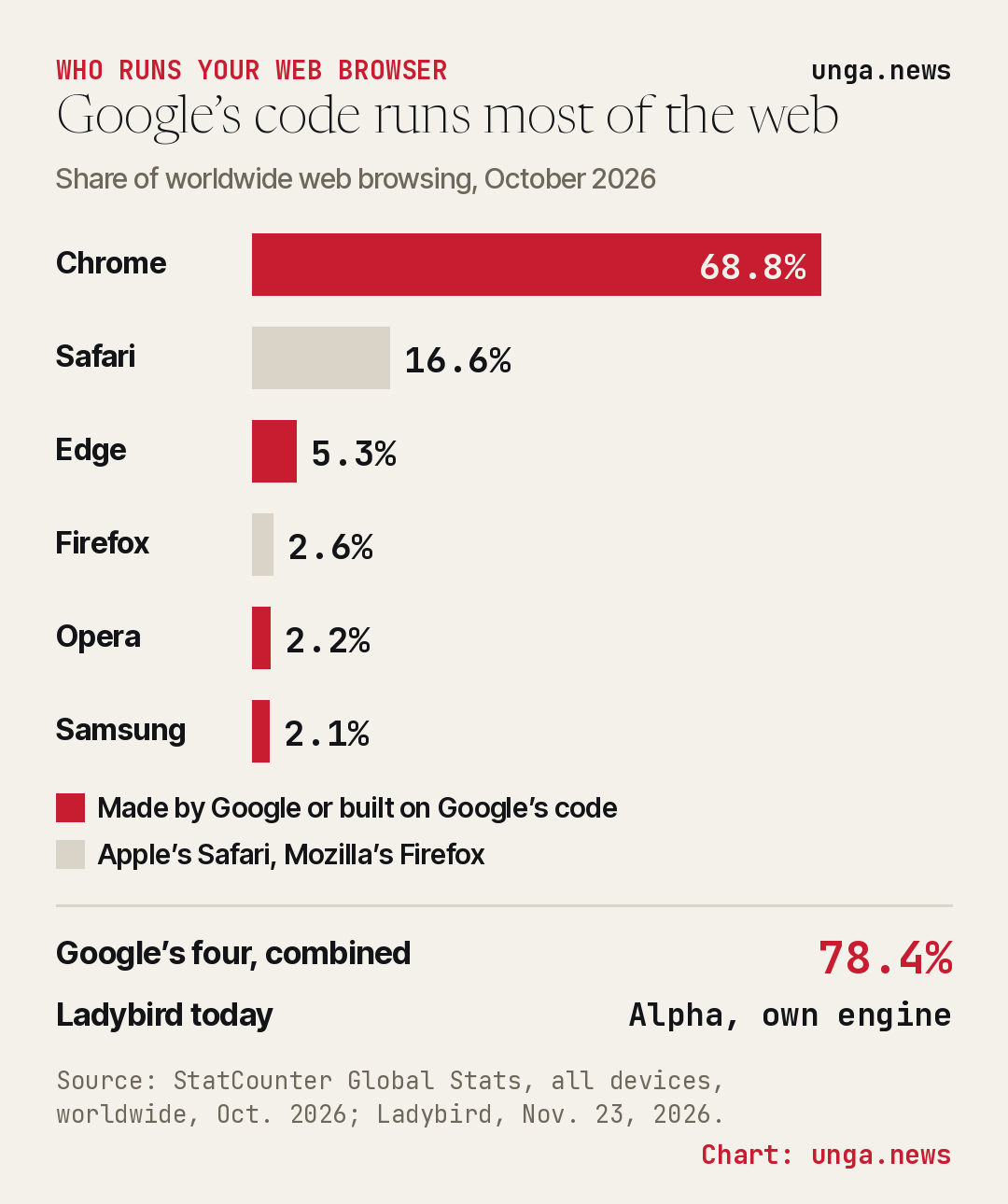
When one company’s code handles that much of the internet, that company gets to quietly set the rules. Website builders test for Chrome first because that’s where the traffic is. New web features tend to go the way Google wants them to go. And Google’s own browser feeds the search and ad business that pays for everything else.
Even the competition leans on Google. Mozilla has for years gotten most of its money from Google paying to be Firefox’s default search engine. Google has also paid Apple billions a year to be Safari’s default, a figure that came out in the government’s antitrust case. That case, it’s worth remembering, was filed by President Trump’s Justice Department in October 2020, and in 2024 a federal judge ruled that Google had illegally kept its search monopoly.
Ladybird says it won’t play that game. Its website promises no “default search deals,” no crypto tokens and no other ways of cashing in on its users. It’s a tax-exempt nonprofit paid for by donations and sponsorships, and it says sponsors get no board seats and no say over what it builds. GitHub co-founder Chris Wanstrath gave $1 million to help launch the nonprofit in 2024.
It actually works, mostly
Nobody is calling it finished. Kling’s own announcement warns that some websites won’t load and it will crash sometimes. “We want security nerds to hack it!” he wrote. “A new browser gets hacked, over and over, and that’s part of the process, so we make no promises about security today.” Windows isn’t supported yet, and there are no add-ons, so your favorite ad blocker won’t install, though it can load blocking lists on its own.
Still, the early reviews are better than anyone should expect from software this young. Ars Technica’s Nick Indge tested it Wednesday and wrote that the most surprising thing was “how little it feels like alpha software.” Google Maps loaded instantly and dropped into Street View in about three seconds. YouTube, GitHub and news sites worked. A dozen tabs switched without a hitch. He did manage to freeze it by jumping around a 4K video over and over, which is about what you’d expect.
Speed is the honest weak spot. A Japanese developer site, DevelopersIO, ran the Speedometer test, which times how fast a browser handles busy web apps, on a Mac. Ladybird scored 21.7. Safari scored 51.3 and Chrome 60.6. In plain terms, it’s running at about a third of Chrome’s pace on heavy apps, even if everyday browsing felt fine to the tester.
The man who walked away from Apple’s browser team
Kling isn’t some hobbyist dabbling in browsers. He worked on browser engines for over a decade, including six years at Apple on WebKit, the engine behind Safari, before leaving in 2017. In 2018 he started SerenityOS, a from-scratch operating system he has described as a project that helped him stay sober. Ladybird began as that system’s little web browser and split off on its own in 2024.
He has also refused to turn the project into a political cause, and some people online have never forgiven him for it. A few years back he turned down a request to rewrite the project’s documents with gender-neutral pronouns, writing that the project was “not an appropriate arena to advertise your personal politics.” That one line set off a pile-on that resurfaced when Ladybird went big in 2024 and still follows him. Even Ars Technica’s glowing review now carries an editor’s note pointing readers to his critics. A browser that renders Google Maps from scratch apparently has to answer for a pronoun.
The bet is simple. A fourth engine means one more independent check on how the web is supposed to work. Every time Ladybird hits a site that only works because Chrome happens to do something a certain way, it exposes a Google habit dressed up as a web standard. More engines mean more competition, and more competition means no single company decides what the internet looks like.
Ladybird won’t dent Chrome’s numbers anytime soon. But for the first time in years, a regular person can download a browser that isn’t owned by Google, Apple or a group living off Google’s checks, and see a real web page come up. If you’ve got a Mac and a spare evening, it’s free at ladybird.org. Just don’t log into your bank with it yet.
Sources
- Ladybird — Ladybird is now in alpha, by Andreas Kling (Nov. 23, 2026)
- Ladybird on 𝕏 — Ladybird is now in alpha (Nov. 23, 2026)
- Ladybird — A truly independent web browser: funding, sponsors and FAQ
- Ars Technica — Ladybird browser’s first downloadable alpha is surprisingly capable (Nov. 25, 2026)
- DevelopersIO — Ladybird alpha compared with Chrome and Safari on macOS, Speedometer 3.1 results (Nov. 2026)
- StatCounter Global Stats — Browser market share worldwide, October 2026
- U.S. Department of Justice — Justice Department Sues Monopolist Google For Violating Antitrust Laws (Oct. 20, 2020)
- Wikimedia Commons — Andreas Kling, Ladybird: Building a new browser from scratch (State of the Browser 2025, London Web Standards)