

Nearly Half of New Jersey Students Are Behind in Reading. Its Governor Now Wants Mississippi’s Fix.
Gov. Mikie Sherrill ordered schools back to phonics-first reading and pointed to Mississippi’s Republican-built turnaround as the model. She left out the part that made it work: holding back third graders who can’t read.
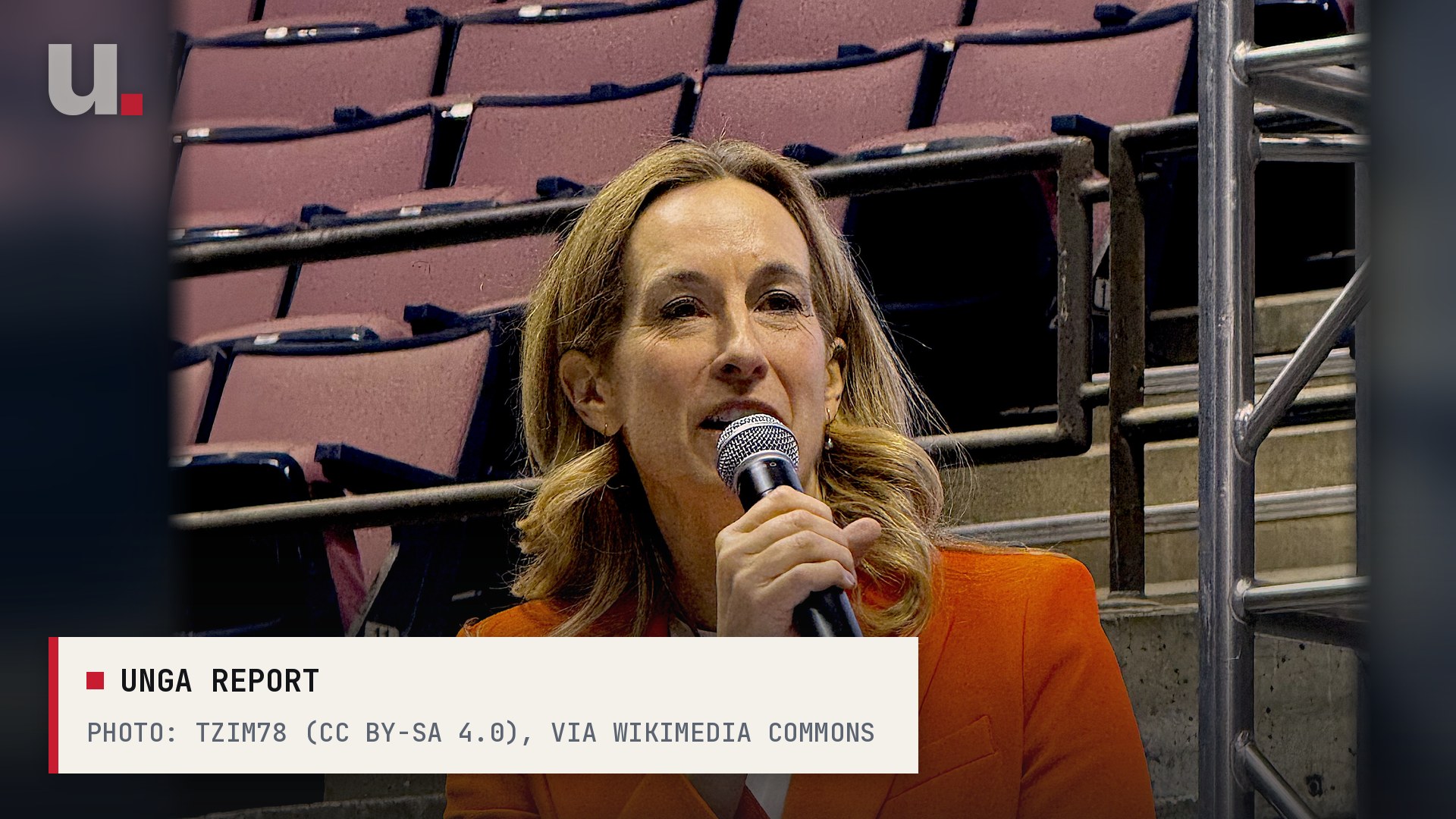
New Jersey likes to call itself the best school state in America. On Monday its governor signed an order admitting that nearly half its kids still fall short in reading, and she named the place New Jersey should learn from: Mississippi.
Gov. Mikie Sherrill, a Democrat, signed Executive Order No. 30 at Arthur Judd Elementary School in North Brunswick. The order tells the state Department of Education to build an early reading plan within 90 days, approve a short list of reading tests that every district must pick from, review the books and lessons kids are taught from, and rewrite how future teachers are trained to teach reading.
The order itself spells out the problem. English language arts achievement “does not yet meet grade-level expectations for nearly half of New Jersey students in grades three through nine,” it says, and the numbers are worse for low-income kids, kids still learning English and students with disabilities.
“That should alarm us all,” Sherrill said at the signing, according to NJBIZ. “Plenty of ink has been spilled about how we got here, from the decline in leisure reading to the increase in screen time during early childhood, but my main concern as a mom and as a governor is how we fix it.”
The model came from a red state
The fix she pointed to was built by Republicans. In 2013, a Republican legislature in Jackson passed and Gov. Phil Bryant signed Mississippi’s Literacy-Based Promotion Act. The law put phonics back at the center of early reading, screened young kids for trouble, sent literacy coaches into the weakest schools and, most famously, ended social promotion. A third grader who still couldn’t read at a basic level would not move on to fourth grade until they could.
The state law’s own words leave no wiggle room. It establishes “an act prohibiting social promotion,” and starting in the 2014–2015 school year, a student whose reading deficiency is not fixed by the end of third grade “shall not be promoted to Fourth Grade.”
Sherrill told the crowd that Mississippi went from 49th in the nation in fourth-grade reading about 13 years ago to ninth in 2024. The federal scores back up the direction. On the Nation’s Report Card, run by the U.S. Department of Education’s statistics arm, Mississippi’s average fourth-grade reading score rose from 208.5 in 2013 to 218.5 in 2024, a 10-point gain. Over the same years New Jersey fell from 228.7 to 221.6, and public schools nationwide dropped from 220.7 to 214.3.
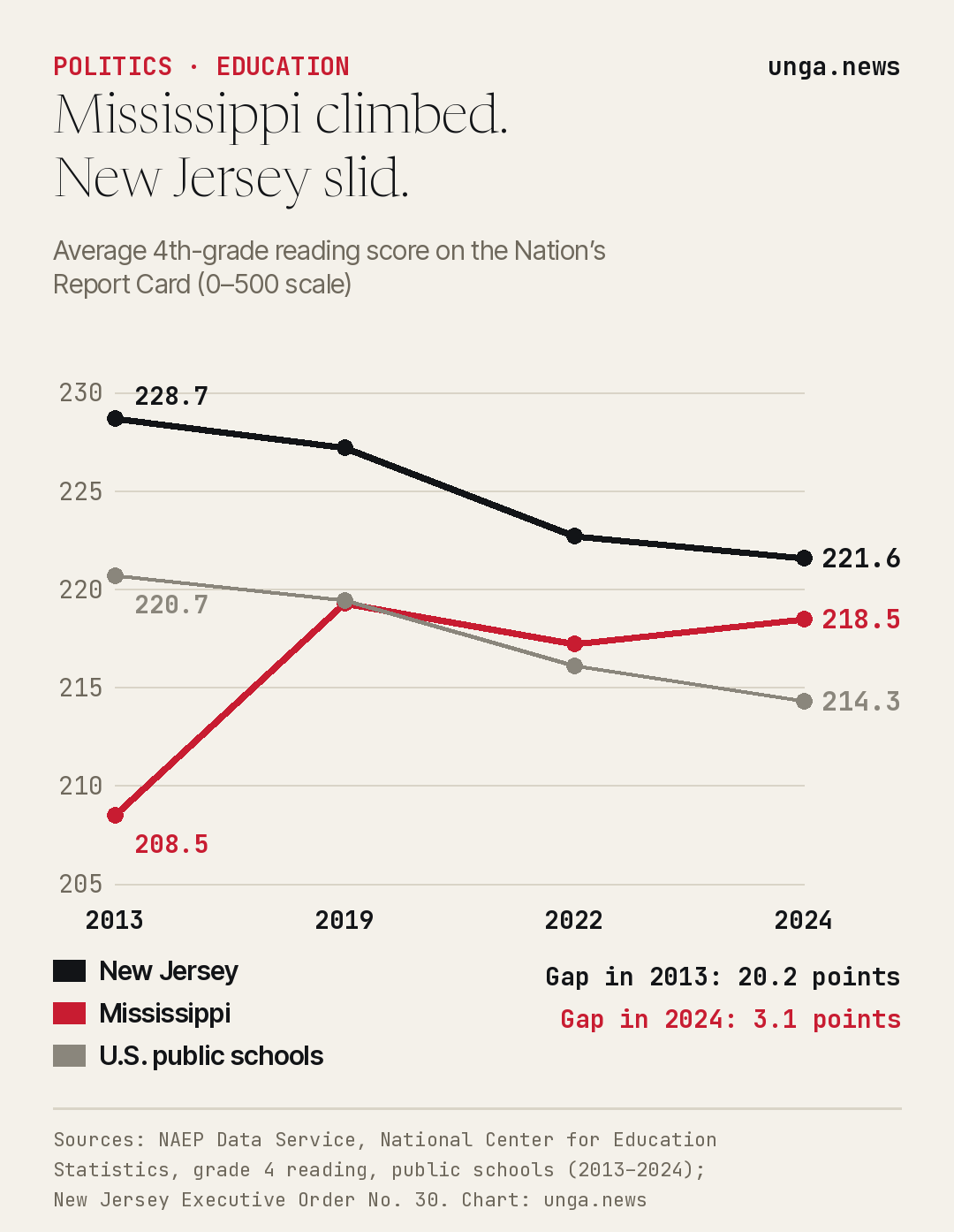
New Jersey still scores a little higher. But the state that brags about leading the nation watched a 20-point lead over Mississippi shrink to about 3 points in a little over a decade. Louisiana, another Southern state that went all in on phonics, climbed too, from 210.5 to 216.0.
What New Jersey is actually ordering
Sherrill’s order defines good reading instruction the way the Mississippi crowd does: “phonological and phonemic awareness, phonics and spelling, fluency, vocabulary, oral language, and comprehension.” In plain terms, kids learn how letters and sounds fit together before they are asked to guess at words from pictures.
Education Commissioner Lily Laux said it simply. “Children need to learn how letters and sounds work together, while building the language, vocabulary, and knowledge to understand what they read,” she said, according to the New Jersey Globe. “We cannot wait until third grade to find out if a child is struggling.”
Within 90 days, the department has to hand the governor a full early reading plan with measurable goals, and a plan for a statewide summer reading camp for kids who end the year behind. Within 180 days, it must publish at least two approved reading screeners, one of them free, and districts will have to choose from that list. Within 360 days, it must publish a list of approved reading lessons and books.
It also calls for a pilot program of regional literacy coaches and a rewrite of the rules for college programs that train teachers.
The tough part got left out
What the order does not do is just as telling. There is no third-grade reading gate. Nothing in Executive Order No. 30 stops a child who can’t read from being passed along to fourth grade, the piece of the Mississippi law that forced schools to take reading seriously.
The new reading lessons aren’t required either. The order says the department “shall encourage” districts to use the approved materials and will only “assess the feasibility” of requiring them, including what it would cost. So a district that keeps using an approach that hasn’t worked can keep doing it for now.
And none of the new work has money attached yet. Sherrill said the order “does not have specific budgetary impacts,” and the summer camps haven’t been approved or funded. Even she conceded that the 2024 reading law signed by her predecessor, Phil Murphy, hasn’t been carried out “as rigorously across the entire state” as it should have been.
That matters because Trenton has been here before. New Jersey already required twice-a-year reading screenings for kids in kindergarten through third grade under that 2024 law, and the state published its own reading framework in May 2025. Nearly half of students still miss the mark.
Kalina Berryman, who leads Newark Youth Career Pathways, put it well at the signing. “An executive order is only as powerful as its implementation,” she said.
Parents deserve the whole playbook
Credit where it’s due. A Democratic governor in one of the bluest states in the country just stood up and said a red state in the Deep South got reading right. That is not a small thing in a party that has spent years defending the education establishment. Sherrill also hinted that the review could reach New Jersey’s school funding formula, comparing similar districts to see “which districts are overperforming and why.”
But Mississippi didn’t win with plans and pilot programs alone. It won by setting a hard line that a child has to be able to read before moving on, and then pouring help into every kid at risk of missing it.
New Jersey parents now get a deadline: a reading plan on the governor’s desk by late February. If Trenton wants Mississippi’s results, it will have to borrow the part that asked the most of the adults, not just the vocabulary.
Sources
- State of New Jersey — Executive Order No. 30, Gov. Mikie Sherrill (Nov. 23, 2026)
- National Center for Education Statistics — NAEP Data Service: grade 4 reading average scale scores and proficiency, New Jersey, Mississippi, Louisiana and U.S. public schools, 2013–2024
- Mississippi Department of Education — Literacy-Based Promotion Act Implementation Guide (Miss. Code § 37-177)
- New Jersey Department of Education — The New Jersey Literacy Framework
- NJBIZ — Sherrill signs executive order to improve literacy in NJ schools (Nov. 23, 2026)
- New Jersey Globe — Sherrill orders overhaul of reading instruction in New Jersey schools (Nov. 23, 2026)