

New Rules Let Your SI Assistant Shop Millions of Online Stores, but Only With Your Permission
Every Shopify store now tells visiting SI helpers what they can do, and Meta’s assistant checks for the rules first. More than 100 companies have signed on, from Delta to Navy Federal.

Handing your credit card to a robot has always sounded like a bad idea. A new set of rules just went live that tries to fix that, and it is already switched on at every Shopify store on the internet.
It is called Personal Agent Protocol, or Poppy for short. Sierra, the customer service SI company run by former Salesforce co-CEO Bret Taylor, released version 1.0 on Nov. 13. The idea is simple. When your SI assistant shows up at a store, a bank or an airline, the business tells it who it is dealing with and what it is allowed to do. You decide how much access the assistant gets, and you can take it back.
Your assistant gets a hall pass
Today, when you ask an SI helper to buy something or fix a problem, “it often has to sign in as the customer and navigate pages built for people,” Sierra wrote when it published the first draft in October. Stores can’t tell a real customer’s assistant from a scraper, and shoppers can’t easily tell how much power they have handed over.
Poppy gives every participating company one standard file on its website. That file tells a visiting assistant how to talk to the business, how the customer signs in and what the assistant is allowed to do. It leans on standards the tech industry already uses, including MCP, OpenAPI and the shopping protocol Shopify supports.
Signing in works the way it already does on most sites, through standard OAuth logins. You approve what the assistant can touch, and you can change that access later. At a store, the assistant can shop as a guest or sign in with your account.
Shopify flips the switch for everyone
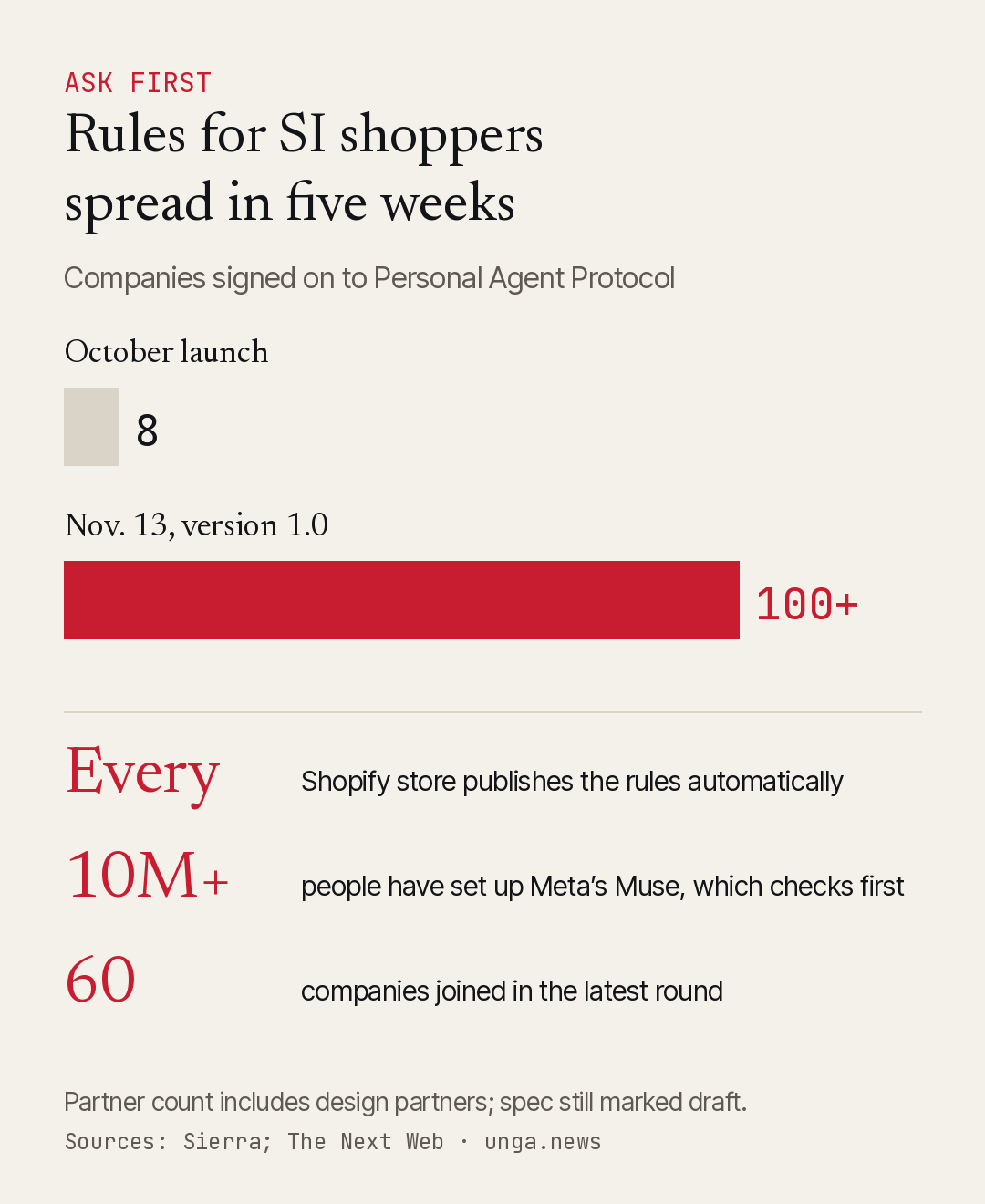
The biggest piece of news is Shopify. The company, which powers businesses in more than 175 countries, now automatically publishes a Poppy file for every merchant, so store owners don’t have to lift a finger. Shopify also co-wrote the shopping part of the rules, and it requires the assistant to “ask the customer before taking certain actions, so it only acts with their permission,” according to Sierra’s announcement.
That matters for anybody who has watched an SI demo cheerfully fill a cart with the wrong thing. The assistant can browse, compare and build the order. When it comes time to do something that counts, it has to come back to you.
Meta is in, too. Muse, Meta’s SI assistant, now looks for Poppy first on every site it visits. More than 10 million people have set up Muse, The Next Web reported.
From eight partners to more than 100
When Sierra first announced Poppy in October, it had eight design partners: Meta, Genesys, Instinct, NiCE, Rocket, Shopify, Stripe and Walmart. Days later it added 35 more, including Bank of America, Target, Visa and United Airlines. With version 1.0, Sierra says 60 more companies joined, bringing the total past 100. The new names include Delta Air Lines, Hyatt, Intuit, SoFi, Wayfair, GoFundMe, Navy Federal Credit Union, Travelers and Zoom.
A few are already live. Mercury, a banking app, lets your assistant check balances, review recent transactions, sort spending and keep receipts in order. It can even start a payment or transfer, but Mercury runs that through the account’s approval rules before any money moves. Turkish Airlines lets assistants check fares, flight status and stopovers, pull up a booking with a reference number and last name, and find business-class upgrades for frequent flyers, which the customer approves before paying. Synchrony, the store card company, is working on bringing its financing and rewards into SI-led shopping across more than 500,000 merchant locations.
Fine print worth reading
This is not finished. Sierra calls it version 1.0, but The Next Web points out the specification is still labeled a draft and allows changes that could break existing setups. And Poppy is one of several efforts racing to set the rules for SI shoppers. Visa and Mastercard are building their own ID checks for agents. Amazon wants shoppers using its own assistant instead of Meta’s.
There is also a real question about who benefits most. A standard that makes it easy for assistants to deal with stores also makes it easy for stores to steer those assistants toward their own offers. Synchrony’s own pitch talks about surfacing “relevant Synchrony offers and financing products along the way.” Shoppers should keep an eye on whether their helper is finding the best deal or the best-placed one.
Still, the core design gets the most important thing right. You sign in on the company’s page. You choose what the assistant can touch. The assistant has to say who it is, and it has to check with you before certain moves. If SI assistants are going to do our holiday shopping, that is the right order of operations: permission first, purchase second.
Sources
- Sierra — Releasing Personal Agent Protocol 1.0
- Sierra — Sharing a draft of Personal Agent Protocol
- The Next Web — Sierra releases Poppy 1.0 as Shopify and Meta’s Muse sign on