

New York Will Force a Warning You Can’t Skip Onto Your Social Media. Tech Just Sued.
Starting Jan. 1, apps like Instagram, TikTok and X would have to freeze New Yorkers’ screens with a state-written message every hour after three hours of scrolling, adults included unless the app checks their age. A free speech lawsuit says Albany can’t make websites talk for it.
Starting Jan. 1, opening Instagram, TikTok, YouTube or X in New York could come with a government message you aren’t allowed to skip. Scroll long enough and the message comes back every hour, covering three-quarters of your screen for at least 30 seconds. Unless the app has decided you’re an adult, it doesn’t matter whether you’re 14 or 54 and just checking the scores.
On Friday, the tech trade group NetChoice sued to stop it. The group filed in federal court in Manhattan against New York Attorney General Letitia James, whose office would enforce the law, arguing that Albany is turning private websites into “government mouthpieces.”
NetChoice on 𝕏, Nov. 13, 2026: “NetChoice Sues New York: The Government Cannot Force Websites to Speak for the State.”
— @NetChoice View on 𝕏
The message Albany wrote for your apps
The law started as Senate Bill 4505, which Gov. Kathy Hochul signed in December 2025 and then rewrote with a chapter amendment in February. It covers any social media platform that offers what the state calls an “addictive feature”: an algorithm-driven feed, autoplay or infinite scroll. That’s nearly every big app on your phone.
Every covered app has to show the same words, written into state law: “The Surgeon General has warned that while social media may have benefits for some young users, excessive use may be associated with significant mental health harms.”
The schedule is where it gets heavy. The first time you hit one of those features each day, the warning has to cover at least a quarter of your screen for at least 10 seconds. After three hours of total use in a day, it comes back bigger, at least 75% of the screen for at least 30 seconds, and then again every hour after that. Users can’t click past it, and apps can’t bury it in their terms of service or make it less visible.
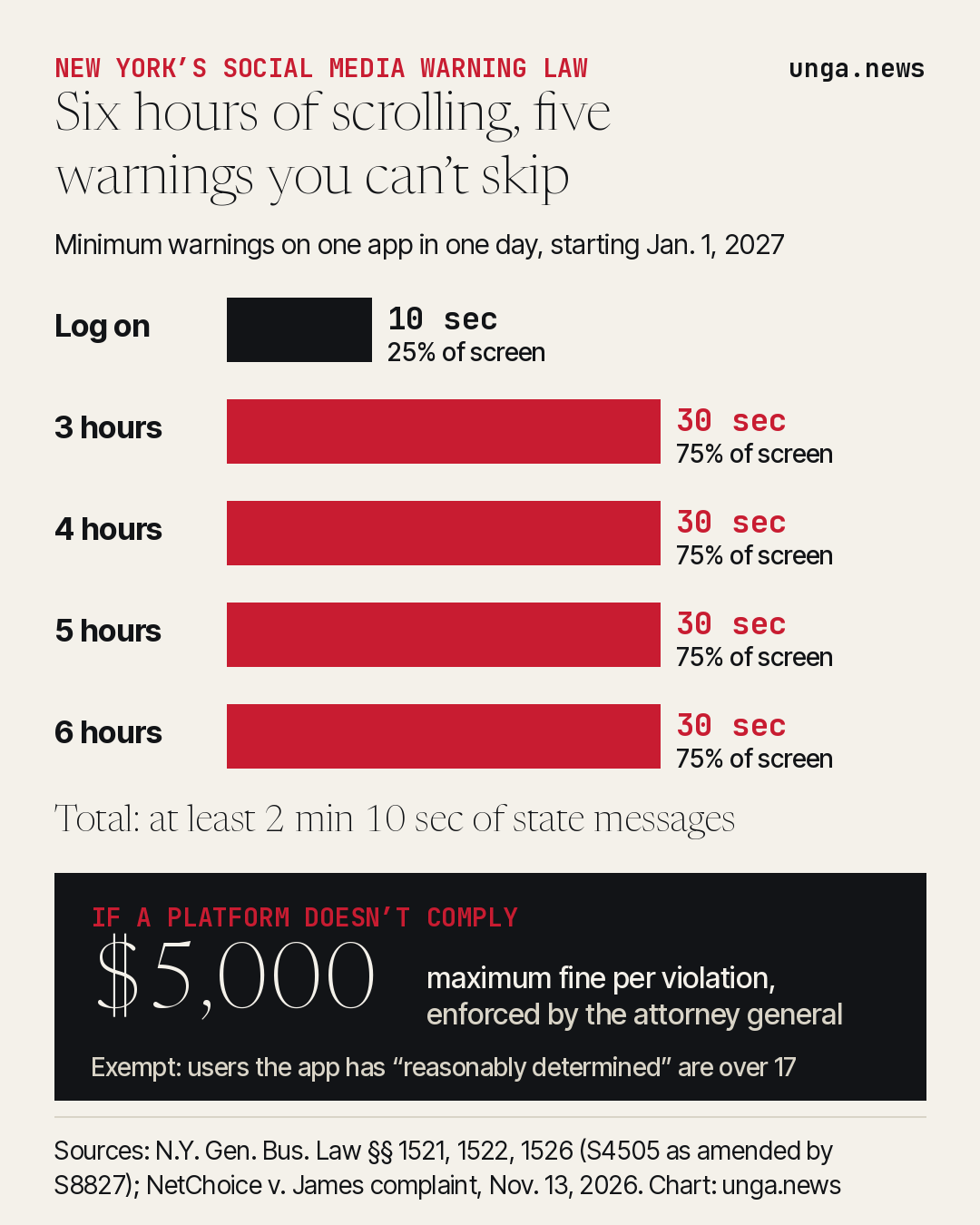
Run the math on a long day. Six hours on one app means at least five unskippable warnings and more than two minutes of staring at a message from Albany. Platforms that don’t comply can be hit with civil penalties of up to $5,000 per violation, plus restitution and damages, in suits brought by the attorney general.
Adults are on the hook too
Hochul’s office sold the bill as protection for “young users,” and the sponsors, state Sen. Andrew Gounardes and Assemblymember Nily Rozic, describe it as a warning for users under 18. But read the fine print. The law spares only users the platform has “reasonably determined” are over 17.
That flips the burden. Unless an app has figured out you’re an adult, you get the warning. The only way for a company to stop lecturing grown men and women is to start sorting every New Yorker by age, which means more ID checks, more age-guessing scans and more personal data handed to tech companies. NetChoice says that trade costs users privacy, security and the ability to stay anonymous online.
The lawsuit names the services it says the law hits, at minimum: Facebook, Instagram, Threads, Pinterest, Reddit, Tumblr, TikTok, YouTube and X.
And the complaint points out a quieter problem. The warning doesn’t say it comes from the state, so it reads as if it were the company’s own message. The law also says showing the warning doesn’t protect a platform from other lawsuits, including ones claiming it failed to warn.
A cigarette label for speech
Hochul’s office pitched the label as the same kind of warning found on tobacco, alcohol and sugary foods. “Keeping New Yorkers safe has been my top priority since taking office, and that includes protecting our kids from the potential harms of social media features that encourage excessive use,” she said when she signed it. Rozic said “New York families deserve honesty about how social media platforms impact mental health.”
NetChoice’s lawyers say the comparison falls apart. A cigarette pack is a product. A social media feed is speech: news, sermons, lectures, family photos and political arguments, all protected by the First Amendment. “Unlike a warning on a cigarette package or product label, these subsequent warnings block access to the underlying speech,” the complaint says. “Users must wait through the State’s message before they can return to the expression they seek.”
“The First Amendment forbids New York from forcing private speakers to serve as government mouthpieces, and that includes compelled state-scripted warnings on speech,” said Paul Taske, who runs the NetChoice Litigation Center. “New York has every right to share its views on social media, but it has no right to make private websites say it for them.”
The suit leans on a 1943 Supreme Court case, West Virginia State Board of Education v. Barnette, which struck down forced flag salutes in public schools. Its most famous line: no official “can prescribe what shall be orthodox in politics, nationalism, religion, or other matters of opinion.” The complaint argues that forcing an app to repeat the state’s view on social media, on a timer, is the same kind of compelled speech.
Colorado already lost this fight
New York isn’t writing on a blank page. Colorado passed a similar warning requirement, and a federal judge there blocked it in 2025 in a case called NetChoice v. Weiser. The state has appealed to the 10th Circuit. NetChoice is also suing California and Minnesota over their versions, and Taske said New York’s mandate “should meet the same fate.”
New York built its case on a 2023 advisory from Vivek Murthy, President Biden’s surgeon general, who later called for warning labels on social media. The law’s own findings cite his conclusion that kids ages 12 to 15 who spend more than three hours a day on social media face double the risk of anxiety and depression.
Parents who worry about that number aren’t wrong to worry. Plenty of conservatives want kids off their phones too, and the lawsuit lists a long menu of tools families already have: parental controls on phones and routers, screen-time limits, teen accounts that default to private, and supervision settings on Instagram, TikTok and YouTube. The question in court isn’t whether too much scrolling is bad for a 13-year-old. It’s whether the government gets to put its own words on every screen in the state, for kids and adults alike, and keep them there until it says you can go.
That’s a call parents should be making at the kitchen table, not one Albany should be making for everyone. NetChoice wants a judge to block the law before it takes effect on Jan. 1. If Colorado is any guide, New York’s warning may never make it onto a single phone.
Sources
- NetChoice on 𝕏 — “NetChoice Sues New York: The Government Cannot Force Websites to Speak for the State” (Nov. 13, 2026)
- U.S. District Court, S.D.N.Y. — NetChoice v. James, No. 1:26-cv-09983, complaint (Nov. 13, 2026)
- NetChoice — NetChoice Sues New York: The Government Cannot Force Websites to Speak for the State (Nov. 13, 2026)
- NetChoice — NetChoice v. James (New York Censorship Labels), case page
- Office of Gov. Kathy Hochul — Governor Hochul Signs Legislation to Require Warning Labels on Social Media Platforms (Dec. 26, 2025)
- Office of State Sen. Andrew Gounardes — Sen. Gounardes & AM Rozic’s Bill to Require Warning Labels on Social Media is Signed into Law (Dec. 20, 2025)
- Bloomberg Law — NetChoice Sues New York Over Social Media Warning Label Law (Nov. 13, 2026)
- Reclaim The Net — New York Social Media Warning Label Law Tracker (S.4505 / S.8827)