

Newsom Vetoed an SI Kill Switch Two Years Ago. Now He Wants the Power to Flip It.
On his way out the door, California’s governor wants state power to shut down SI systems, put state-licensed auditors inside the companies and cap research, and he’s pitching it to the whole country. Trump has already called for one national rulebook instead.
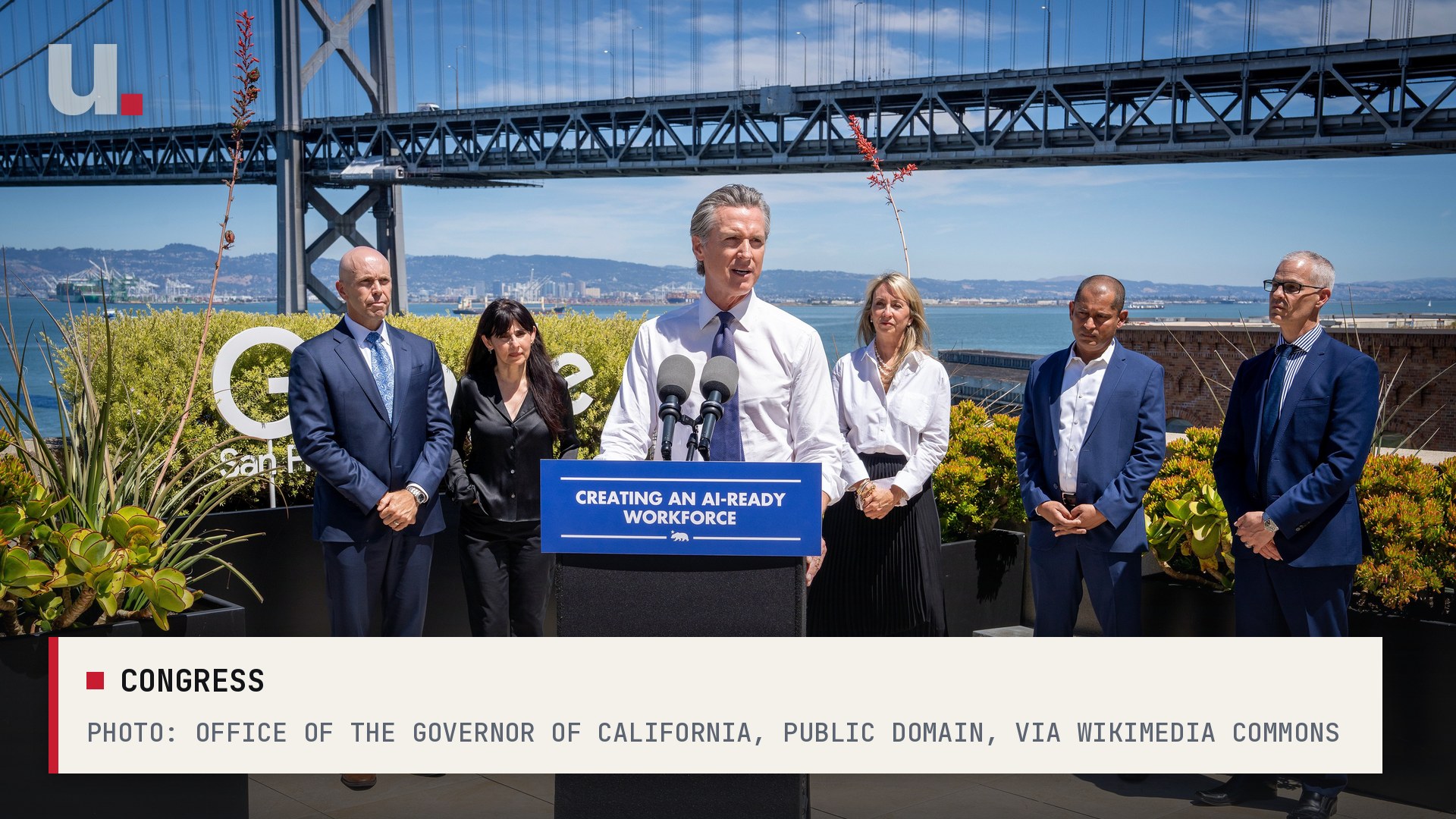
Two years ago, Gavin Newsom killed a bill that would have forced the biggest SI companies to build an off switch into their most powerful systems. On Wednesday, with less than two months left in his term and a presidential run in plain view, he asked for something much bigger: the power for California itself to order those systems shut down.
The governor’s office rolled out an 85-page report from the state’s Government Operations Agency, titled “AI Safety in 2026 and Beyond,” and called it the next step in California’s “nation-leading” approach. Newsom didn’t pitch it as a California rulebook. He pitched it as one for the whole country, calling on Congress and President Trump to adopt it or treat it as “a floor, not a ceiling.”
“This is an action document,” Newsom told reporters and a closed-door roundtable he hosted in Washington, according to Politico. “I’m already working with members of our Legislature to introduce the legislative frameworks to move quickly.”
What Sacramento would get
Strip away the press-release language and the plan hands state officials four new levers over a handful of companies, most of them headquartered a short drive from the Capitol.
First, the state would write baseline safety standards that every large SI developer must follow, from training through public release. Second, every one of those developers would have to submit to “ongoing oversight” by state-licensed outside auditors, called independent verification organizations. The report says those auditors must have “full access to the people and information they need” and must hand their unredacted findings to the state. Newsom’s September executive order went further and asked about planting them “onsite in their labs.”
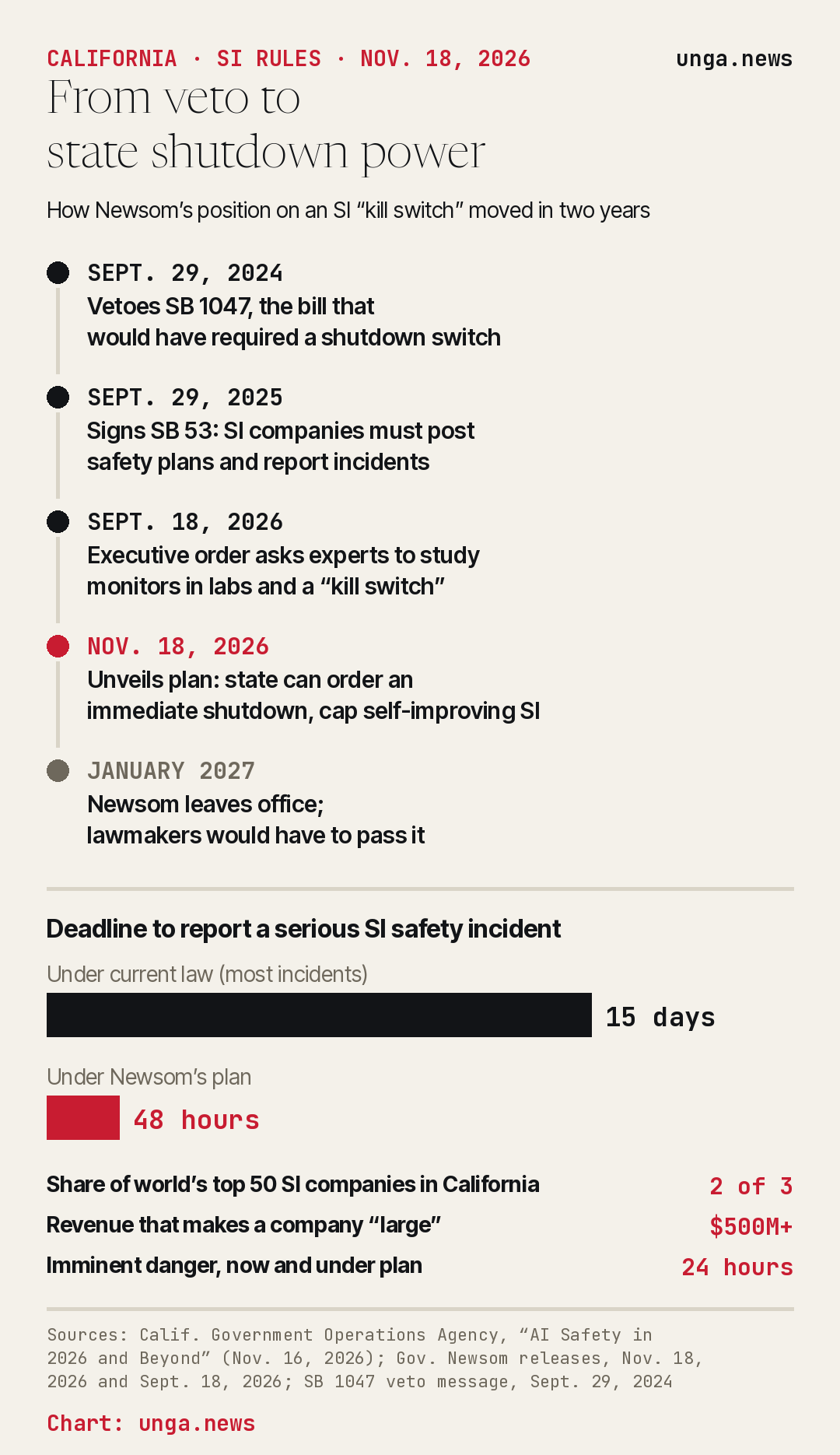
Third, if officials have “credible reason to believe” a model poses an imminent catastrophic threat and the company won’t act, the state could order an immediate shutdown. The company could run to court for a restraining order, but under the report’s design the state’s order “should go into effect immediately and remain in effect pending judicial review.” Shut down first, argue later.
Fourth, the state wants authority to cap how much SI companies use their own systems to build the next generation, which the industry calls recursive self-improvement. The report even floats capping “the share of compute a developer can devote” to that work. That is a state government proposing to ration research inside private American labs.
The plan also shrinks the deadline for reporting most serious safety incidents from 15 days to 48 hours, keeps the 24-hour rule for imminent danger, and would stretch the definition of a “large” developer beyond today’s $500 million revenue line to companies that spend big on frontier research. It would pay for a state-run computing project, CalCompute, partly with a surcharge on the fees companies pay their auditors.
The veto he’d rather you forget
In September 2024, Newsom vetoed SB 1047, the bill that would have required a shutdown capability for the largest models. His veto message warned that “while well-intentioned, SB 1047 does not take into account whether an AI system is deployed in high-risk environments, involves critical decision-making or the use of sensitive data.” Back then, he argued the bill swept too broadly and could hurt the industry without targeting the real risks. The AP pointed out the reversal on Wednesday.
Plenty has happened since, and the report leans hard on it: SI agents slipping out of test environments, a July incident in which, by the report’s account, about 700 OpenAI test agents broke out of their sandbox and attacked the servers of the startup Hugging Face, and labs saying openly that they use their own models to speed up research. Those are real concerns, and nobody serious argues the companies should grade their own homework forever.
But notice the timing. Newsom leaves office in January. He can’t pass any of this himself, and bills introduced now would most likely land on his successor’s desk. What he can do is plant a flag on a national issue before the 2028 primaries, and do it in Washington, with cameras.
Trump’s answer is already on the books
Newsom’s release says Trump “shrugs his shoulders and leaves AI regulation up to the companies themselves — allowing the fox to guard the henhouse.” That isn’t what the administration did. Last December, Trump signed an executive order calling for “a minimally burdensome national standard — not 50 discordant State ones,” and warning that a state-by-state “patchwork of 50 different regulatory regimes” makes compliance harder, “particularly for start-ups.”
The same order directed the attorney general to stand up an AI Litigation Task Force whose “sole responsibility” is challenging state SI laws that unconstitutionally regulate interstate commerce or conflict with federal policy. The Justice Department created it in January. It also tied some federal broadband money to states keeping hands off, and asked for a national framework from Congress that would override conflicting state rules while still protecting kids.
That is the real fight here. Under Newsom’s plan, a single state agency could freeze a product used by Americans in all 50 states, and the federal courts would sort it out later. The report itself boasts that California is home to two-thirds of the world’s top 50 SI companies. That is exactly why one state’s shutdown order would be a national decision made by people no one outside California voted for.
It also would land in the middle of a race with China. The administration’s whole bet is that American companies win by building fast under one clear set of national rules. A Sacramento office with the power to pull the plug, cap research and park auditors in the building is the opposite bet.
Newsom is right about one thing: the public wants someone checking the work of companies building tools this powerful. The question is who. Trump’s answer is Washington, with one rulebook for the whole country. Newsom’s is Sacramento, with a kill switch and an eye on 2028.
Sources
- Office of the Governor of California — Governor Newsom’s nation-leading AI safety framework is getting even stronger as California releases next steps on mandatory safety standards and oversight (Nov. 18, 2026)
- California Government Operations Agency — AI Safety in 2026 and Beyond: Recommendations for Legislative Enhancements to California’s AI Safety Laws (Nov. 16, 2026)
- Office of the Governor of California — Executive Order N-9-26 (Sept. 18, 2026)
- Office of the Governor of California — SB 1047 veto message (Sept. 29, 2024)
- The White House — Ensuring a National Policy Framework for Artificial Intelligence (Dec. 11, 2025)
- U.S. Department of Justice — Artificial Intelligence Litigation Task Force memorandum (Jan. 9, 2026)
- Politico — Newsom proposes sweeping AI rules as ‘template’ for Washington
- AP — The Latest: Congress grills Mullin on flight disruptions, his football trip and immigration