

No Cell Signal? Elon Musk Wants More Teslas Pulling Internet Straight From Space by Late 2027
Musk says built-in Starlink should reach Teslas beyond the Cybercab by the end of next year. The robotaxis now giving rides in Dallas already carry the dish.
Anyone who has driven across Nevada, the Texas Panhandle or a stretch of southern Utah knows the moment. The map freezes, the music cuts out, and the bars on your phone drop to nothing. Elon Musk wants Teslas to stop caring where the nearest cell tower is.
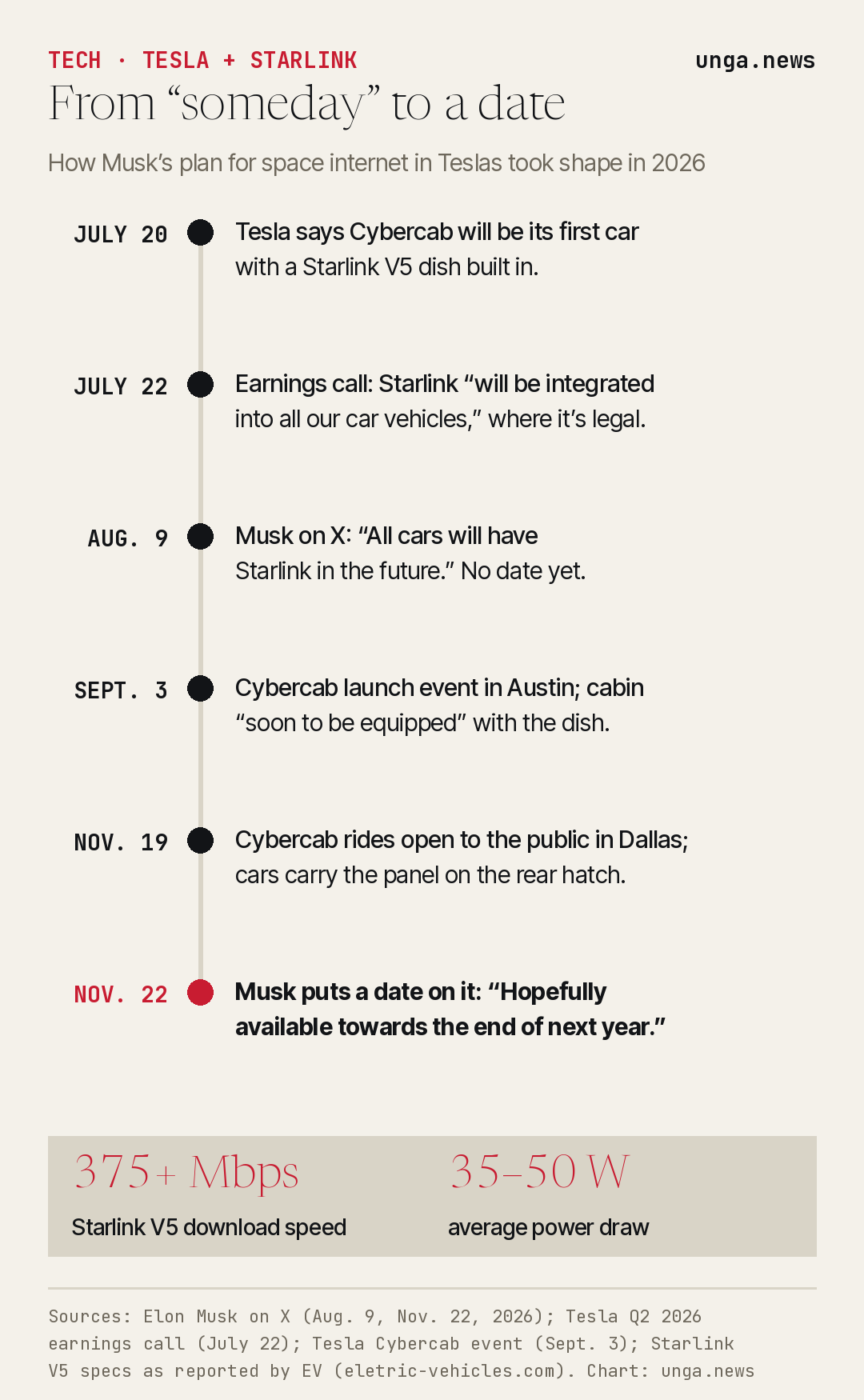
On Sunday night, Musk put the first real date on a promise he has been making since summer: Starlink satellite internet built right into Tesla cars beyond the Cybercab. Payments executive David Marcus, the former PayPal president who now runs Lightspark, wrote on X that he “can’t wait for Tesla to offer an embedded Starlink option in all models.” Musk answered him directly.
Elon Musk on 𝕏 — “Hopefully available towards the end of next year. This will be important for unsupervised FSD, so passengers have high bandwidth everywhere for work and entertainment.” (Nov. 22, 2026)
— @elonmusk View on 𝕏
“Hopefully available towards the end of next year,” Musk wrote. “This will be important for unsupervised FSD, so passengers have high bandwidth everywhere for work and entertainment.” Written in November 2026, that means late 2027. In a follow-up reply to Tesla investor Sawyer Merritt, he added one exception: “Except in China, as Starlink is illegal there.”
A dish that already rides in the trunk lid
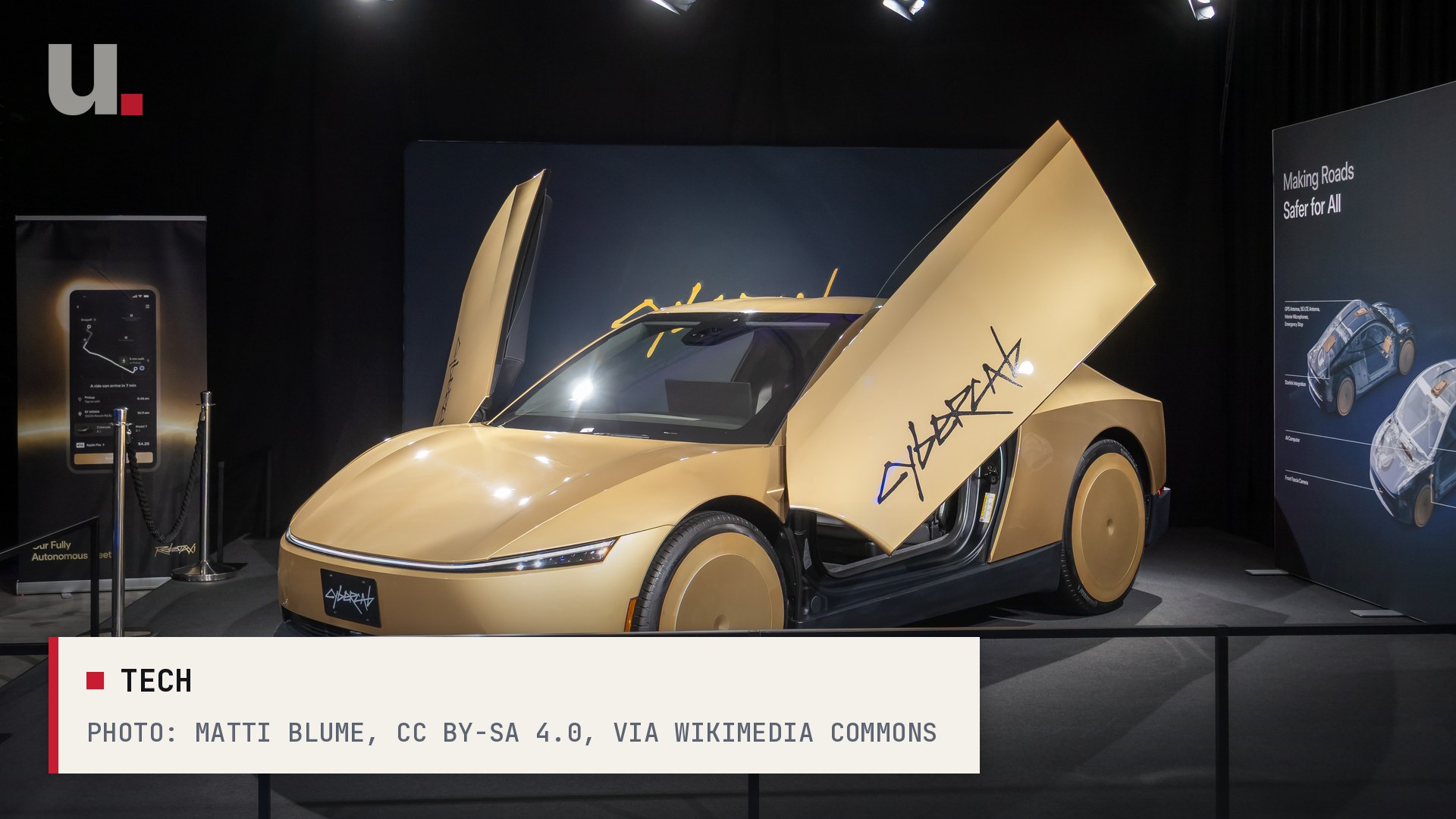
This is not a slide-deck idea. The hardware is already on the road. The Cybercab, Tesla’s two-seat robotaxi with no steering wheel, started public rides in Dallas on Nov. 19, and those cars carry a rectangular Starlink panel on the rear hatch. Tesla’s own Cybercab first-responder guide, version 1.3, dated Nov. 20, tells firefighters and police that cabs built starting this month have “a Starlink integration embedded in the trunk lid, which helps provide more reliable connectivity,” according to GetTesla, which reviewed the document.
The panel is based on Starlink V5, the dish SpaceX rolled out in July. Starlink lists it at download speeds of 375 megabits per second or more, with average power draw of 35 to 50 watts, about half of what the previous dish used. That is more than enough to stream a 4K game in the back seat, and a small sip from a battery pack that runs the whole car.
Riders can’t log on to it yet. Merritt noted the Dallas cabs “already have this, although it doesn’t seem like riders can connect to it yet,” and Tesla hasn’t said when passenger Wi-Fi switches on. Right now the link handles the car’s own business.
Why a robotaxi can’t live on cell towers
Musk laid out the reasoning on Tesla’s second-quarter earnings call on July 22. “Starlink will be integrated into all our car vehicles, at least for markets that Starlink is active,” he said, as reported by EV. “For a Robotaxi situation, you need to have coverage everywhere,” including places “where the cellular coverage is terrible or sometimes non-existent.”
Then came the line that sums up the whole plan: “We can’t have Robotaxis getting stuck in these Bermuda Triangles of lack of cellular connectivity.”
That is the practical case. A car with no driver still has to check in with home base, pull fresh maps, reach a human support agent when a rider presses the help button, and get routed to the next fare. Cell coverage in America is patchy once you leave the interstate. Satellites overhead are not.
Tesla’s own software chief has been careful to say what the link is not for. “It is still not required for safe operation of the vehicle,” Ashok Elluswamy, Tesla’s vice president of AI software, wrote on X after the July announcement. “Connectivity is primarily meant for navigation, customer service and, in general, fleet management.” In plain terms, the car drives itself with the brain on board. Starlink keeps it connected to everything else.
For passengers, Musk’s pitch is simpler. Once the cars truly drive themselves, the back seat becomes an office or a living room, and nobody wants a video call dropping on a mountain pass. On the July call he put it in sports-fan terms: “With Starlink, you can watch 4K live sports in the car.”
What Tesla owners don’t know yet
Musk was answering a question about future models, and he kept it to that. He didn’t name which cars come first, whether the dish will be standard or an add-on, what a monthly plan would cost, or whether a Model 3 or Model Y already in your garage could be fitted with one. Tesla hasn’t published a retrofit program. Anyone who owns a Tesla today should treat Sunday’s post as a target for new cars, not a promise for theirs.
There are engineering questions too. Starlink’s support page says the home version of V5 is “not intended for in-motion use,” and Tesla hasn’t said whether the Cybercab’s unit was reworked for highway speeds. Fitting a flat panel into a Model Y with a big glass roof is a different job from building one into a car designed around it from day one. Those are the kinds of problems Tesla and SpaceX, both run by Musk, have a long record of solving faster than anyone predicted.
The China line matters more than it looks. Starlink is banned there, so Tesla’s biggest overseas market won’t get the feature. That cuts the other way, too. Beijing’s carmakers are pushing hard into markets around the world, and none of them can offer a car wired into an American satellite network that already covers most of the globe.
The only carmaker with its own sky
No other car company can do this. Ford, GM and Toyota rent their connectivity from phone carriers. Tesla’s sister company owns the largest satellite constellation in history, and Musk said on the July call that Tesla could even “use the Starlink terminals that are in the Tesla cars as cell towers,” turning a fleet of parked cars into a moving network.
Back in August, Musk wrote that “all cars will have Starlink in the future,” calling it “the only way to get super high bandwidth to billions of vehicles.” For months that was a vision without a calendar. Now there’s a calendar, with a “hopefully” attached, and a robotaxi in Dallas already carrying the dish.
If late 2027 holds, the dead zone on the drive to grandma’s house becomes somebody else’s problem.
Sources
- Elon Musk on 𝕏 — “Hopefully available towards the end of next year…” (Nov. 22, 2026)
- Elon Musk on 𝕏 — “Except in China, as Starlink is illegal there” (Nov. 22, 2026)
- EV (eletric-vehicles.com) — Musk Says Tesla Hopes to Offer Built-In Starlink Beyond Cybercab by Late 2027 (Q2 call quotes, Elluswamy post, V5 specs)
- GetTesla — Tesla Starlink for All Models Hopefully by Late 2027 (Cybercab First Responder Interaction Plan v1.3)