

No Surgery, Just a Cap: Startup Turns Brain Waves Into a Picture of What You’re Focusing On
Alljoined’s new SI read a man’s brain signals through his scalp and drew the object he was concentrating on, live, without him moving or saying a word.

A man sits in a chair wearing what looks like a swim cap full of wires. He doesn’t move. He doesn’t speak. A few feet away, a big screen goes from blank to a potted plant, drawn from scratch by a computer, because that’s the object he was concentrating on.
That’s the demo a San Francisco startup called Alljoined put out Tuesday, and it’s been passed around all day. The company calls the system AIR-O and says it is “a model that decodes what a person is attending to directly from brain scans.” No implant and no surgery. The signal comes through the scalp.
Alljoined on 𝕏: “Introducing AIR-O, a model that decodes what a person is attending to directly from brain scans.”
— @alljoined View on 𝕏
The post had drawn more than 160,000 views and about 2,000 likes by evening, plus more than 1,200 bookmarks. That last number tells you people want to come back to this one.
What the cap is actually picking up
The cap is an EEG, the same basic tool hospitals use to check for seizures. It reads tiny electrical ripples from the brain through the skin, measured in millionths of a volt. That signal is weak and noisy, which is why most of the jaw-dropping “mind reading” results of recent years came from giant MRI scanners or from implants placed inside the skull.
Alljoined’s bet is that smarter software can pull more out of the cheap signal. In replies on 𝕏, the company explained that the demo runs only two neural networks. The first is its own decoder, which turns the brain-wave readings into a kind of digital fingerprint of the concept the person is focused on. The second is an off-the-shelf SI image generator that the company didn’t build and didn’t change. It just paints whatever the fingerprint describes.
“The challenge is not image gen,” the company wrote. The hard part is “regressing out the minute signal from microvolts of signal to something reliably able to infer what concept you are focusing on.”
That also clears up what AIR-O isn’t. It doesn’t read words. When a viewer asked whether the man in the video was thinking of a word, the company answered, “Mario is not thinking a word. He is concentrating on a particular object, and we were able to infer this when he did not move or say anything.” The picture on screen is the computer’s version of that object. It isn’t a photograph of the thought.
A $2,200 kit and a $50,000 amplifier
Price is the part that could matter most for regular people. Alljoined built its name on a giant public dataset called Alljoined-1.6M, described in a paper the company says is peer-reviewed. It holds more than 1.6 million recorded trials from 20 people looking at images, more than twice the size of the most popular benchmark in the field. It was recorded on a 32-channel consumer-grade system costing about $2,200, which the authors say is around 27 times cheaper than the research gear most neuroscience labs use.
The paper found that decoding improved steadily as more data was added. That’s the same pattern that made today’s chatbots work, and it’s why the company keeps collecting.
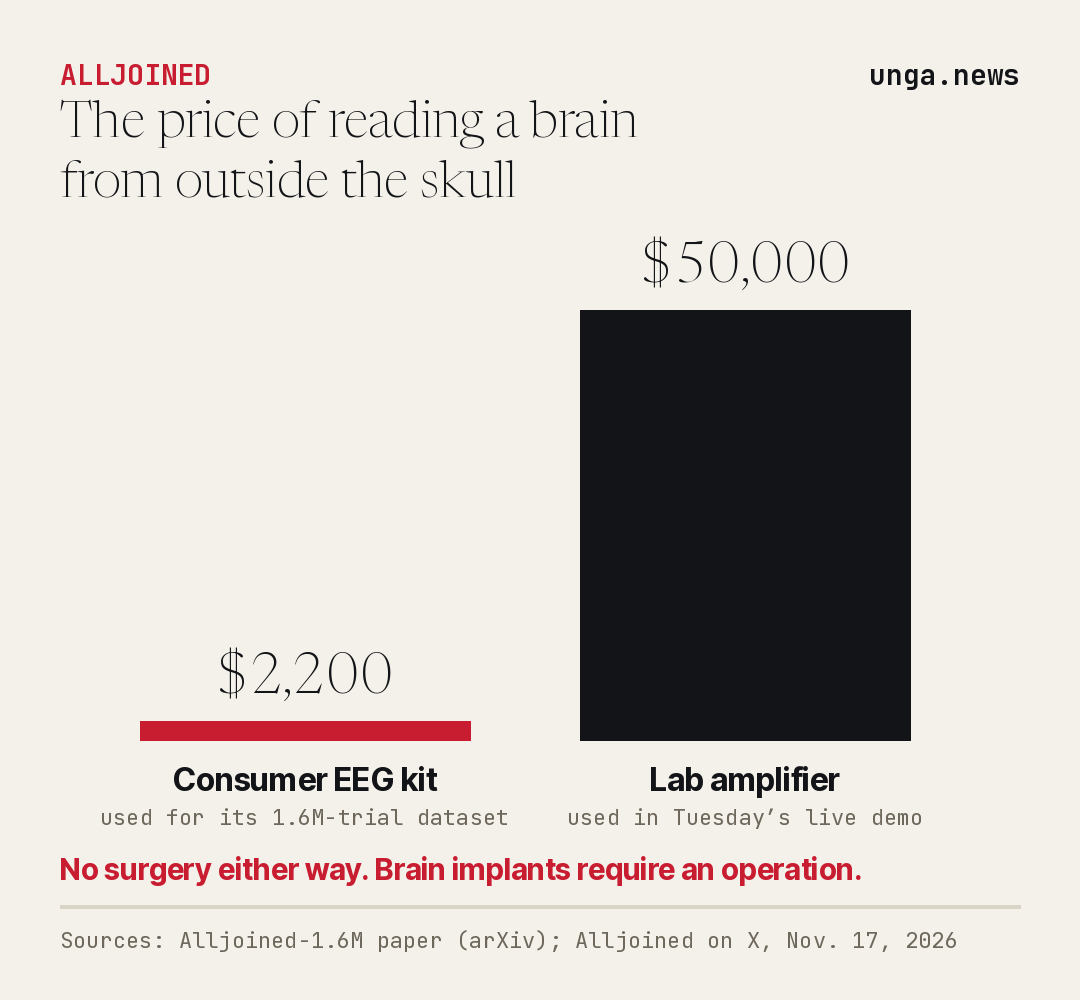
The live demo wasn’t done on the bargain kit, though, and the company was upfront about it. Asked about the hardware, Alljoined said the cap is “very cheap,” but the amplifier is a BrainVision actiCHamp Plus, which it called “a $50k” unit. “The hardware has not changed,” it wrote. “Our focus is on building models that can extract weaker signal from such data.”
Earlier this year the company also released a model called ENIGMA. It said that model could adapt to a brand-new user in minutes rather than the hours of calibration older systems needed. Every brain is wired a little differently, so that kind of speed is what separates a lab trick from something you could put on a stranger and use the same day.
A demo is not a measurement
Be clear about what this is. AIR-O is a company demo video, and Alljoined hasn’t published accuracy numbers for this specific system alongside it. It hasn’t said how often the system gets the object right or how many tries a clean result takes. Until outside researchers can test it, the honest description is a promising showing, not a proven product.
The team does have real credentials. Alljoined says it started about three years ago, and its seed round was led by Khosla Ventures, with Conviction and several other firms joining. Founder Jonathan Xu previously worked on MindEye2, a well-known project that rebuilt images people had seen from MRI brain scans, according to a post from @iScienceLuvr, who worked with him on it.
The two paths to reading the brain are now moving at once. Implants like Neuralink’s sit right on the neurons and give the strongest signal, and they’ve already let paralyzed patients control computers with their thoughts. A cap gives a far weaker signal, but anyone can put one on in a few minutes and take it off again.
If software keeps closing that gap, the payoff is easy to picture. A stroke patient who can’t speak could point at what they need just by looking at it and thinking. Somebody will also have to decide who gets to see the readout. A cap that can tell what you’re focused on is a medical breakthrough in a hospital, and it raises harder questions anywhere else.
Sources
- Alljoined on 𝕏 — Introducing AIR-O
- Alljoined on 𝕏 — Reply on hardware: “This is a $50k BrainVision ActiChamp Plus”
- Alljoined on 𝕏 — Reply on method and paper
- arXiv — Alljoined-1.6M: A Million-Trial EEG-Image Dataset for Evaluating Affordable Brain-Computer Interfaces
- Alljoined Blog — Toward accessible, real-time brain decoding: Introducing ENIGMA