

North Carolina Republicans Get Seven More Weeks Running the House. Permitless Carry and $1 Billion Are on the Table.
Lawmakers return Monday with five of Gov. Josh Stein’s vetoes still alive, hundreds of board seats to fill and a new property-tax cap to write. House Republicans are one vote short, unless two members stay home.

Monday morning, North Carolina’s Republican lawmakers walk back into the Legislative Building in Raleigh with something they won’t have for long: the majorities they’ve held in both chambers for more than a decade. Their terms run through the end of December. New members take their seats in January, and the House changes hands.
So the next seven weeks are the last stretch, for a good while, in which the Republican caucus can pass what it wants without first striking a deal across the aisle. The calendar is already set. Lawmakers meet Nov. 16 through 19, then come back Nov. 30 for a final session that can run as late as Dec. 18.
Nobody has posted an agenda. CBS 17 asked Republican leaders on Friday whether override votes or changes to appointment powers are planned and hadn’t heard back. But the adjournment resolution the legislature passed earlier this year spells out what’s allowed: veto overrides, certain appointments, constitutional amendments, election laws, compromise conference reports, and bills that only need one chamber to agree.
Inside that fence sits a long list of unfinished business.
Five vetoes still waiting
Gov. Josh Stein, a Democrat, has spent two years using his veto pen on the Republican agenda. Four of those vetoes are still eligible for a vote in the House, according to Carolina Journal.
The biggest is Senate Bill 50, “Freedom to Carry NC,” which would let eligible adults carry a concealed handgun without first getting a state permit. Roughly half the states already work that way. The North Carolina Senate has overridden Stein’s veto. The House never finished the job.
House Bill 958 would trim a week of early voting in primary elections and allow more post-election ballot challenges. Speaker Destin Hall said earlier this year that Republicans would try to override that one after the election. House Bill 377 would let the chief justice of the state Supreme Court suspend trial judges without pay; Stein vetoed it in August, calling it a threat to judicial independence. House Bill 437 would restrict camping on public property and deals with drug-free zones. Stein said it would criminalize homelessness and stick local governments with the bill.
The fifth sits in the Senate. House Bill 171 would ban diversity, equity and inclusion programs in state government. The House overrode Stein’s veto back in June. The Senate never took its vote.
The math comes down to one seat and who shows up
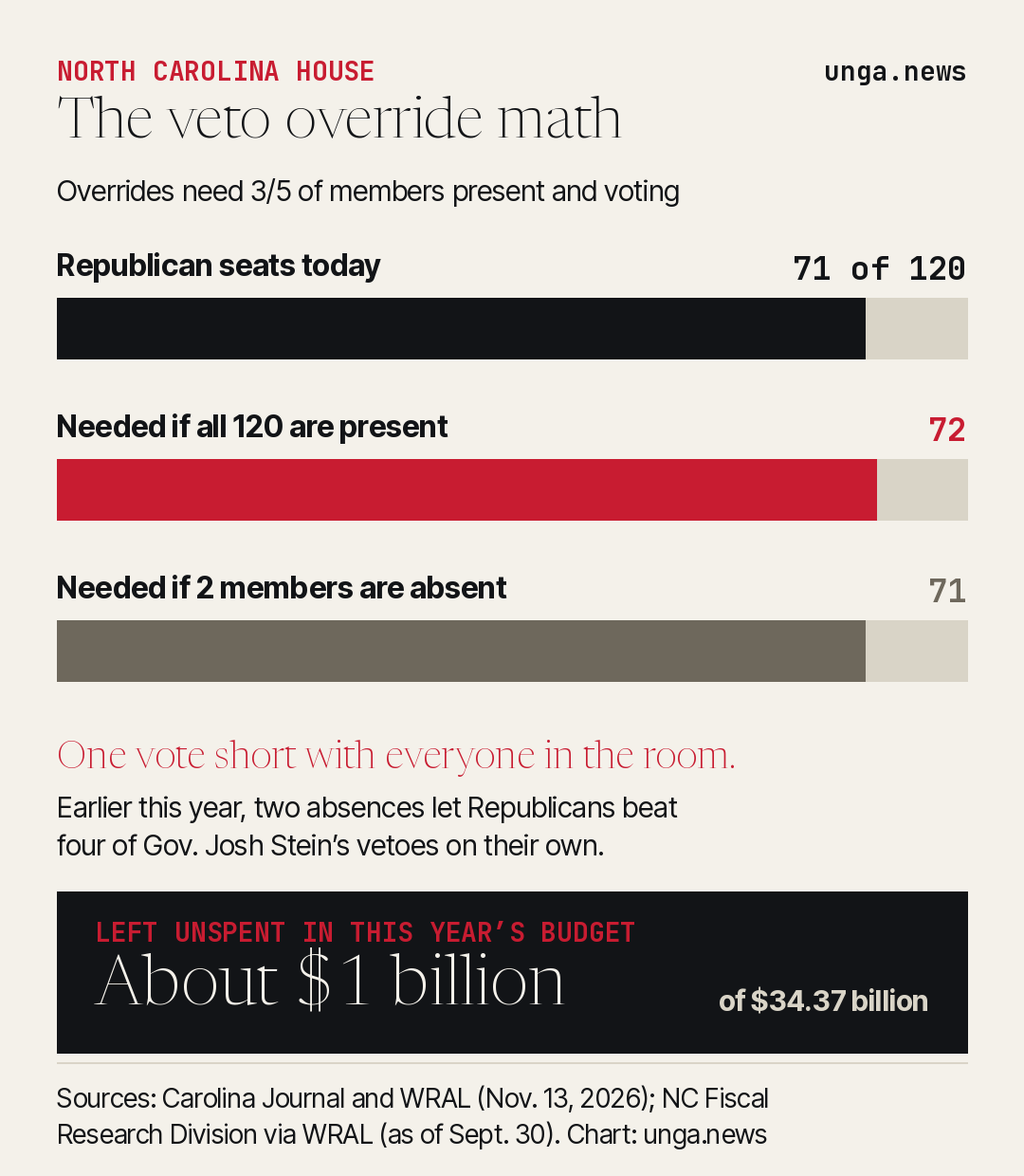
Here’s the problem for every one of those House overrides. Republicans hold 71 of the 120 seats. Overriding a veto takes three-fifths of the members present and voting, which is 72 if everyone is in the room.
That one-vote gap hasn’t always stopped them. Earlier this year House Republicans beat four Stein vetoes after two members, Reps. Carla Cunningham of Mecklenburg County and Shelly Willingham of Edgecombe County, were absent. With 118 members present, the bar dropped to 71, and Republicans cleared it on their own.
Both of those members lost their Democratic primaries in March after taking heat from their own party for siding with Republicans on key votes. Cunningham has since left the party and is now unaffiliated. Neither will be back in January. But both still hold their seats until then, which is exactly why their attendance matters this month.
WRAL put the other half of the equation plainly. Any successful override would take perfect attendance and a united Republican caucus if every Democrat shows up. That is a tall order in a session squeezed around Thanksgiving, with members who are retiring or headed out the door.
Political scientist Chris Cooper doubts it happens. “They have not had the votes. And so if they haven’t had the votes before, I seriously doubt they’re going to have the votes now at this point in the session,” he told CBS 17 about the carry bill.
A billion dollars and hundreds of open seats
The less flashy work may matter more. The state went more than a year without a budget before leaders agreed this summer on $34.37 billion in spending. They left about $1 billion of General Fund money unspent, according to the legislature’s Fiscal Research Division.
Hall’s spokeswoman, Demi Dowdy, told WRAL that more Hurricane Helene recovery money will be considered, along with extra funding for state agencies that had to cut jobs under the budget. Carolina Journal lists other ideas floating around: more for the new children’s hospital in Apex and a proposed Major League Baseball stadium in Raleigh that didn’t make the final budget.
That billion dollars is there because Republican leaders spent years building reserves instead of spending every dime. They get to decide, one more time, what to do with it.
Then there are appointments. Legislative leaders fill seats on hundreds of state boards and commissions, including the boards that govern public universities. WRAL reports Hall’s top priority for the week of Nov. 16 is filling as many vacancies as possible before January. Those terms outlast the session.
The tax cap voters just approved
One more item could follow every homeowner in the state. On Nov. 3, voters approved a constitutional amendment limiting how much local governments can raise property tax levies. The amendment orders the legislature to set that limit in law, but it gives no formula and no deadline.
Incoming House Democratic leader Robert Reives and most Democratic lawmakers opposed the amendment. If Republicans don’t write the rules before January, Carolina Journal notes, the new House could slow-walk them or push for looser limits with more exceptions. Writing the cap now is the surest way to make the vote voters just cast actually bite.
Reives wants the opposite. “You walk into this lame duck session and you do the bare minimum that you need to do,” he said, warning that a contentious session would signal “there is no interest in working with us.”
That’s a request, not a rule. Republicans were elected to two-year terms, and those terms don’t end in November. Senate leader Phil Berger, who lost his March primary, is serving his final weeks. Monday tells everyone how hard he and Hall plan to use them.
Sources
- Carolina Journal — NC House Republicans weigh final moves before Democrats take control (Nov. 13, 2026)
- WRAL — NC Republicans return to Raleigh next week before losing power. Here’s what they’ll try to do (Nov. 13, 2026)
- CBS 17 (WNCN) — NC lame-duck session: What’s at stake as Democrats prepare to take House (Nov. 14, 2026)
- HERE Raleigh — Lame-Duck GOP Majority Returns to NC Legislature (Nov. 14, 2026)
- North Carolina General Assembly — Senate Bill 50 (2025-2026 Session), Freedom to Carry NC