

North Korea Stole $6.3 Billion in Crypto. The Exchange Paid It Back Itself and Just Reopened Withdrawals.
Four weeks after the biggest crypto heist ever, Binance says customers didn’t lose a cent, its reserves are open for anyone to check, and money can move again.
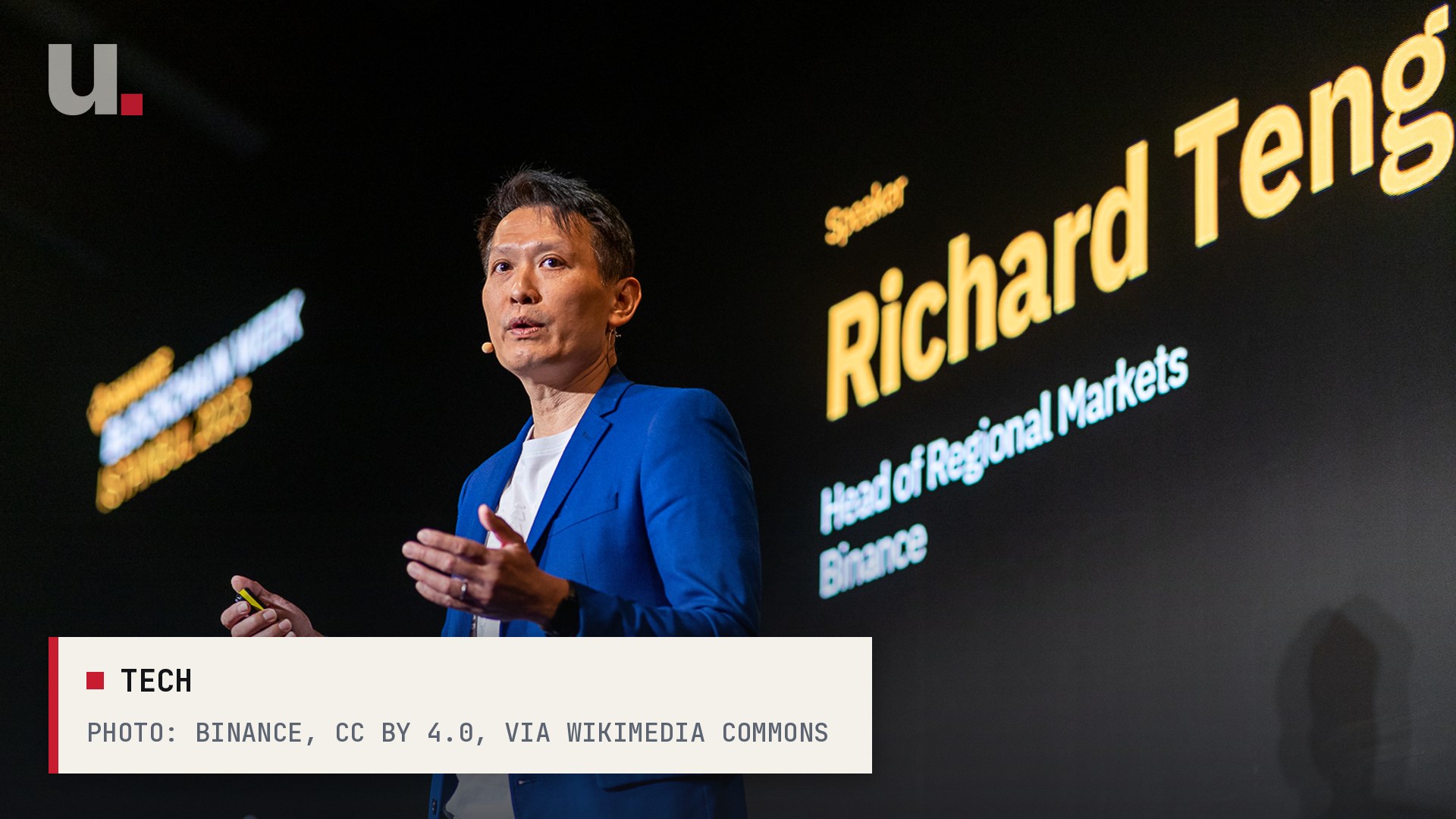
A month ago, North Korean hackers pulled off the biggest crypto robbery ever recorded, draining about $6.3 billion from Binance, the world’s largest crypto exchange, in about 20 minutes, investigators said. Customers who woke up to frozen accounts had every reason to expect the worst. Instead, Binance now says the money is back, the books are open for anyone to check, and every customer can move their coins out again.
“Our withdrawal recovery work is completed and the withdrawal suspension from the October security incident has been fully lifted,” the company said in a Nov. 26 notice to users. A small number of networks are still paused for routine maintenance or planned upgrades, which Binance says has nothing to do with the hack and touches “a very small percentage of regular traffic.”
Binance on 𝕏, Nov. 26, 2026: the exchange announces its withdrawal recovery work is complete and the hack suspension is fully lifted.
— @binance View on 𝕏
Withdrawals are simply how customers pull their crypto off the exchange and into a wallet they control. When those stop, people panic, because the last time a giant exchange froze withdrawals, in November 2022, it was FTX, and the money was already gone.
Here is how we got here. On Oct. 29, an attacker sent out billions in withdrawals nobody had approved. Binance said about $6.34 billion in assets were hit and roughly $3 billion was frozen before it could get away. Blockchain investigators tied the theft to North Korea’s TraderTraitor hacking crew, as we reported at the time. Two weeks later, the Justice Department moved to seize more than $1.2 billion of the loot, a story we covered here.
Paid back out of the company’s own pocket
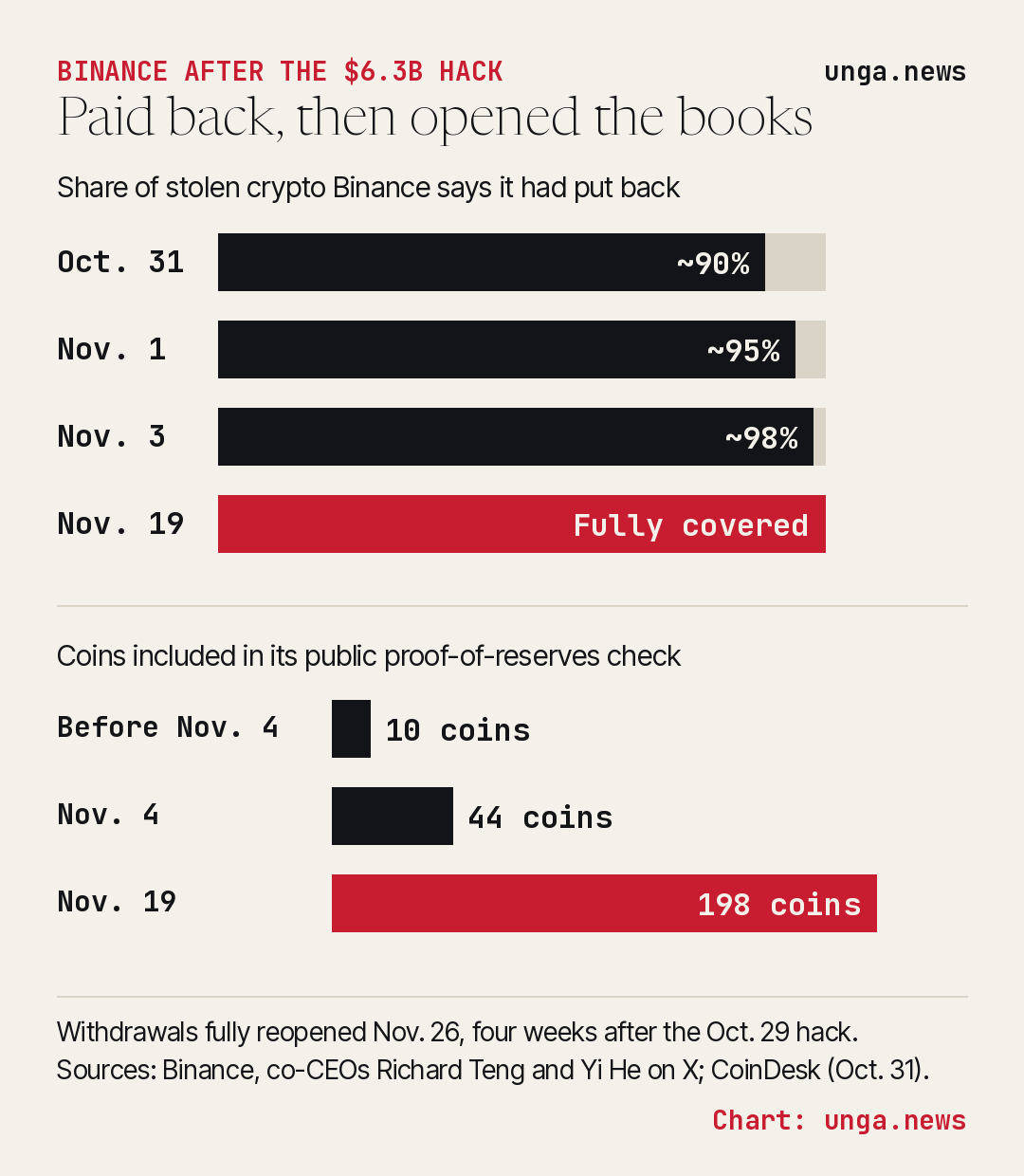
The part that matters most to regular people is who ate the loss. It wasn’t customers. Co-CEO Yi He promised within hours to cover “all hacking losses,” CoinDesk reported. By Oct. 31, Binance said it had put back about 90% of the stolen crypto, using its own money and its SAFU fund, an emergency reserve it built for exactly this kind of day.
Co-CEO Richard Teng posted on Nov. 1 that about 95% was replenished. On Nov. 3 he said 98%, and he was blunt about it: “We take full responsibility and we’re making it right. No user bears the loss.” By Nov. 19, the company’s own question-and-answer post said “affected user balances were fully covered.”
Think about what did not happen here. Nobody passed a bailout. No taxpayer dollar went in. No bankruptcy judge spent years deciding which customers get pennies on the dollar. FTX customers waited until 2025 to start getting bankruptcy payouts, and FTX founder Sam Bankman-Fried is serving 25 years for fraud. A private company with real reserves took the hit, refilled the accounts, and got back to business. That is the free market working the way conservatives always said it could, even in an industry the last administration treated like a crime scene.
Don’t trust them. Check them.
Promises are cheap in crypto, so Binance leaned on proof. “The difference is verification, not just promises,” Teng said of his CNBC interview on Nov. 3.
The tool is called Proof of Reserves. In plain terms, it is a snapshot that compares what Binance holds against what it owes customers, and each user can look up whether their own balance was counted. Binance says every customer asset is backed at least one-to-one, meaning a dollar in the vault for every dollar in an account. Right after the hack, the check covered just 10 coins. Yi He announced a fresh snapshot on Nov. 4 covering 44. By Nov. 19, it covered 198. Anyone with an account can run the check themselves in the app under Wallet, then Verification.
Snapshots are not the same as a full outside audit, and smart customers should keep that in mind. But it gives every account holder a way to check their own balance instead of taking the company’s word for it.
The reopening itself went slowly on purpose. Bitcoin came back first on Nov. 1, followed the same day by the big dollar-pegged coins, USDC and USDT, plus ETH and BNB, on the Ethereum and BNB Smart Chain networks. More dollar coins came back on Nov. 3. On Nov. 6, Binance set a goal of restoring withdrawals for six more coins, including Litecoin, by the end of the following week, along with every coin on networks that were already fixed. The Nov. 26 notice closed out the job.
How one laptop opened the door
The way the thieves got in should worry every company, not just crypto shops. Teng said early on that the break-in “may have started with a compromised DevOps engineer’s laptop.” In a Nov. 3 report, Binance said the attackers used fake job interviews, malicious software and compromised internal SI tools to reach the systems that control its wallets. That is the same playbook federal investigators keep tying to North Korea: pose as a recruiter or a colleague, get one employee to run one file, and work inward from there.
The scammers come next
Big hacks draw a second wave of crooks, and Binance is warning users ahead of it. The company says it will never contact anyone to “speed up withdrawals,” offer “priority processing,” or move money into a “Binance vault.” It will never ask for a password, a two-factor code or a seed phrase, the list of words that unlocks a crypto wallet. If a message asks for any of that, it is not Binance.
None of this changes the rough month crypto prices are having. Bitcoin traded near $59,500 on Saturday after briefly falling to a two-year low last week, and investors have pulled a record $5.78 billion out of U.S. bitcoin funds in November through Friday, according to Farside Investors figures cited by Investing.com.
But prices go up and down. What customers will remember is that the biggest theft in crypto history ended with their balances whole, more than $1.2 billion of the loot in the sights of American prosecutors, and the exchange showing its work instead of asking for blind faith.
Sources
- Binance — Service Recovery Update: Withdrawals Recovery Work Complete (2026-11-26)
- Binance on 𝕏 — Service Recovery Update: withdrawal suspension fully lifted (Nov. 26, 2026)
- Binance on 𝕏 — 29 October Binance Security Incident: Initial Findings and Response Update (Nov. 3, 2026)
- Binance on 𝕏 — Security Incident Recovery Update #7: 98% of Stolen Assets Covered; New & Expanded PoR Snapshot (Nov. 4, 2026)
- Binance on 𝕏 — Security incident FAQ: how Binance replenished the full ~$6.3B (Nov. 19, 2026)
- Binance on 𝕏 — Proof of Reserves snapshot now covers 198 tokens (Nov. 19, 2026)
- Binance on 𝕏 — Withdrawal Update: Ethereum and BNB Smart Chain assets restored (Nov. 1, 2026)
- Binance on 𝕏 — Update: reopening withdrawals for HYPE, INJ, APT, PLASMA, NEAR, LTC (Nov. 6, 2026)
- Richard Teng on 𝕏 — “We take full responsibility and we’re making it right. No user bears the loss.” (Nov. 3, 2026)
- Richard Teng on 𝕏 — “The difference is verification, not just promises.” 98% replenished (Nov. 3, 2026)
- Richard Teng on 𝕏 — Phased resumption of withdrawals; ~95% of impacted assets replenished (Nov. 1, 2026)
- Richard Teng on 𝕏 — Initial account of the Oct. 29 security incident (Oct. 30, 2026)
- Yi He on 𝕏 — New Proof of Reserves snapshot covers 44 tokens, up from 10 (Nov. 4, 2026)
- CoinDesk — Binance says customer withdrawals are fully restored, four weeks after the $6.3 billion hack (Nov. 26, 2026)
- Investing.com — Bitcoin pares losses near $59,500 after volatile week as ETF outflows persist (Nov. 28, 2026)
- U.S. Department of Justice — Justice Department Announces Actions to Disrupt North Korea’s Massive Theft of Cryptocurrency (Nov. 12, 2026)