

Nvidia Puts Its Board in Charge of Keeping Its Best SI Chips Out of China
Hours before its first earnings report without Jensen Huang, Nvidia created a board committee to oversee export controls, with its compliance teams reporting straight to it.

Nvidia’s board on Tuesday set up a new committee whose whole job is making sure the world’s most valuable SI chips don’t end up where U.S. law says they can’t go. The company announced the National Security and Export Control Oversight Committee hours before it reports quarterly results after the closing bell, its first earnings report since Jensen Huang stepped down as chief executive.
The timing is not subtle. Nvidia has spent the last week answering questions about its founder’s personal life, a Singapore data-center customer and whether its top chips have been leaking into China. Tuesday’s move is the board’s answer to the people who matter most for that question: the federal government and the investors watching tonight’s numbers.
A committee that answers to the board, not the sales team
The new group is a standing committee of the board, the same rank as the audit or pay committees every public company has. It is responsible for “board-level oversight of the company’s national security policies, export control compliance and global trade risk management,” Nvidia said.
Director Suzanne Nora Johnson will chair it. Directors Stephen C. Neal and John O. Dabiri join her. The committee will meet at least four times a year, including sessions with managers and closed-door sessions without them.
Two internal groups change who they report to. Nvidia’s National Security Team and its Global Trade Compliance Team will now report directly to the committee, and to interim chief executive Colette Kress for day-to-day work. The committee will also hire independent outside experts in law, national security and trade compliance to back it up.
That reporting line is the real change. Compliance staff who used to answer up through management now have a straight line to directors who don’t run the business and don’t answer for quarterly sales.
“NVIDIA recognizes that advanced silicon technologies and the emergence of artificial and superintelligence present unprecedented challenges for national security,” board chairman Harvey Jones said in the announcement. “As the world’s leading advanced computing company, NVIDIA has both a responsibility and an opportunity to lead the industry in addressing these challenges.”
Jones said the company wants to work “constructively with government and industry partners to help establish and advance a robust framework that uses every tool at our disposal to safeguard national security while supporting continued technological innovation.”
How Nvidia got here
Huang resigned last week after reports that he had a relationship with a woman U.S. authorities suspect of spying for China, along with a relationship with a subordinate at the company. The spying claim is still an allegation. According to CBS News, the woman, Alice Huang (no relation), had worked for Megaspeed, a Singapore-based data-center company that bought billions of dollars’ worth of Nvidia chips.
That customer is the sore spot. Washington bars sales of Nvidia’s highest-end SI chips to China. But a company in China doesn’t have to buy a chip to use one. It can rent computing time from a data center in Singapore or elsewhere in Southeast Asia. That rental route is exactly what worries lawmakers, and it is why Republicans in Congress want Huang to testify before Thanksgiving.
Washington moved on the same problem from its side on Monday. The Commerce Department’s Bureau of Industry and Security issued an interim rule that closes the rental loophole for advanced chips, starting Nov. 19. Nvidia’s committee lands one day later, and it reads as a company trying to show it will police the same line from the inside.
Last week a former OpenAI researcher, Will Depue, also published what he called forensic evidence that China’s top SI labs trained their newest models on Nvidia’s Blackwell chips, which are banned from export there. Nvidia has not been accused by the government of breaking export law. But the drumbeat of questions has been loud enough that the board clearly decided waiting was the bigger risk.
The stand-in boss faces Wall Street
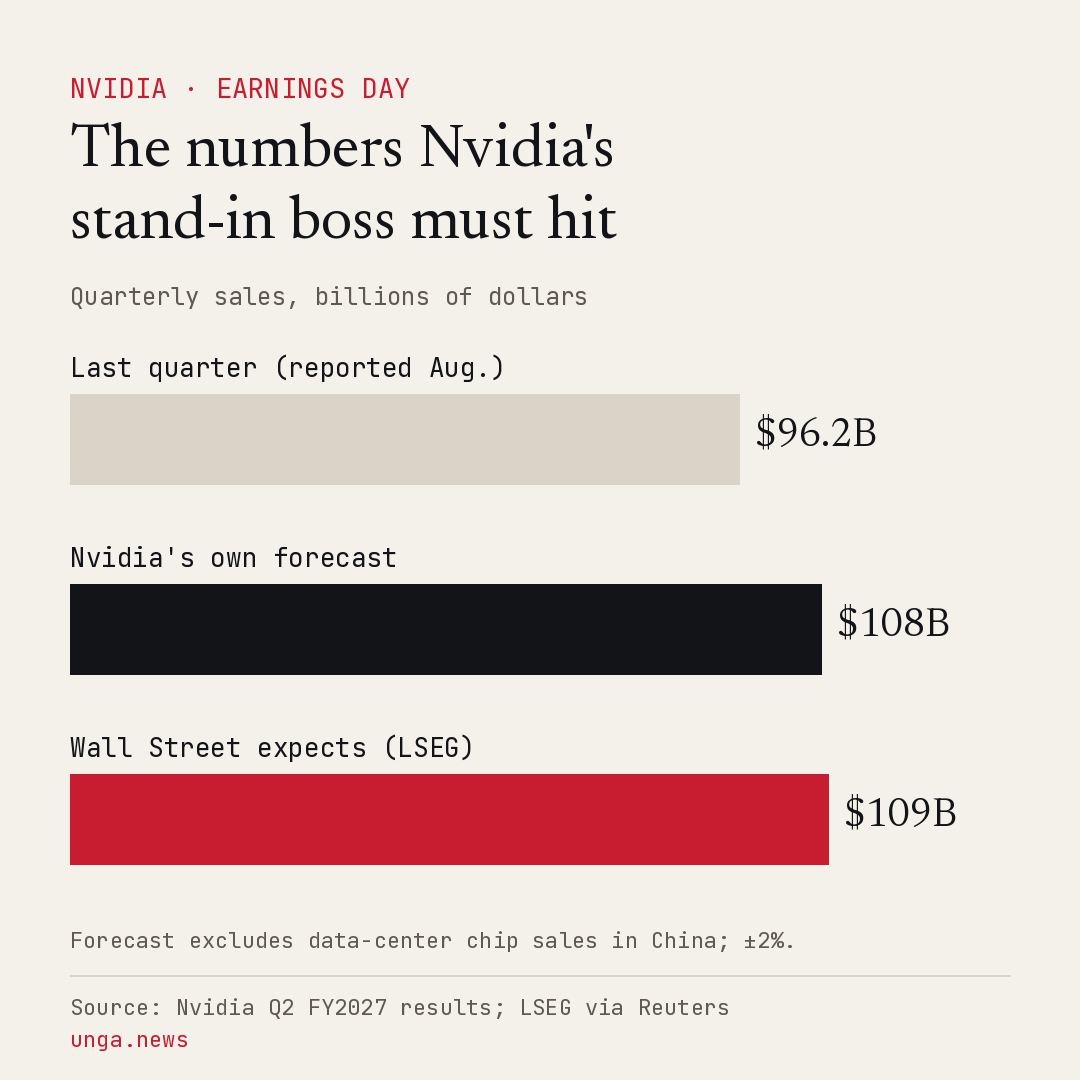
Kress, Nvidia’s longtime chief financial officer, now carries both jobs into Tuesday’s call. In its last report in August, Nvidia said it brought in $96.2 billion over three months, up 106% from a year earlier, and $89 billion of that came from data-center chips. It told investors to expect about $108 billion this quarter, give or take 2%, without counting data-center chip sales in China. Analysts polled by LSEG expect a little more, about $109 billion.
The sales line isn’t what has investors nervous. Nvidia was worth about $5.8 trillion in early October and about $3.9 trillion by last Friday’s close, according to LSEG data cited by Reuters. That is roughly $1.9 trillion gone in six weeks while revenue kept climbing. Much of that slide tracks the questions about leadership and China, not the business itself.
A board committee won’t settle those questions tonight. What it does give Kress is something to point to when analysts ask whether the company has a handle on its export risk: a named chair, named members, a meeting schedule, outside experts and compliance teams that report to directors instead of to salespeople.
Who else is watching
The biggest buyers of Nvidia chips are watching too. Elon Musk, whose companies are among the largest customers for Nvidia hardware anywhere, argued over the weekend that much of Nvidia’s edge came from trust built person to person with Huang, the kind of deal that never shows up in a filing. A board committee is the opposite of a handshake. It is paperwork, schedules and reporting lines, the slow machinery a company builds when the founder isn’t there to vouch for it.
Nvidia reports after the market closes Tuesday. The committee’s first job is already clear from the calendar. Commerce’s new rental rule takes effect Wednesday, and every Nvidia customer running data centers in Southeast Asia will want to know how hard the company plans to check who is renting its chips.
Sources
- Nvidia — NVIDIA Board of Directors Establishes National Security and Export Control Oversight Committee
- CBS News — Nvidia's board forms export oversight panel after scrutiny over China chip sales
- AP — Nvidia establishes committee to oversee national security after abrupt departure of CEO Jensen Huang
- Nvidia — NVIDIA Announces Financial Results for Second Quarter Fiscal 2027
- Reuters via Devdiscourse — Wall St Week Ahead: Nvidia results, Anthropic IPO pose tests for tumultuous AI trade