

Nvidia’s Biggest Rival Promised Facebook’s Owner and ChatGPT’s Maker Shares for a Penny Each. Its Stock Sank.
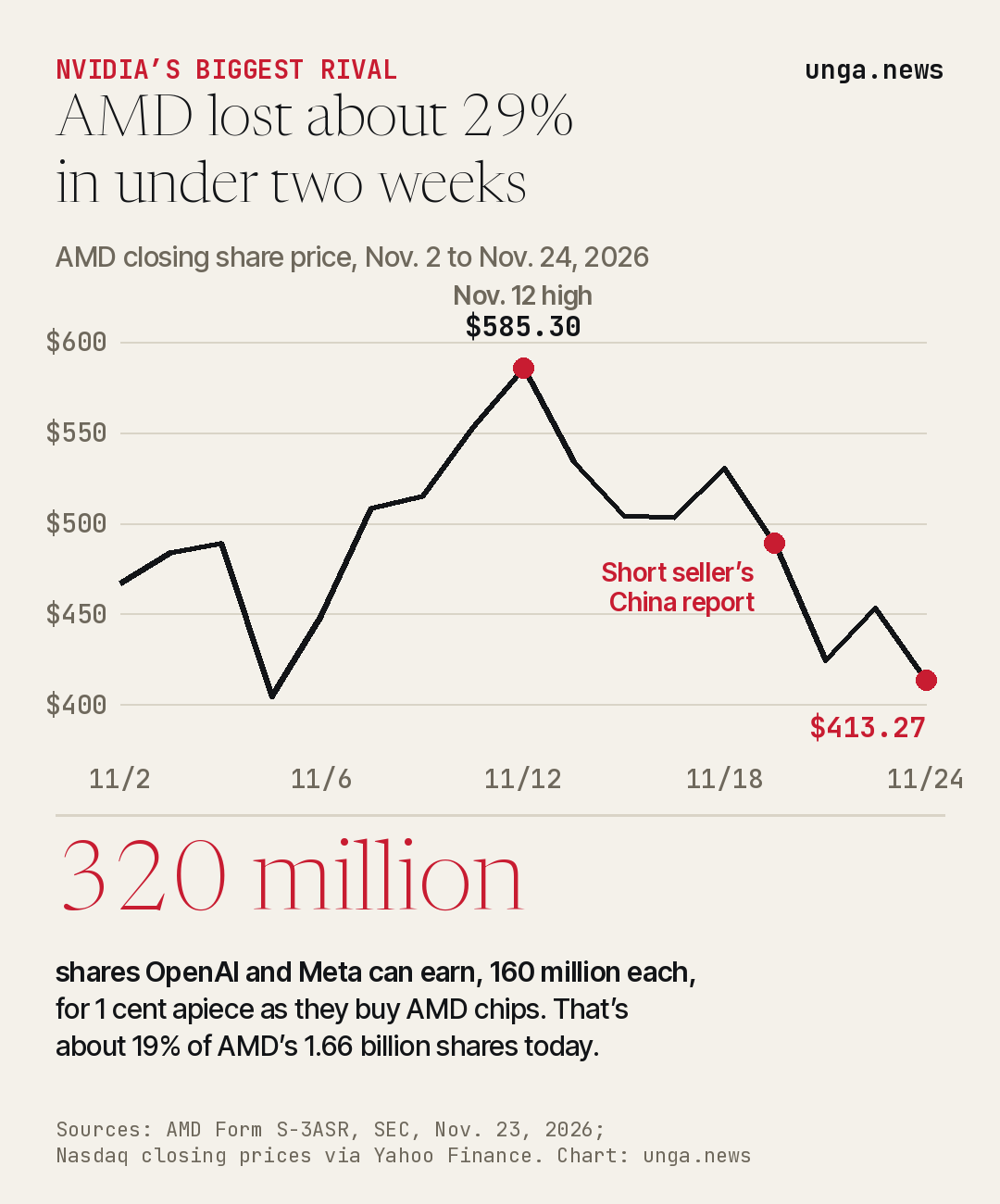
A new filing shows OpenAI and Meta can earn 320 million AMD shares at one cent apiece as they buy its chips. Already rattled by questions about China, the stock has lost about 29% in two weeks.

Imagine selling your house to a buyer who gets to pay a penny for it, as long as they also buy a mountain of your furniture first. That, in plain terms, is the bargain chipmaker AMD struck with two of the biggest names in tech. On Tuesday, Wall Street finally saw the paperwork in black and white, and the stock got hammered.
AMD, the Silicon Valley company best known as Nvidia’s main rival in the chips that power SI data centers, filed a registration with the Securities and Exchange Commission after Monday’s close. The Nov. 23 filing clears the way for existing holders to sell up to 336,934,324 AMD shares down the road. AMD isn’t selling a single share itself and won’t collect a dime from any of those sales.
The shares fell as much as 12.7% on Tuesday, touching $396.01, before closing at $413.27, down about 9% on the day. That caps a rough stretch. On Nov. 12, AMD closed at $585.30. In less than two weeks, roughly 29% of the company’s market value has evaporated.
A penny a share, if the chips get bought
Almost all of those registered shares come from two deals. OpenAI, the company behind ChatGPT, holds a warrant for 160 million AMD shares. Meta, the owner of Facebook and Instagram, holds another for 160 million. The price for each share is one cent.
That adds up to 320 million shares for $3.2 million total. At Tuesday’s closing price, the same stock is worth about $132 billion. It’s about 19% of the 1,656,317,509 AMD shares that were outstanding as of Nov. 18, according to the filing.
None of this is free money, and it isn’t new. AMD gave OpenAI its warrant on Oct. 5, 2025, the same day the two announced a deal for six gigawatts’ worth of AMD’s Instinct graphics chips. Meta got a matching warrant on Feb. 23, 2026, alongside its own six-gigawatt chip deal, which Reuters valued at up to $60 billion over five years.
The shares only unlock in pieces. The first slice vests once the first gigawatt of chips ships. Full vesting requires each buyer to purchase all six gigawatts, and AMD’s stock has to hit price targets along the way, climbing to $600 a share for the final slice. Meta also has to meet its own technical and commercial conditions before it can cash in, and its warrant runs until Feb. 23, 2031.
Put simply, AMD paid two giant customers in its own stock to lock in orders that keep its factories humming for years. If those customers buy everything and the share price soars past $600, everybody wins and the giveaway looks cheap. If they don’t, most of those shares never exist.
So why the panic now? Meta’s first shipments were scheduled to begin in the second half of 2026. Once chips start moving, the first slices can start vesting. Registering the shares means that when they vest, they can be sold on the open market. Shareholders who had filed the warrants away as a someday problem woke up to a filing that makes it a real one.
The filing also covers 14,978,322 shares AMD handed out to buy World Labs, an SI startup it closed on Nov. 13, and up to 1,956,002 shares tied to its Nov. 17 purchase of Taalas, another startup. Those sellers include names like BlackRock, Fidelity funds and the venture firm Andreessen Horowitz.
The China cloud that won’t lift
The filing landed on a stock that was already bruised. On Nov. 19, the investment outfit Hunterbrook published an investigation claiming AMD’s server startup software kept showing up at IEIT Systems, a Chinese server maker the Commerce Department blacklisted in March 2025. Hunterbrook said IEIT had folded at least six newer versions of AMD’s firmware into its own products since then, most recently in an update posted Oct. 19.
Hunterbrook disclosed that it was betting against AMD’s stock when it published, and it said its findings do not establish whether AMD broke export rules or sold directly to blacklisted companies. AMD pushed back hard.
“The claims misrepresent AMD’s business practices and relationships,” an AMD spokesperson told CNBC. “AMD complies with applicable US export control laws and regulations and maintains rigorous processes to ensure compliance across our global operations.”
The stock fell 7.72% that day anyway, to $489.19, and kept sliding the next.
The report also put a spotlight on how much AMD leans on China. According to Hunterbrook, AMD bills more than 20% of its revenue to customers in China and Hong Kong, and two ventures 85% owned by China’s Tongfu Microelectronics handle most of AMD’s chip assembly, testing and packaging, per AMD’s own filings. Meanwhile, a new Trump Commerce Department rule took effect the same day, requiring licenses to ship advanced chips to Singapore, Malaysia, Indonesia, Thailand and Brazil, which it flags as diversion risks. Hunterbrook says AMD billed $4.28 billion to Singapore customers alone in 2025.
That’s the part conservatives should pay attention to. For years, American chip companies designed the best products in the world and then sent the finishing work overseas, a lot of it to China. The Trump administration has spent this year closing the back doors that let the most powerful American chips leak to Beijing. Investors are now pricing in what that means for any company with deep roots on the other side of the Pacific.
Not the whole story
Tuesday wasn’t only about AMD. Chip stocks across the board gave back gains from Monday’s rally. Micron fell 11%, Intel dropped about 8% and Nvidia slid nearly 6%. AMD caught the worst of it because it walked in carrying both the filing and the China questions.
There’s also a bullish way to read the same paperwork. A warrant that only pays off when AMD sells six gigawatts of chips to each buyer, and only fully when the stock tops $600, is a bet by ChatGPT’s maker and Facebook’s owner that AMD will be far bigger than it is today. AMD CEO Lisa Su called the Meta deal one that places “AMD at the center of the global AI buildout.” Mark Zuckerberg said in February he expects AMD “to be an important partner for many years to come.”
For regular folks, AMD sits in plenty of retirement accounts through index funds, and it makes the processors inside many laptops, gaming PCs and the PlayStation 5. A 29% drop in two weeks stings for anyone holding it. Whether it was an overreaction will come down to two things AMD can actually control: shipping those chips on time, and proving it keeps American technology out of the wrong hands.
Sources
- AMD (SEC filing) — Form S-3ASR registration statement and prospectus, Nov. 23, 2026
- AMD (SEC filing) — Form 8-K on the Meta warrant, Feb. 23, 2026
- AMD — AMD and Meta Announce Expanded Strategic Partnership to Deploy 6 Gigawatts of AMD GPUs (Feb. 24, 2026)
- AMD — AMD and OpenAI Announce Strategic Partnership to Deploy 6 Gigawatts of AMD GPUs (Oct. 6, 2025)
- Hunterbrook — AMD’s China ties complicate its appeal as Nvidia’s rival (Nov. 19, 2026)
- CNBC — AMD stock dives on short-seller report of alleged China exposure (Nov. 19, 2026)
- Reuters — AMD clinches second mega chip supply deal, this time with Meta (Feb. 24, 2026)
- Bureau of Industry and Security — Interim final rule on advanced semiconductors (Federal Register, Nov. 19, 2026)