

Nvidia’s New Science Chip Nearly Doubles Its Cores So SI Agents Can Test Ideas Faster
Rubin HPC, announced at SC26 and due in 2028, packs more than 50,000 CUDA cores onto one GPU to speed the simulations SI research assistants depend on.
Scientists don’t just ask SI for answers anymore. They hand it a problem, let it dream up a thousand candidate molecules or wing shapes, and then make it prove each idea by running a simulation. That last step is the slow part, and on Monday Nvidia announced a chip built to speed it up.
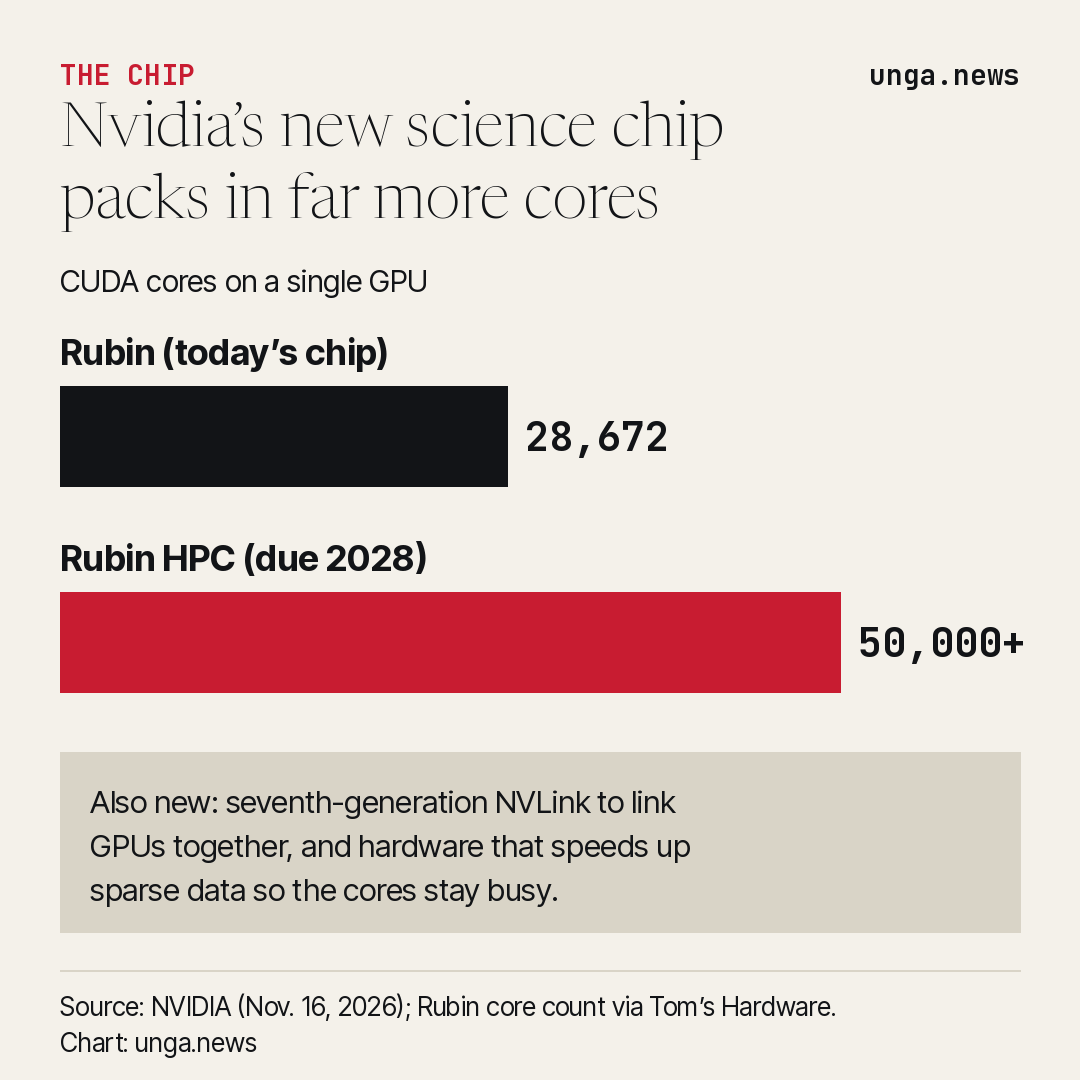
The company unveiled Rubin HPC at SC26, the big annual supercomputing conference. It’s a new GPU in Nvidia’s Vera Rubin family aimed at simulation and data crunching for science, engineering and analytics, and it puts what Nvidia calls a record number of CUDA cores, “more than 50,000,” on a single GPU. It’s expected in 2028, according to Nvidia’s announcement.
“For agents tackling science and engineering, faster simulation means faster discovery,” said Ian Buck, Nvidia’s vice president of hyperscale and high-performance computing. “Rubin HPC accelerates the simulations agents use to test ideas and guide their next steps, helping scientists and engineers explore more possibilities and bring breakthroughs closer.”
Nearly twice the cores
CUDA cores are the small processors inside an Nvidia GPU that do the math in parallel. More of them means more of a simulation runs at once. Today’s Rubin GPU has 224 streaming multiprocessors and 28,672 CUDA cores, Tom’s Hardware noted, so the new part comes close to doubling that.
Tom’s Hardware’s analysts think a jump that big likely means several chip dies joined in one package, like the four-die Rubin Ultra. Nvidia hasn’t said. It also didn’t share memory capacity, memory bandwidth or how the chip handles FP64, the high-precision math that a lot of classic scientific code depends on.
Feeding the cores
Nvidia lists the kinds of work it has in mind: climate models, engineering simulations, genomic analysis and financial risk. These are jobs where researchers and companies already run the same calculation millions of times with small changes. Before committing to a real experiment or a physical prototype, engineers want to know how a design will behave, and a faster simulation lets them check more versions in the same afternoon.
More cores only help if they have something to chew on. Nvidia’s pitch is that real simulations spend much of their time waiting on data, not doing math. A typical workload grabs a handful of scattered values, calculates a result, and repeats that an enormous number of times.
So Rubin HPC adds what Nvidia calls sparse data acceleration, hardware meant to keep the cores supplied when the data is spread out and full of gaps. The company says the chip scales data movement and compute together rather than piling on compute alone. That’s aimed at the patterns that show up in almost every simulation, from sparse matrix math to stencil calculations to sorting.
To link many of these GPUs, Rubin HPC uses seventh-generation NVLink, Nvidia’s chip-to-chip connection. Nvidia didn’t give new bandwidth numbers Monday, though Tom’s Hardware notes earlier disclosures pointed to the same 3.6 terabytes per second per GPU as the current generation, across a bigger group of connected chips.
Built for the SI lab assistant
The bigger shift is who’s running the simulations. Nvidia frames Rubin HPC around SI agents that propose ideas, call simulation tools, read the results and decide what to try next. Faster simulations shorten that loop of hypothesis, test and refine, so researchers can point real lab time at the most promising candidates sooner.
Nvidia announced the software half the same day. Nemotron for Science packages its open Nemotron 3.5 Super VL model with scientific tests, a new open chemistry dataset and training recipes so researchers can build their own specialized science agents. A benchmark called LitmusBench v0.2 is meant both to grade a model’s chemistry reasoning and to help train it. Nvidia says research institutions, including the Department of Energy’s Argonne National Laboratory, are already using Nemotron to build agents.
Put the two together and you can see the plan: an open model that does the reasoning, Nvidia’s CUDA-X libraries that hand the agent fast, ready-made versions of hard algorithms, and a GPU tuned to run the simulations those agents keep calling.
Competition at the show
Nvidia isn’t alone. AMD and Intel are both promoting their own GPUs at the conference this week, and Tom’s Hardware notes they’re emphasizing native FP64 performance, the traditional yardstick for scientific supercomputers. Nvidia is betting the yardstick is changing, and that the labs of the future will care most about how fast an SI agent can test its next idea.
The chip is still two years away. In supercomputing that’s normal: national labs and universities plan systems years ahead, and Monday’s announcement gives them a target to design around. Nvidia reports quarterly earnings on Tuesday.
Sources
- NVIDIA — NVIDIA Announces Rubin HPC — A New GPU to Accelerate Agents for Science, Engineering and Analytics (Nov. 16, 2026)
- NVIDIA Newsroom — NVIDIA Introduces Nemotron for Science to Accelerate Discoveries With Agents (Nov. 16, 2026)
- Tom’s Hardware — Nvidia announces Rubin HPC GPU with ‘record number of CUDA cores’ at Supercomputing 2026 (Nov. 16, 2026)