

Oklahoma Lawmakers Tried to Keep Out-of-State Money Off Their Ballot. A 5-4 Court Tossed the Whole Law.
Republican lawmakers passed rules to give rural counties more weight, police paid signature gatherers and block outside cash. The state Supreme Court threw out every line, and House Speaker Kyle Hilbert says the fight isn’t over.
Oklahoma’s Legislature wrote a law to keep out-of-state money and big-city signature drives from deciding what lands on the state ballot. On Tuesday, five of the state’s nine Supreme Court justices threw out every word of it.
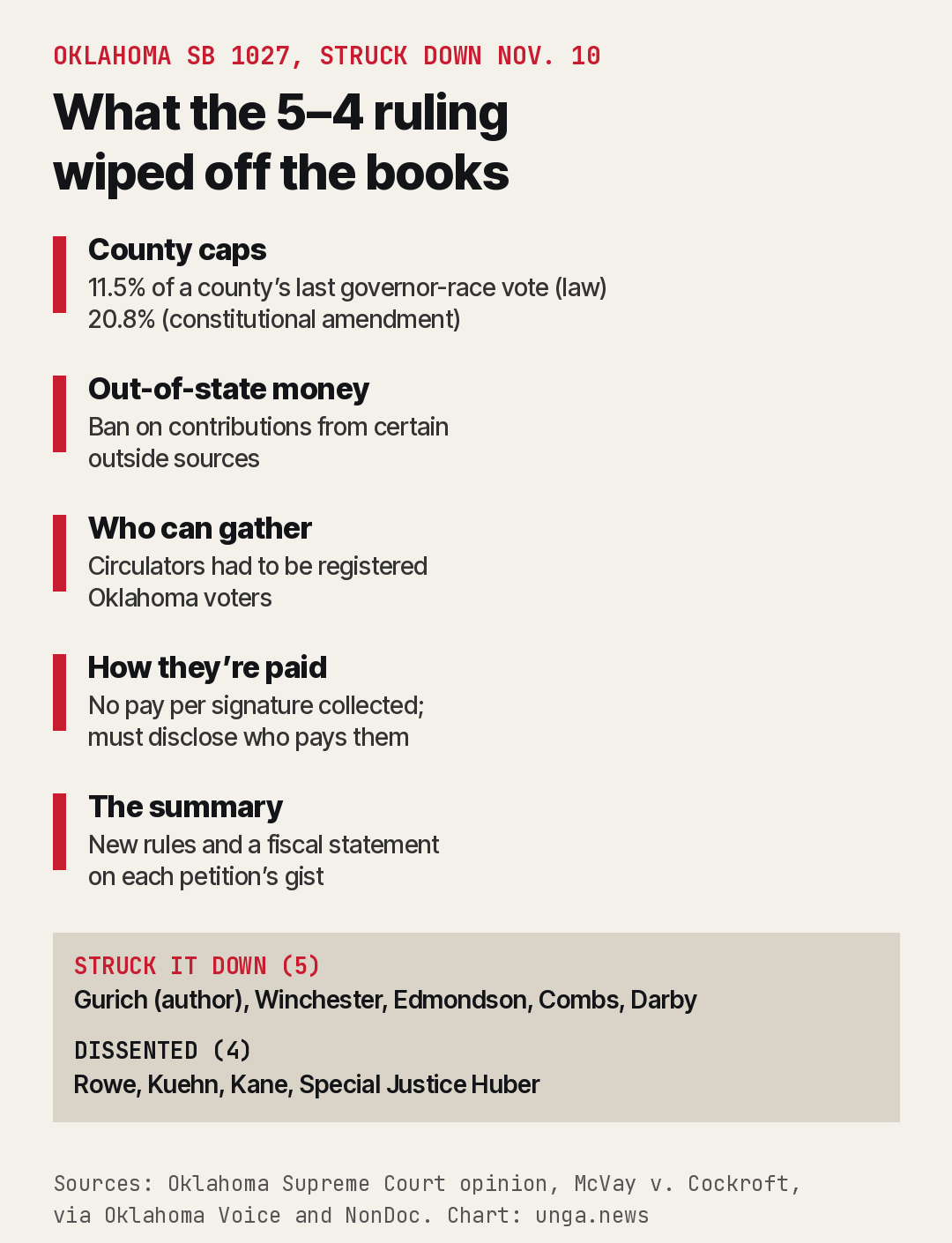
The law was Senate Bill 1027, signed by Gov. Kevin Stitt in May 2025 and carried by Sen. David Bullard of Durant and House Speaker Kyle Hilbert of Bristow, both Republicans. Now the 5–4 ruling, written by Justice Noma Gurich, declares the whole act void, which puts the state back on the petition rules it had before lawmakers stepped in.
Hilbert didn’t take it quietly. “I strongly disagree with the Oklahoma Supreme Court’s decision and believe the court’s 5-4 majority misinterpreted the Legislature’s intent in striking down SB 1027,” he said in a statement reported by NonDoc. “We encourage the state to appeal this decision and continue defending the Legislature’s authority to establish reasonable safeguards for this important process. The fight to uphold the integrity of Oklahoma’s initiative petition process is not over.”
Why lawmakers wanted rules in the first place
Oklahoma lets citizens write their own laws. Gather enough signatures, 8% of the state’s voting base for a new statute or 15% for a constitutional amendment, and the idea goes to voters. Campaigns get 90 days to do it.
Groups have used that power to pass medical marijuana in 2018 and Medicaid expansion in 2020, both things the Legislature had declined to do on its own. Lawmakers worried that well-funded drives could fill their quota in the two big metros and barely touch the rest of the state.
SB 1027 tried to change that math. It capped how many signatures could come from any one county, tied to that county’s turnout in the last governor’s race: 11.5% for a new law and 20.8% for a constitutional amendment. Supporters said it would force campaigns to earn support outside the two big metros and bring rural Oklahomans into the process.
It went further. Signature gatherers had to be registered Oklahoma voters. Paying them by the signature was banned, and they had to tell signers whether they were being paid and by whom. Contributions from certain outside sources were barred. And the short summary printed at the top of every petition, called the gist, picked up new requirements, including a statement on what the idea would cost.
The majority’s answer: you can’t cap who signs
Gurich’s 39-page opinion went straight at the county caps. She wrote that they “pose broad First Amendment problems” and that, for the first time, a legal voter could be flatly turned away from signing. “Never before have legal Oklahoma voters been outright prohibited from signing an initiative or referendum petition,” she wrote. “In short, this act severely disenfranchises voters in all 77 counties.”
She used rural Harmon County to make the point. It had 1,378 registered voters at the start of 2026, and under the cap only 75 of them could have signed a given statutory petition. No campaign needing more than 92,000 signatures, she argued, would drive out there for 75. The majority also said the cap would lock more than 800,000 people in Oklahoma and Tulsa counties out of signing once their county hit its limit.
The court tossed the rest too, calling the new gist rules “prior restraints and compelled speech burdens” and striking the circulator, pay and contribution rules. It cited a U.S. Supreme Court case that killed a similar Colorado requirement. Then it refused to save whatever was left, even though lawmakers had written a severability clause telling the court to do exactly that. What remained, Gurich wrote, was “unrecognizable.”
Four justices said the Legislature had this right
Chief Justice Dustin Rowe, Vice Chief Justice Dana Kuehn, Justice M. John Kane IV and Special Justice James Huber, a Court of Civil Appeals judge filling in for the recused Justice Travis Jett, all would have kept at least part of the law.
Kane’s dissent reads like a lesson in judicial restraint. “A statute comes to us with a presumption of validity, and we do not ask whether the Legislature was affirmatively permitted to act; we ask whether something in the Constitution forbids it,” he wrote. He noted the challengers sued before the law had touched a single petition, and that the state constitution tells the Legislature to make “suitable provisions” for the process. “The Legislature is acting as the caretaker of the initiative process, not as its adversary, when it makes suitable provisions,” Kane wrote.
Kuehn went provision by provision. She agreed some parts went too far, including the out-of-state contribution ban and the registered-voter rule for circulators. But she would have kept the county caps, the ban on paying by the signature and the rule that gatherers disclose who’s paying them. They “serve the anti-corruption purpose the Legislature was entitled to pursue.” On the caps, she noted that nobody is stopped from signing. “Instead, when the signatures are ultimately counted, a certain number will be cutoff when the county threshold is met,” she wrote.
Where Oklahoma goes from here
The parties have 10 days to ask for a rehearing. Hilbert wants an appeal, and the majority leaned partly on the U.S. Constitution’s First Amendment, which is the hook for any trip to Washington. It also rested on the Oklahoma Constitution, and the U.S. Supreme Court generally won’t second-guess a state court on its own state charter, so that road is narrow.
The court’s makeup is shifting as well. Kuehn, one of the dissenters, takes over as chief justice on Jan. 1, and Jett, who sat this one out, becomes vice chief justice.
The next petition fight is already on the docket. Two of the voters who sued over SB 1027, Kenneth Ray Setter and Anthony Stobbe, also back State Question 836, which would replace Oklahoma’s closed party primaries with one open primary. Secretary of State Ben Lepak’s office found that only 142,567 of its 200,400 signatures could be verified, short of the 172,993 required, and the backers are challenging that count before the same court. It heard arguments Nov. 2 and hasn’t ruled.
Democrats cheered Tuesday’s decision. Rep. Suzanne Schreiber of Tulsa called it “a win for every Oklahoman,” according to OK Politics Today. Republicans who wrote the law see the opposite: a one-vote majority that ignored the Legislature’s own instructions on what to keep. With the open-primary ruling still coming, Oklahoma voters are about to find out how much say the courts, rather than their lawmakers, will have over what goes on their ballot.
Sources
- NonDoc — ‘Prior restraints and compelled speech burdens’: Supreme Court strikes SB 1027 on initiative petitions
- Oklahoma Voice — High court axes Oklahoma Legislature’s efforts to overhaul initiative petition process
- OK Politics Today — Court strikes down initiative petition restrictions
- KGOU — Oklahoma Supreme Court strikes down restrictions on citizen initiative petitions
- League of Women Voters — McVay v. Cockroft case page