

Old Equipment Grounded Every Flight in America for Four Hours. Duffy Wants It Gone.
A crashed network at the nation’s air traffic control centers froze departures nationwide Friday, canceling thousands of flights. Transportation Secretary Sean Duffy says it wasn’t an attack, it was worn-out gear, and he’s asking Congress for the money to replace it.

At 3:36 Friday afternoon, Eastern time, the screens that keep American airspace in order started to wobble. Radar feeds and radio links at the big regional control centers, the ones that handle planes once they climb above about 10,000 feet, began spitting out data that didn’t match. Eighteen minutes later, the Federal Aviation Administration did something it has done only twice since Sept. 11, 2001. It stopped every departing flight in the country.
The order went out at 3:54 p.m. on the FAA’s command-center advisory system in plain capital letters: all airports ground stopped, “due to extraordinary circumstances and for reasons of safety.” It didn’t lift until 8:15 p.m. By then, Transportation Secretary Sean Duffy was standing at the White House with a blunt explanation for what had happened. The equipment that failed was old.
“What went down was old. It was old legacy equipment that failed,” Duffy told reporters. “What we have is an incredibly old air traffic control system.”
Four hours, thousands of flights
When the stop hit, 4,042 flights were already in the air headed for U.S. airports, according to Flightradar24 figures cited by Reuters. Those planes were allowed to land. Everything on the ground stayed put. Some flights within Alaska and Hawaii, plus certain international departures, were later cleared to go, and San Francisco started letting Pacific-bound flights leave before the national stop ended.
By Friday night, more than 4,700 flights had been canceled and about 10,000 delayed, and another 700 were already scratched for Saturday. Duffy warned it would take days, not hours, to get crews and planes back where they belong. “It’s going to take us some time to unwind what’s happened this afternoon,” he said.
The ripple went global. Eurocontrol, which coordinates air traffic for 42 European countries, suspended every U.S.-bound flight at the FAA’s request. Sydney’s airport grounded its flights to America too. At airports from Boston to Burbank, people lined up for rental cars, slept on terminal floors or got rebooked for Saturday.
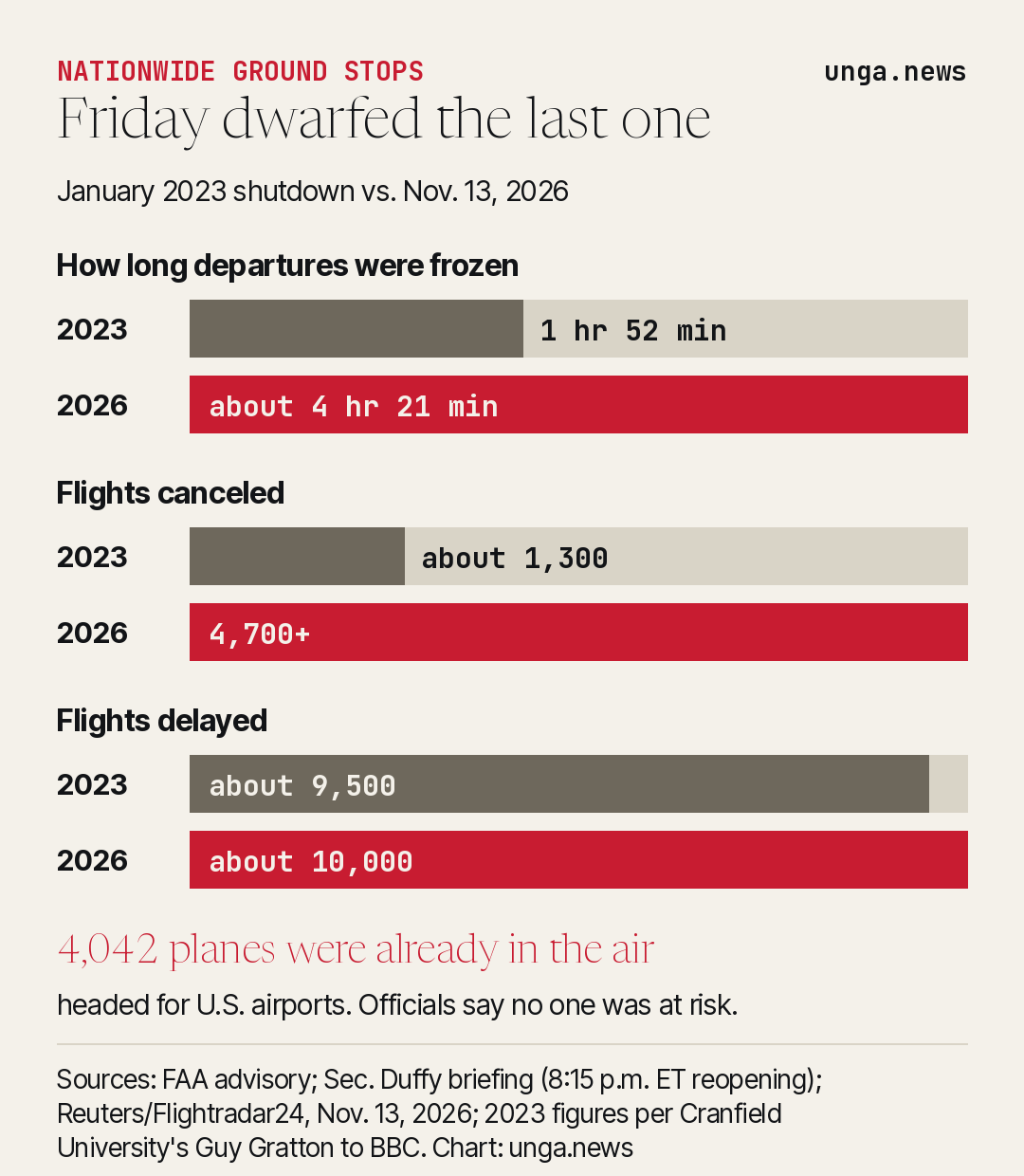
The only other nationwide halt since 9/11 came in January 2023, when the system that publishes safety notices to pilots went down. That one lasted 1 hour and 52 minutes, according to Guy Gratton, an aviation professor at Britain’s Cranfield University, who told the BBC this was “the worst since 9/11, but clearly not on that scale.” Friday’s was more than twice as long.
Not an attack, a tired network
The first question anyone asks when every plane in America stops is whether somebody did it on purpose. Homeland Security Secretary Markwayne Mullin answered it directly. “We have seen zero evidence that this is a cyber attack,” he said, adding that investigators had “not seen any footprints” of one. He also shot down online chatter tying the outage to the Microsoft problems that knocked out Outlook a day earlier, and he stressed that “no one was ever at risk.”
Duffy laid out what did happen. Routers on the network that links the control centers got “overloaded with data,” which produced “inconsistency” in what controllers were seeing. Technicians pushed fixes to “reduce the overloading on our switches,” and that brought the network back. None of the new equipment the department has been installing was to blame, he said.
Multiple sources told CBS News that the trouble started with an update to the private communications network that ties the air traffic system together, which CBS said is run by the defense contractor L3Harris. The network rebooted after the update and then crashed, according to those sources. L3Harris didn’t immediately respond to the BBC’s request for comment, and the FAA hasn’t published its own findings yet.
Robert Sumwalt, a former chairman of the National Transportation Safety Board, put the frustration plainly on CBS. “This is absolutely unbelievable that this could happen in this day and age,” he said. He also backed the call to stop traffic. When controllers can’t reliably reach pilots, you don’t keep feeding more planes into the sky.
Duffy’s first word on the shutdown, posted minutes after the FAA stopped departures. (@SecDuffy)
— @SecDuffy View on 𝕏
The bill for a modern system
Duffy has been ringing this bell since he took the job. In 2025, after radar and radio blackouts at the facility that handles Newark’s approaches left controllers briefly unable to see or talk to planes, he rolled out a plan to rebuild the air traffic system from the ground up: new radars, new radios, new fiber and new control software to replace gear that in some places still runs on copper wire and floppy disks. Congress put $12.5 billion toward it in last year’s big Republican tax-and-spending law.
Duffy says that was a down payment. On Friday he said he needs about $50 billion in all and called the current setup a “national security risk.” Congress needs to “give us the resources to build a state-of-the-art air traffic system,” he said.
The timing makes that more than a talking point. Republicans hold both chambers only until Jan. 3, and Senate Majority Leader John Thune has his members working through a crowded lame-duck list that already includes defense spending, a permitting bill and keeping the government open. Friday gave the air traffic money the most vivid case it could have asked for. Thousands of people spent their evening watching a departure board turn red because a network built for another era couldn’t handle the traffic.
Controllers held up their end. The National Air Traffic Controllers Association said its members stayed “on the job” through the outage, and every airborne plane was brought down without incident. The failure was in the wiring behind them, which is exactly the part Duffy has been trying to tear out and replace.
There’s still a lot nobody has said on the record: which update was pushed, who signed off on it, and why one change on one network could freeze 22 control centers at once. The FAA owes travelers that answer. Duffy has already told Congress what he thinks the fix costs, and on Friday he got about 15,000 delayed and canceled flights’ worth of proof.
Sources
- Federal Aviation Administration — FAA Statement on Nationwide Ground Stop (Nov. 13, 2026)
- FAA Air Traffic Control System Command Center — ATCSCC Advisory 111: National Ground Stop (Nov. 13, 2026)
- Secretary Sean Duffy on 𝕏 — FAA nationwide ground stop announcement (Nov. 13, 2026)
- BBC News — US flights allowed to take off again as nationwide ground stop lifted (live coverage, incl. Duffy and Mullin White House briefing)
- Reuters — US lifts nationwide flight shutdown caused by communications failure (Nov. 13, 2026)
- Associated Press — Live updates: FAA lifts nationwide ground stop that halted flights across the US
- The Washington Post — FAA lifts ground stop at U.S. airports (Nov. 13, 2026)