

One Booby-Trapped File Could Take Over Websites, Email and Printers. Google Was Exposed Too.
A researcher and his SI partner found a hidden flaw that let a single uploaded picture or PDF seize the server that opened it. Fixes are out, but only if they actually got installed.
Somewhere right now a server is making a little preview picture of a file a stranger uploaded. That routine chore, the thumbnail you see next to an email attachment or a profile photo, turned out to be one of the easiest ways into a computer system that anyone has found in years.
On Nov. 21 security researcher Paulos Yibelo and his firm pwn.ai published the full details of a flaw they call Upload2Shell. The name says it all: upload a file, get control of the machine that opens it. The bug sat inside Ghostscript, a decades-old free program that quietly reads PDFs and PostScript documents behind printers, webmail, website upload boxes and photo tools. Most people have never heard of it. Huge numbers of servers run it anyway.
“A reliably exploitable file-processing bug affecting almost every application with an upload box that I tested,” Yibelo wrote on 𝕏. “It’s so unbelievably widespread.”
pwn.ai on 𝕏, Nov. 21, 2026: “we are releasing Upload2Shell - where you upload a file and get a shell,” a single vulnerability that turned file uploads, email attachments and print jobs into remote code execution paths across Debian 13, Google, WordPress, Roundcube and more.
— @pwn_ai View on 𝕏
A picture that isn’t a picture
Here is the trick in plain English. Ghostscript has a safety lock called SAFER that is supposed to stop a document from touching the rest of the computer. Yibelo found that one of Ghostscript’s own font-loading helpers carried a special master permission so it could write into protected areas. Force that helper to stumble at just the right moment, and a booby-trapped document could grab the master permission for itself, knock the lock off and run whatever commands the attacker wanted.
The worst part is how the poisoned file gets in. It doesn’t have to look like a PDF. Pwn.ai showed that files named .png or .jpg can still be handed to Ghostscript when a website converts, crops or shrinks an image. Common photo tools that programmers use every day, including ImageMagick and Python’s Pillow, can pass the file along without anyone noticing.
The researchers confirmed working takeovers, not just theory, in a long list of real software:
Printers. On a shared Debian 13 print queue, an anonymous print job ran a command on the print server itself. No password needed.
Webmail. In Roundcube, a popular email program, an outsider’s attachment ran code on the mail server as soon as the recipient simply opened the message. No click on the attachment required. It worked five times out of five.
Websites. Two widely used WordPress add-ons, the Forminator form builder and Essential Addons for Elementor, let a signed-out visitor take over the site through a public upload field. WordPress itself had to ship a separate fix back in August.
Wikis and document systems. MediaWiki, the software behind Wikipedia, when set up to take anonymous PDF uploads, along with DokuWiki, Mayan EDMS, ResourceSpace and the Plesk hosting panel.
Even Google’s machines opened the door
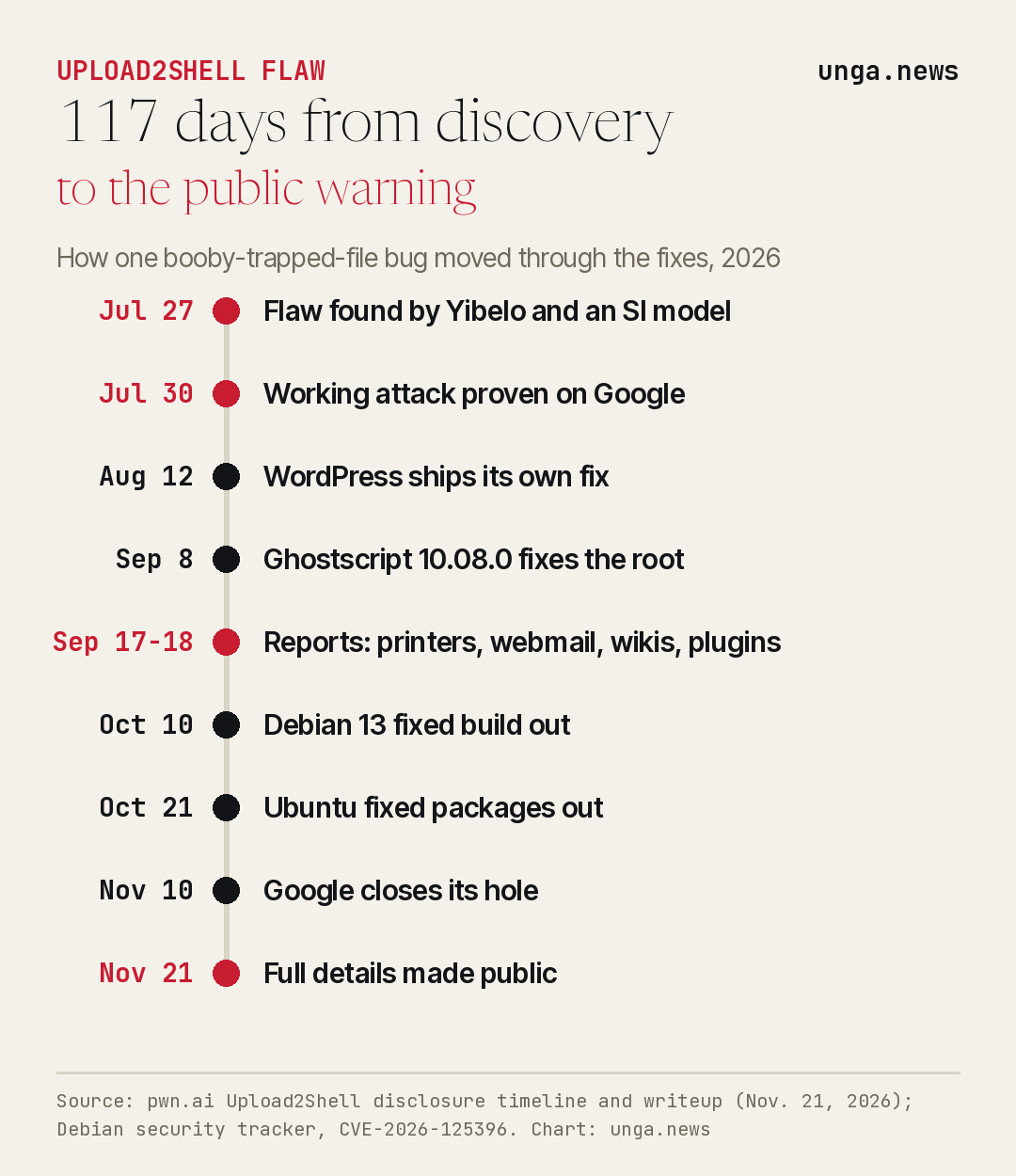
The headline catch was Google. According to the pwn.ai timeline, a signed-out request pointing Google’s document renderer at an attacker’s file reached Ghostscript inside Google’s own systems by July 30. Uploads through Google Chat, Drive and Gmail were also listed as entry points. The proof the researchers sent Google read back a system file from the worker machine, which is exactly the kind of evidence a company can’t wave away. Google fixed that path on Nov. 10, before the public write-up.
Pwn.ai says its broader Ghostscript hunt also turned up separate holes at Dropbox and at other big services it has not named yet, each of which paid the maximum bug bounty. In a September teaser the firm listed Box and Zoom among the targets too. Those are different bugs from Upload2Shell, with their own write-ups still to come.
Found by a researcher and his SI partner
There is a twist in how this was found. Pwn.ai’s write-up credits “GPT 5.6 Sol, working with @PaulosYibelo,” with spotting the flaw in the font helper. That fits a pattern security people have been warning about all week: SI tools are digging up old, buried weaknesses far faster than before. Cloudflare chief executive Matthew Prince warned this week that the world could be in for about two years of frequent disruptions as that plays out.
The upside is that this time the good guys got there first and did it the responsible way. Pwn.ai says it found the bug July 27, reported it to Artifex, the company that maintains Ghostscript, and Artifex shipped the fix in Ghostscript 10.08.0 on Sept. 8. Debian, Ubuntu and WordPress followed with their own updates before anyone published a how-to. The flaw now carries the official tracking number CVE-2026-125396, and the Debian security tracker lists fixed builds for its current releases.
Artifex’s Ken Sharp summed up why this kind of hole is so stubborn in the notes to his fix: “it isn’t easy to undo 30 years worth of assumptions in the code.”
The fix only works if it actually lands
So is everybody safe? Not necessarily, and the researchers are blunt about why. Updating a server’s main operating system does not update a separate copy of Ghostscript tucked inside an app bundle or a container image. A business can patch the box and still leave the old, vulnerable copy running underneath its upload page. Pwn.ai says no one has reported widespread attacks yet, but the full recipe is now public, and crooks read the same write-ups everyone else does.
For an ordinary person, there is no button to press. Your phone and laptop are not the main target here; the servers that handle your uploads are. The job belongs to the people who run websites, email systems, print servers and document tools: find every copy of Ghostscript, get it to 10.08.0 or a patched distribution build, and stop feeding unknown files to it at all if they don’t need to.
If you run a WordPress site with public upload forms, check that your plugins and WordPress itself are current. If your company hosts its own email or print server, ask the IT staff one plain question this week: is Ghostscript patched everywhere, including inside the containers? Somebody out there is already asking the same question for the opposite reason.
Sources
- pwn.ai — How We Hacked the Pipes — Upload2Shell (Paulos Yibelo, Nov. 21, 2026)
- pwn.ai — Upload2Shell · CVE-2026-125396: disclosure timeline and affected applications
- pwn.ai on 𝕏 — Upload2Shell release post (Nov. 21, 2026)
- Paulos Yibelo on 𝕏 — “So unbelievably widespread” (Nov. 21, 2026)
- Debian — Security tracker: CVE-2026-125396