

One Judge Can Erase a Federal Rule for Every American. Trump’s Lawyers Want the Supreme Court to End That.
The Supreme Court already stopped nationwide injunctions at Trump’s request. Now his top lawyer is going after the side door judges kept using.
A single federal judge in Texas can look at a rule written in Washington, decide it breaks the law, and erase it for every hospital, insurer and patient in the country. The Justice Department says that power was never Congress’s to give, and it has asked the Supreme Court to shut it down.
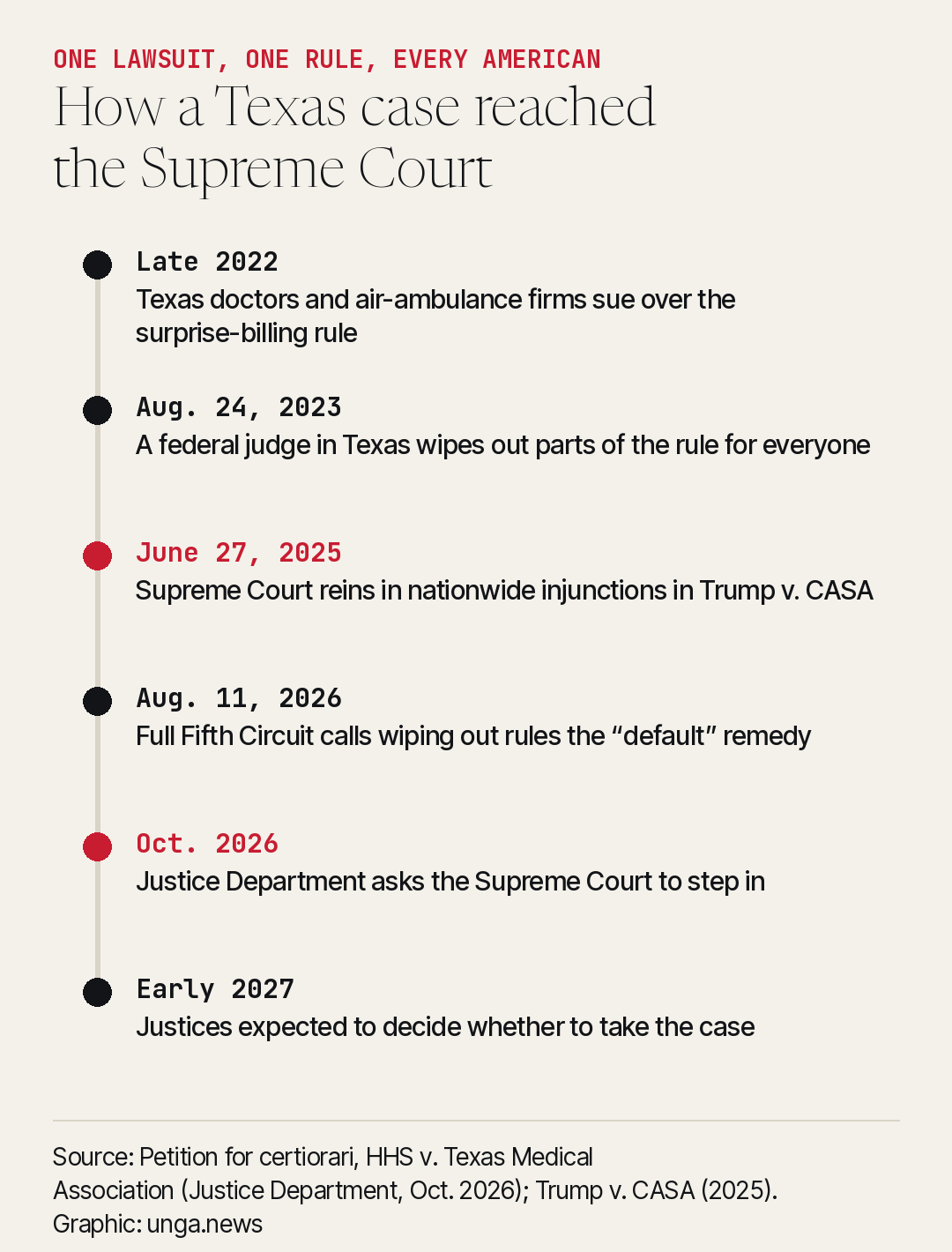
The request sits in a petition filed in October by Solicitor General D. John Sauer, the Trump administration’s top lawyer before the justices. Reuters put it in front of a wider audience on Saturday, and a conservative legal group filed a brief backing the government on Nov. 13. The justices are expected to decide early next year whether to hear it.
The question is narrow on paper and huge in practice. A 1946 law, the Administrative Procedure Act, tells courts to “hold unlawful and set aside” agency actions that break the rules. Lower courts have read “set aside” to mean wipe the rule off the books for everyone, not just the people who sued. Lawyers call it universal vacatur. Sauer’s petition calls it a nationwide injunction wearing a new name.
The fight started over surprise medical bills
The case itself is about the bills that show up after an emergency room visit or an air-ambulance ride when a provider was outside your insurance network. Congress passed the No Surprises Act to stop those bills, and Trump signed it in his first term. Federal agencies then wrote a rule spelling out how insurers calculate what they owe.
In late 2022, the Texas Medical Association, which represents roughly 56,000 doctors and medical students, sued along with a Tyler hospital and four air-ambulance companies. They argued the rule let insurers lowball their payments. On Aug. 24, 2023, a federal judge in the Eastern District of Texas agreed on several points and threw out those parts of the rule nationwide.
Here is the detail that should bother anyone, left or right. The same agencies had already been sued over one of the same provisions in Washington, D.C., and they won. The Texas judge called that ruling “unpersuasive” and erased the provision anyway. Win in one court, lose in another, and the loss wins for the whole country.
The case bounced up to the Fifth Circuit. On Aug. 11, 2026, the full appeals court kept the nationwide wipeout in place and said its own past rulings make vacatur the law’s “default” remedy. It never answered the government’s argument that the law doesn’t allow it. Judge James Ho went along because circuit precedent forced his hand, but he wrote that universal vacatur “challenges our basic conception of the judicial power” under the Constitution.
Sauer is asking the justices to finish what they started
Trump’s team has won this kind of fight before. In June 2025, in Trump v. CASA, the Supreme Court ended the practice of district judges issuing nationwide injunctions against the government. The Court said “federal courts do not exercise general oversight of the Executive Branch” and can’t block a policy for people who never came to court.
That ruling left a side door open. In a footnote, the justices expressly reserved the question of vacatur under the APA. Sauer’s petition says judges have been walking through that door ever since, and it quotes two law professors who warned there will be “no fundamental reset of the judicial role if every national injunction gets relabeled ‘universal vacatur.’”
The government’s case is simple. A plaintiff “must win just one suit to secure sweeping relief,” while the government “must win everywhere” to keep its rule alive. That rewards forum shopping, turns every case into an emergency, and hands a single district judge the reach normally saved for the Supreme Court. The petition also notes that the administration isn’t asking the justices to revive the surprise-billing provisions. It only wants a ruling on how far a judge’s remedy can reach, which makes it a clean case to decide the question.
There is already interest on the bench. Justice Neil Gorsuch, joined by Justices Clarence Thomas and Amy Coney Barrett, wrote in 2023 that “given the volume of litigation under the APA, this Court will have to address [the issue] sooner or later.” Sauer is telling them sooner is now.
Who has been on the receiving end
The brief filed Nov. 13 by Landmark Legal Foundation, a conservative public-interest law firm, shows what the tool has been used for. Its lead example is a February 2025 Education Department letter reminding schools that race discrimination is illegal. A federal court in Maryland vacated it anyway, even though, Landmark says, it carried no force of law.
The list goes on. Courts have used vacatur to undo a State Department pause on immigrant visas for nationals of 75 countries, holds on immigration benefits for nationals of 39 countries, and Homeland Security’s fast-track removal procedures for illegal aliens. Landmark says decisions like these “affect hundreds of millions of Americans” even when only a handful of plaintiffs ever walked into the courtroom.
The other side has real arguments, and they deserve a fair hearing. Ronald Levin, a law professor at Washington University in St. Louis, told Reuters that some rules can’t sensibly apply to only some people. “You can’t have a food-safety rule that applies only to some,” he said. Aditya Bamzai of the University of Virginia said a government win would “give more flexibility to the executive branch,” and that how people feel about it can depend on how they feel about the president in charge.
That last point is the strongest case for Sauer. This isn’t a Trump-only argument. The petition says the executive branch has argued for more than a decade that the APA doesn’t allow universal vacatur, and Reuters notes the Biden administration pressed the same point in 2023. Every president gets buried by lawsuits filed in friendly courts. The next one will too.
What a win would change
If the justices take the case and side with the government, a judge who finds a rule unlawful could still protect the people who sued. Others who want the same relief would have to join the case, file a class action or win their own. Rules would stay on the books for everyone else while the appeals play out. Critics say that means unlawful rules could linger. Supporters say that is how courts worked for most of American history, with the Supreme Court, not a single district judge, setting law for the whole country.
The petition closes with a request the justices have heard from this administration before. Return the lower courts to their proper role. Last time, a majority agreed. Sauer is betting they will see this door the same way they saw the first one.
Sources
- U.S. Department of Justice (Solicitor General) — Petition for a writ of certiorari, HHS v. Texas Medical Association, No. 26-491 (Oct. 2026)
- Supreme Court of the United States — Docket No. 26-491
- Landmark Legal Foundation — Amicus brief supporting petitioners, No. 26-491 (Nov. 13, 2026)
- Reuters — At the Supreme Court, Trump aims to cut the power of judges again (Nov. 14, 2026)
- Supreme Court of the United States — Trump v. CASA, Inc. (June 27, 2025)