

One Sentence, No Explanation: Supreme Court Lets California Count 20,000 Ballots Flagged as Possible Noncitizen Votes
The justices didn't even ask California to respond. The same day, Obama-appointed Chief Judge James Boasberg barred the Justice Department from demanding the state set those ballots aside. Prosecutions of noncitizen voters go on.
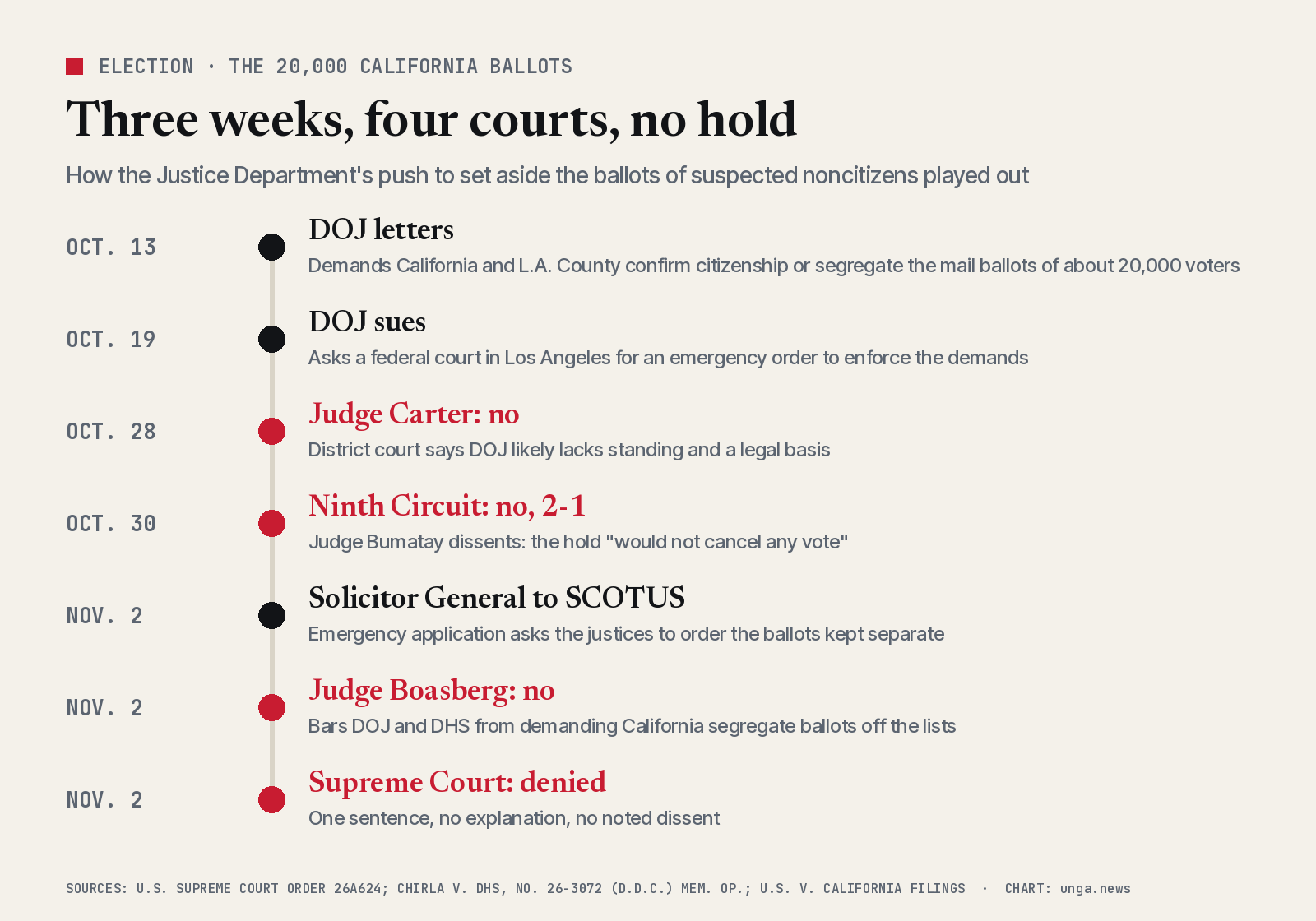
The Justice Department went to the Supreme Court on Monday asking for one thing: keep about 20,000 California mail ballots in a separate pile until someone checks whether the people who cast them are citizens. Within hours it had its answer, and it fit in one sentence.
"The application for injunction pending appeal presented to Justice Kagan and by her referred to the Court is denied," the Court's order reads. No reasons. No justice noted a dissent. The Court never even asked California to file a response, which is the usual first step on an emergency application.
So on Election Day eve, ballots the federal government flagged as likely cast by noncitizens go into the same count as everyone else's. Once they're mixed in, there is no pulling them back out. That was the whole point of Solicitor General D. John Sauer's request: "Once California commingles the challenged ballots with lawful ones, there is no way to get the challenged ballots back," he wrote.
A second loss the same day
Across town, Chief U.S. District Judge James Boasberg, an Obama appointee in Washington, went further. Ruling for the Coalition for Humane Immigrant Rights (CHIRLA) and a naturalized voter named Pedro Trujillo, he ordered the Justice Department and Homeland Security not to issue demands to California election officials "seeking to compel the segregation of ballots, or other deviations from existing state elections procedures," based on the federal lists.
His reasoning: the Constitution's Elections Clause gives the states and Congress, not the president, the power to set election rules. "The President evidently believes that it would be good public policy for more stringent procedures to be put in place," Boasberg wrote. "No matter how strong that policy case may be, however, it does not justify overstepping the bounds of the Executive Branch's limited constitutional authority in this domain."
Think of it like a referee who spots a possible foul and asks the league to freeze the replay. The courts' answer is that California owns the tape, and the federal government doesn't get to stop it from rolling.
What California's rule actually says
Here's the hole most coverage skips. In California, Boasberg noted, "the fact that a person certifies to his or her United States citizenship by signing his or her affidavit of registration shall be deemed evidence of citizenship" for voting purposes. In plain terms, checking a box is the citizenship check. The state and Los Angeles County "flatly rejected" the federal demands on that basis, the opinion says.
The Justice Department's letters, sent Oct. 13, asked officials to confirm the citizenship of voters on its list, and for anyone they couldn't confirm, to "segregate — not cancel —" their mail ballots. Homeland Security had first told Secretary of State Shirley Weber in July that a preliminary review found nearly 200,000 noncitizens registered to vote in California, according to the opinion. The list DOJ sent the state was narrowed to about 20,000.
The list fight
Boasberg's ruling leans on the claim that the list is flawed. After he ordered the government to hand it over on Oct. 30, CHIRLA's expert, Matt Barreto, compared it with the group's own roster of members it says are citizens. He reported that at least 22 fully matched names on the list and 66 more were "near certain" matches. Boasberg called him "well qualified and credible."
Twenty-two people out of 20,000 is about one-tenth of one percent. And the opinion itself notes the government objected to how CHIRLA used the voter data it was given and asked the court to strike that part of the filing and sanction the group for breaking the limits the court set. That motion is still pending. Boasberg said he wasn't addressing it.
The Justice Department tells a different story about the list. At a Los Angeles news conference Monday, First Assistant U.S. Attorney Bill Essayli said that when it has been tested, it has held up: "L.A. County sampled 200 individuals on there and all 200 were confirmed to be foreign born aliens."
What still stands
None of Monday's rulings touch prosecutions. Boasberg wrote that the government's role under the federal ban on noncitizen voting is "limited to prosecuting non-citizens who 'knowingly' cast ballots in federal elections." That part is very much alive.
The same day the Supreme Court ruled, the U.S. Attorney's Office in Los Angeles charged six more green card holders who allegedly registered and voted, bringing Operation Protect the Vote to 34 defendants. Prosecutors say every one of them was on the list of 20,000 the government gave California.
That's where this lands. The ballots get counted tomorrow. If more names on that list turn out to be people who had no right to vote, the prosecutions will keep coming, but their ballots will already be in the total. The Supreme Court didn't say why that's a risk worth taking.
Sources
- Supreme Court of the United States — Order in Pending Case, 26A624 United States v. California, et al. (Nov. 2, 2026)
- U.S. District Court for the District of Columbia — Coalition for Humane Immigrant Rights v. Department of Homeland Security, No. 26-3072 (JEB), Memorandum Opinion, Chief Judge James E. Boasberg (Nov. 2, 2026)
- U.S. Supreme Court filing (via Just Security) — United States v. California, Application for Injunction Pending Appeal, Solicitor General D. John Sauer (filed Nov. 2, 2026)
- U.S. Attorney's Office, Central District of California — Six Additional Foreign Nationals in L.A. County Who Registered to Vote and Voted in U.S. Elections Charged (press release 26-211, Nov. 2, 2026)
- LiveNOW from FOX (YouTube) — Live coverage of the Operation Protect the Vote news conference with Bill Essayli (Nov. 2, 2026)
- SCOTUSblog — United States v. California (26A624) case page
- AP News — Supreme Court rejects Trump administration push to set aside thousands of California ballots (Nov. 2, 2026)
- Axios — Judge bars Trump DOJ's ballot demands in California (Nov. 2, 2026)
- The Washington Times — Supreme Court shuts down Trump's bid to block 20,000 California ballots (Nov. 2, 2026)