

OpenAI Broke Up Its Robot Team. It Says Its Everyday SI Can Already Run Robots.
In an Nvidia test, OpenAI’s all-purpose model finished 75% of simulated robot chores with no robot training, beating the best robot-built systems at 51%. It was also slow and pricey. A humanoid demo is still planned for 2027.
OpenAI no longer has a robot team. Not a fired one or a failed one, the company says. A dissolved one, because the people running OpenAI have decided the same SI that writes code and answers questions can already work a robot’s arms.
The company confirmed the change to Fortune, which broke the story Friday. OpenAI’s robotics researchers now sit inside its main research group under Chief Research Officer Mark Chen. The people building robot hardware and real-world uses moved into the Applied group run by President Greg Brockman. A company spokesperson told Fortune robotics “remains a core part” of OpenAI’s long-term vision, and called the shuffle a sign of commitment, not a retreat.
The move happened fast enough that OpenAI had already rented a booth at CoRL, one of the biggest academic robotics conferences in the world, held in Austin this week. When Fortune walked over to booth #208, it was empty. No logo, no demo. A few former members of the team milled around anyway, and they still drew a crowd.
The Robot Brain Was Hiding in the Chatbot
Here is what changed OpenAI’s mind. At the start of 2026, its researchers figured the road to useful robots ran through Sora, its video generator, on the idea that a model good at faking realistic video must understand how the physical world moves. OpenAI has since shut Sora down. What surprised the company was its general model, GPT-6 Astra, which turned out to handle robot work it was never specially trained for.
The clearest public evidence comes from Nvidia, of all places. Three Nvidia researchers published a study they titled “Astranomy” that plugged Astra into a simulated robot and ran it through RoboLab-120, a test of 120 pick-and-place chores like putting hammers in the right bin without touching anything else, stacking mugs on a shelf or packing cans by color. Each chore ran five times.
Nobody fine-tuned Astra on robot data first. The researchers gave it camera images, the robot’s measurements and a way to issue movement commands, all described in the prompt, and let it work.
When Astra ran as an agent inside a persistent Codex session, it could look back at what it had already tried. In that mode it finished 74.8% of the jobs. Asked to answer directly with no helper setup, it hit 66.3%. As a supervisor correcting a smaller robot model, 66.5%. The best robot-trained system on the RoboLab leaderboard, a model called Lakeside, sits at 51.0%. Nvidia’s own Cosmos robot model scored 36.8% in the same study, and the well-known π0.5 model from the startup Physical Intelligence scored 28.0%.
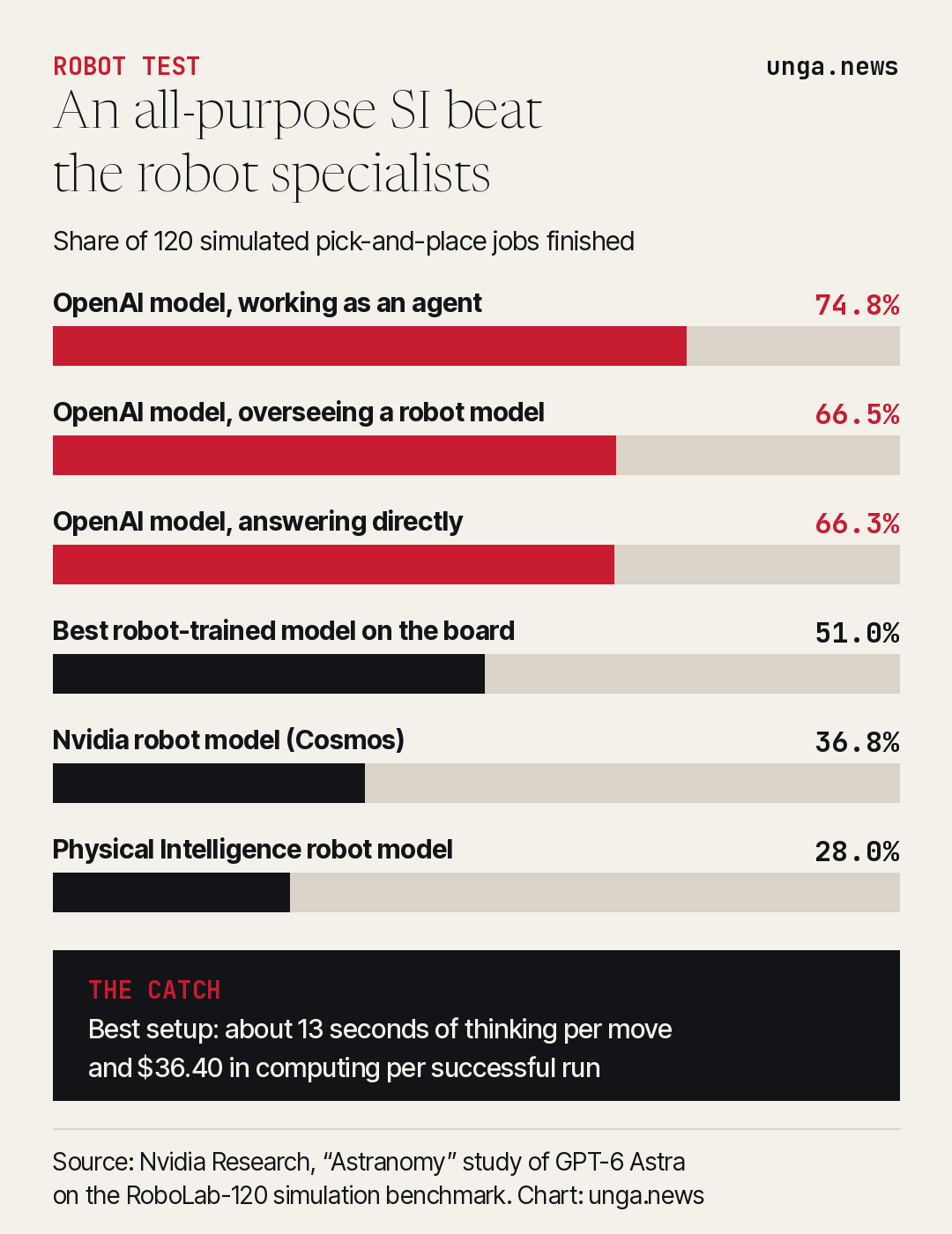
That is a 23.8-point margin over the specialists, and it came from a model whose day job is text, code and images.
Fast Hands Still Win on the Factory Floor
The same study is just as blunt about the bill. In direct mode, each call to Astra averaged 18.56 seconds. The agent setup that scored best averaged about 13 seconds per call and burned through 30.9 million tokens a run, which Nvidia priced at $36.40 per successful run. The direct mode cost $1.96. The specialized robot models, by contrast, answer in well under a second; Physical Intelligence’s model came back in about 47 thousandths of a second.
Picture a robot arm that stops and thinks for a quarter of a minute before each grab. That works in a simulation. It does not work on a packing line or in your kitchen.
Every number above also comes from a simulation, not a physical robot. Simulated wins have a long history of shrinking once real friction, real lighting and real cereal boxes get involved. The researchers say plainly that latency and cost are “a central consideration” for whether any of this gets used for real.
Guanya Shi, a robotics professor at Carnegie Mellon, told Fortune he reads OpenAI’s move as a signal that the company now sees robotics as “no longer a special problem,” just another job for a general SI, the way the same frontier models now power coding tools and legal assistants. He also said robots will still need small models running on their own onboard computers, because a big cloud model needs a constant internet connection and can’t react fast enough for tight control.
MIT professor Russ Tedrake, who runs Walden Robotics, made the case for the startups. Their robots are already clocking hours in real factories, and that on-the-job data makes them better at specific workplaces. Smarter base models, he argued, only make that site-specific data more valuable.
A Second Try, and a Bill Coming Due
This is the second time OpenAI has walked away from a stand-alone robot team. It shut down the first in 2020, when cofounder Wojciech Zaremba later pointed to a shortage of robot data and a faster path through training on text. That bet produced ChatGPT. OpenAI rebuilt a robot group in 2024 and teamed up with the humanoid startup Figure, a deal that ended in February 2025 when Figure decided to build its own robot brain.
Money matters here too. Fortune reports OpenAI lost about $10.9 billion in its most recent quarter, is trying to close a new funding round and is eyeing a possible stock-market debut in early 2027. Sam Altman has already told staff to drop “side quests,” and Sora was one of the casualties. Folding robotics into the core lab means the robot work rides on the model OpenAI was going to build anyway instead of paying for a separate one.
None of that cancels the humanoid. OpenAI says it is still building its own walking robot, and Altman is aiming for a first public demonstration in 2027.
If OpenAI is right, the expensive part of a household robot shrinks to a body and a fast local controller, with the smarts rented from the same SI people already use on their phones. If the startups are right, the robots learning on real job sites will keep the edge. Pete Florence, cofounder of the robot-model startup Generalist, put it simply to Fortune: “There may be different starting points for how to grow intelligence.”
For now, the score from Nvidia’s test favors the generalist, and the stopwatch favors the specialists.
Sources
- Fortune — Exclusive: OpenAI disbands its stand-alone robotics team as its general models start running robots (Nov. 13, 2026)
- Nvidia Research — Astranomy: An empirical study of GPT-6 Astra as a native robot policy (Yang, Khetan, Zhang)
- The Decoder — OpenAI reassigns robotics researchers to other teams as general-purpose models might make specialized robotics AI unnecessary