

Operation Blackout Reaches Nigeria: Nine Arrested, 53 Devices Seized as FBI Hunts Scammers Targeting Americans
The FBI and its Nigerian, Ghanaian and British partners hit West African scam networks in a single week. Here is what they seized, and how the bureau is bringing Nigerian sextortionists to American courtrooms.
The scammers who empty Americans' retirement accounts and the sextortionists who drive American teenagers to suicide have long counted on one thing: distance. They work from rented apartments and compounds in West Africa, thousands of miles from their victims, and they bet that no American cop will ever knock on the door.
FBI Director Kash Patel says that bet is off. On Sunday afternoon he posted the Nigeria results of Operation Blackout, the FBI's global campaign against overseas scam centers.
"Our latest operation in Nigeria delivered: 9 ARRESTS. 53 electronic devices seized. $11 MILLION in potentially freezable funds identified across multiple countries." (@FBIDirectorKash, Oct. 25, 2026)
— @FBIDirectorKash View on 𝕏
"These scam centers exploit innocent victims, steal life savings, and operate across international borders believing they are beyond the reach of law enforcement," Patel wrote. "They're wrong." He thanked "Nigerian law enforcement and our partners in London," and ended with a warning: "To the criminals targeting Americans from overseas: JUSTICE WILL FIND YOU." The FBI's graphic adds that Nigerian law enforcement will prosecute the suspects under Nigerian law, and that operations are ongoing.
What happened in Nigeria
The arrests came out of what the Justice Department calls West Africa's first "Joint Disruption Week," a coordinated push in the week of Oct. 6. The FBI, the Justice Department, the Secret Service, Homeland Security Investigations and Treasury worked alongside the Nigeria Police Force's National Cybercrime Center, Nigeria's Joint Case Team on Cybercrimes, Ghana's Cyber Security Authority and INTERPOL, with Britain's National Crime Agency hosting the operation at its London headquarters.
In Nigeria, nine people were arrested across Delta State, and agents seized six laptops, 35 phones and 12 routers, the 53 devices in Patel's post. Down the coast in Ghana, authorities in the Accra suburb of Sasaabi arrested 19 more people, seized 303 devices, and identified 117 victims of human trafficking, now pending return to Nigeria. Ghana's operation was led by its Cyber Security Authority, with support from the NCA, the FBI and Nigeria's Economic and Financial Crimes Commission.
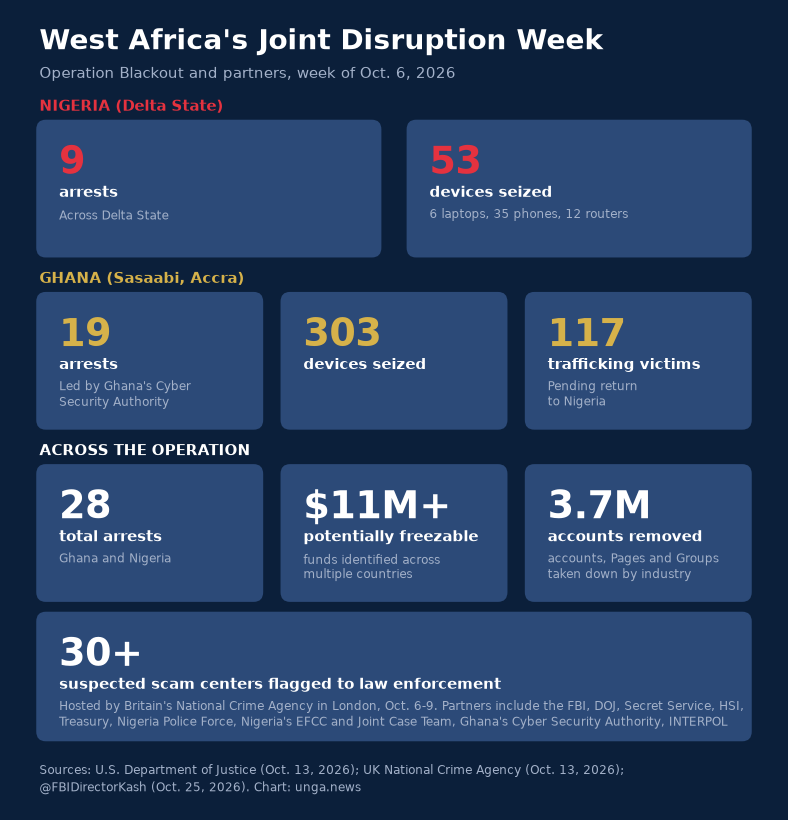
The tech industry pitched in too. Meta, Google, Microsoft, Coinbase, Binance and other companies removed more than 3.7 million accounts, Pages and Groups targeting people in the U.S., the U.K. and beyond, and shared leads on more than 30 suspected scam centers, the Justice Department said. Private-sector partners identified more than $11 million in potentially freezable funds. The schemes being run included law-enforcement impersonation, "digital arrest" extortion, and cryptocurrency investment fraud, the con known as "pig butchering."
"Thanks to brilliant partnership with the Department of Justice and the private sector, across multiple African countries, we arrested dozens of criminal actors, seized hundreds of devices, identified at least $11 million in potentially freezable funds, and truly saved lives," Patel said in the department's release. "We are demolishing Scam Centers across the globe and crushing a criminal industry preying on American citizens."
What the partners said
Britain's National Crime Agency, which hosted more than 100 officers and industry representatives in London, credited the partnership. "Fraudsters can operate from anywhere and will target victims both domestically and globally," said Nick Sharp, the NCA's deputy director of fraud. "Collaborating in this way sends a clear signal to criminals that the combined capabilities of law enforcement and industry means that we will relentlessly pursue them and the infrastructure they rely on no matter where they operate." Britain's fraud minister, Lord Hanson, thanked "all the officers involved in intercepting and arresting these scammers."
Assistant Attorney General A. Tysen Duva of the Justice Department's Criminal Division called the arrests "just the beginning" and said he was "especially grateful to the courageous law enforcement officers in Ghana and Nigeria who put themselves in harm's way to seize evidence and arrest the criminals who prey on innocent people." U.S. Attorney Jeanine Pirro of Washington, D.C., who founded the department's Scam Center Strike Force, put it simply: "Transnational fraud demands a transnational response."
Blackout is bigger than Nigeria
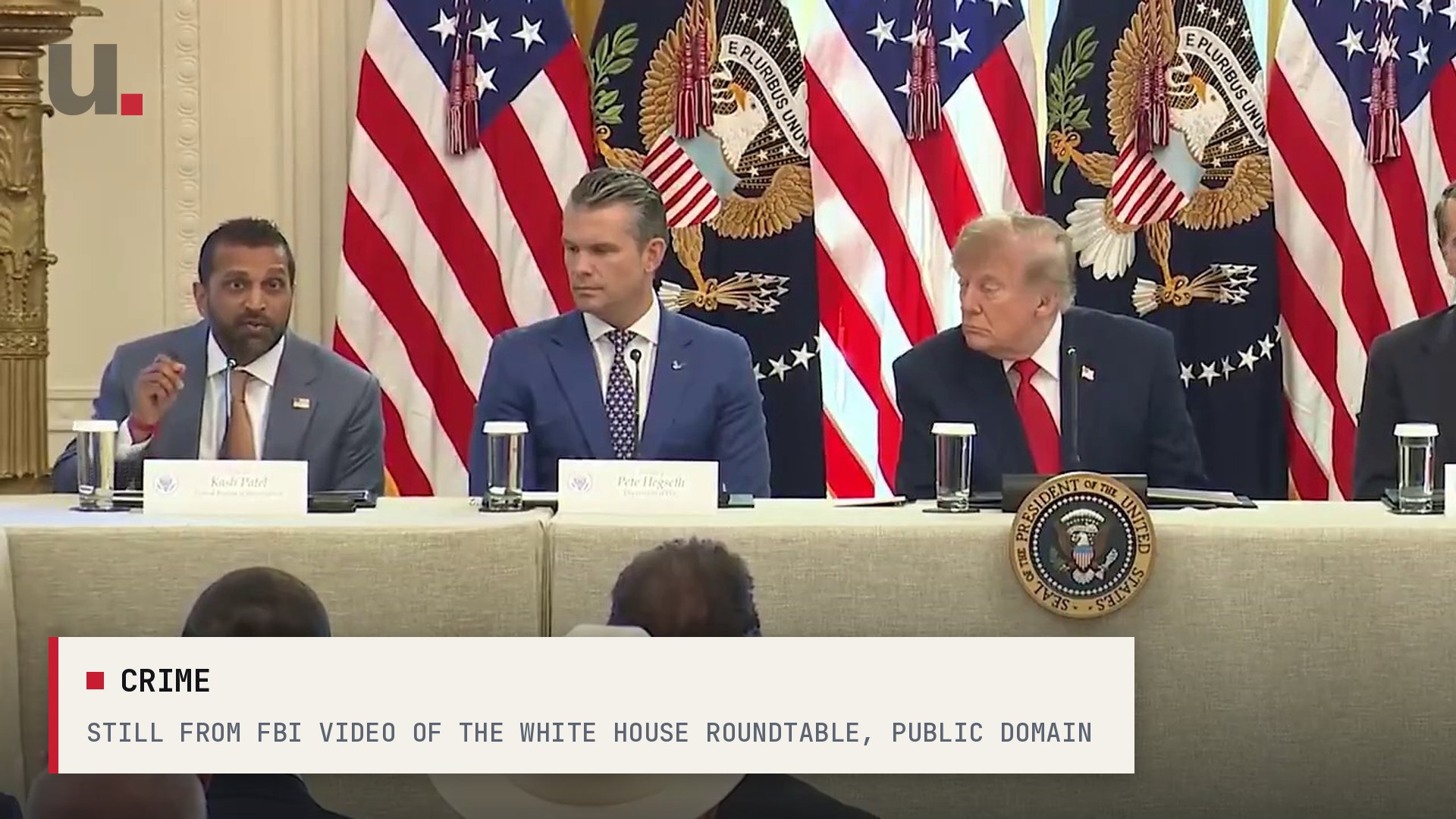
Nigeria is one front in a much bigger fight. Patel laid out the full campaign at a White House roundtable on cybercrime with President Trump on Oct. 21: more than 20 scam compounds demolished, more than $17 billion seized, and 11,000 Americans warned in time to save them from $675 million in fraud.
"20+ scam compounds DEMOLISHED. $17 BILLION+ seized. 11,000 Americans protected from $675 MILLION in fraud." (@FBIDirectorKash, Oct. 21, 2026)
— @FBIDirectorKash View on 𝕏
The sextortion pipeline from Nigeria
For American families, the most dangerous product of West African scam networks is financially motivated sextortion. A scammer poses online as a teenage girl, gets a boy to send an explicit image, and then threatens to send it to his family and classmates unless he pays. The Justice Department says the Nigeria-based networks behind these schemes are "directly linked to dozens of American teen deaths by suicide."
The FBI has been going after them on the ground. Under Operation Artemis, the bureau surged agents, analysts and forensic experts to Nigeria, working with Australian and Canadian police and Nigeria's EFCC, and the operation ended with 22 arrests in Nigeria, according to the Australian Federal Police. More than 20 American teenagers have died by suicide in sextortion cases since 2021, the AFP said.
The cases are ending up in American courtrooms. On Aug. 27, FBI agents flew to Nigeria and brought back Adebola Festus Adekunle, 26, and Mudasiru Afeez Olawale, 24, each charged in the sextortion of an American minor who died. Adekunle faces charges including sexual exploitation of a minor resulting in death in Mississippi, and Olawale faces charges in North Carolina, where a federal indictment says one of his victims died. The child exploitation resulting in death charge carries a mandatory minimum of 30 years.
"They've been overseas for three years, but this FBI and our DOJ partners went and got them," Patel said. "Sextortion is a heinous crime targeting innocent people, often young children - and this FBI will stop at nothing to pursue every single individual who harms vulnerable Americans."
Nigeria's anti-graft agency, the EFCC, carried out the extraditions on its end. Nigeria's Court of Appeal cleared the way on July 7, 2026, overturning a lower court's refusal to extradite, the EFCC said. The commission called the handover proof of "the continued collaboration between the EFCC and the FBI in tackling transnational financial crimes, particularly internet-enabled crimes involving the exploitation of minors and sextortion."
The model case is Jordan DeMay, a 17-year-old high school student in Marquette, Mich., who died on March 25, 2022, after two Nigerian brothers, Samuel and Samson Ogoshi, sextorted him. Extradited from Nigeria in August 2023, they pleaded guilty and were each sentenced to 210 months in federal prison. Prosecutors said the brothers had targeted more than 100 victims, including at least 11 minors.
What the FBI's complaint data shows
The scale shows up in the FBI's Internet Crime Complaint Center. In 2025, IC3 took in 1,008,597 complaints reporting $20.9 billion in losses, up 26% from the year before. Investment fraud was the costliest category at $8.6 billion, and cryptocurrency investment scams alone cost Americans more than $7.2 billion. Romance and confidence scams took another $929 million.
Sextortion is its own epidemic. IC3 received more than 75,000 sextortion reports in 2025, including 11,316 from victims under 20, and referred more than 5,700 complaints involving minors to the National Center for Missing & Exploited Children. The biggest dollar losses fell on Americans 60 and older, at $14.9 million.
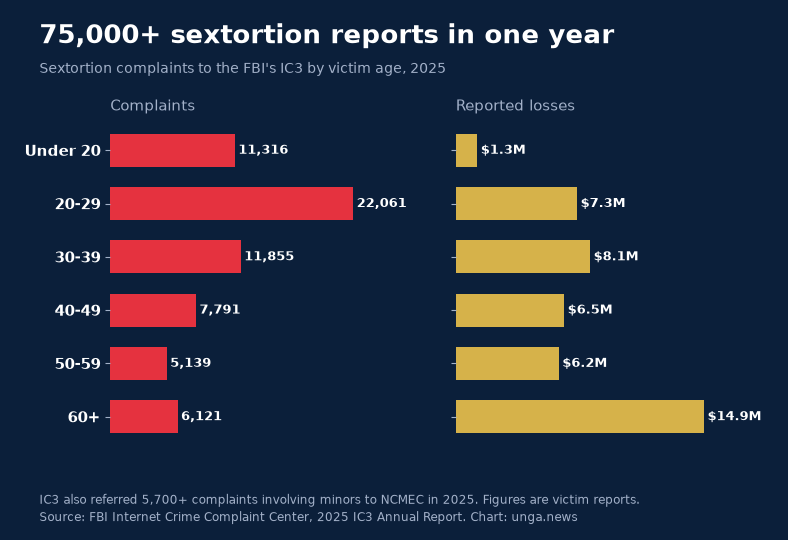
Those numbers come from victims who came forward. The Justice Department says reported losses "are believed to significantly underrepresent actual losses, as many victims do not report to law enforcement."
How to fight back
Patel's message to the public was direct: report it. "No piece of information is too small," he told the president. "Every piece of information you give us allows us to cripple this global criminal syndicate."
Victims of online fraud or sextortion can report at ic3.gov or tips.fbi.gov, or call 1-800-CALL-FBI. The FBI's advice to anyone caught in a sextortion scheme: block the sender, report the behavior to the platform, and tell someone, such as a parent or another trusted adult. "Being a victim of sextortion is not your fault," the bureau says. "There are people who want to help."
The bottom line
For years, West African scam rings treated distance as armor. In one week in October, nine suspects in Nigeria and 19 more in Ghana found out it isn't, and two accused sextortionists linked to the deaths of American boys now face charges in American courtrooms. Patel's warning was the right one: to the criminals targeting Americans from overseas, justice will find you.
Sources
- 𝕏 / @FBIDirectorKash — Operation Blackout: Nigeria results (Oct. 25, 2026)
- U.S. Department of Justice — Results of Law Enforcement and Private Industry Joint Disruption Week Targeting Online Scam Accounts and Transnational Criminal Networks Operating in West Africa (Oct. 13, 2026)
- UK National Crime Agency — NCA hosts international law enforcement and tech industry crackdown on fraud and scams (Oct. 13, 2026)
- 𝕏 / @FBIDirectorKash — Operation Blackout: 20+ scam compounds demolished, $17 billion+ seized (Oct. 21, 2026)
- 𝕏 / @FBI — Director Patel: "We are not waiting for the scammers to hit our citizens" (Oct. 22, 2026)
- 𝕏 / @FBI — Operation Blackout is taking the fight directly to the source (Oct. 22, 2026)
- U.S. Department of Justice — Two Nigerian Nationals Extradited from Nigeria to the United States to Face Sextortion Charges in North Carolina and Mississippi (Aug. 28, 2026)
- EFCC — Two Extradited to U.S. for Alleged Child Exploitation, Sextortion (Aug. 28, 2026)
- Australian Federal Police — International operation results in arrest of 22 men in Nigeria for sextortion (June 2, 2025)
- U.S. Attorney's Office, W.D. Mich. — Ogoshi Brothers Sentenced To Lengthy Prison Terms In Sextortion Scheme That Resulted In Death Of Teen (Sept. 5, 2024)
- FBI IC3 — 2025 IC3 Annual Report