

Oregon’s Governor Wants to Ban ICE Detention Centers. California and New Jersey Tried That and Lost.
Gov. Tina Kotek wants a law to keep immigration detention out of Oregon for good. Federal appeals courts already struck down two states’ bans, and Homeland Security says sanctuary politicians don’t run federal law enforcement.

Oregon Gov. Tina Kotek wants her state to slam the door on immigration detention for good. Two states already tried to slam that same door, and two federal appeals courts made them open it back up.
At a press conference Friday, Kotek was asked what more Oregon could do to push back on federal immigration enforcement. Her answer was a new law. “I would like to see a bill that we can have here in Oregon to never allow detention facilities in the state of Oregon,” she told reporters, according to the Oregon Capital Chronicle, which first reported her remarks. “We don’t have one now. I don’t think we should have them. We need to stop that.”
Her office declined Tuesday to say what kind of bill she wants. The Department of Homeland Security had a much shorter answer. A spokesperson said the agency has no new facilities to announce “at this time,” then added the line that sums up the whole fight: the Constitution’s supremacy clause “makes it clear that sanctuary politicians do not control federal law enforcement.”
That isn’t just a talking point. It’s what the courts have already said, twice.
California went first, and lost 8 to 3
In 2019, California passed AB 32, a law that said a “person shall not operate a private detention facility within the state.” It sounded like a prison reform. In practice it hit Immigration and Customs Enforcement, which relied almost entirely on privately run facilities in California, two of them run by the GEO Group.
GEO and the federal government sued. In September 2022 the full 9th Circuit, hardly a conservative bench, ruled against California 8 to 3. Judge Jacqueline Nguyen wrote for the majority, and the conclusion was blunt: whether you call it intergovernmental immunity or preemption, “California cannot exert this level of control over the federal government’s detention operations.”
Complying with AB 32 would have forced ICE to shut down its detention operations in California and start over from scratch. States don’t get a veto over how Washington enforces federal law.
New Jersey tried a cleverer version
New Jersey watched California lose and tried a different angle. Its law, AB 5207, signed in 2021, didn’t ban detention centers outright. It banned the state, local governments and private companies from signing, renewing or extending any contract to hold people for civil immigration violations. Lawmakers wrote their “intent” into the statute: to prevent new, expanded or renewed detention agreements.
The target was obvious. CoreCivic had run an immigration detention center in Elizabeth, New Jersey, under a federal contract since 1996. When that contract came up for renewal in 2023, the new law blocked it. CoreCivic sued.
In July 2025 the 3rd Circuit threw the law out, 2 to 1. Judge Stephanos Bibas wrote the opinion, joined by Judge Cheryl Ann Krause, and he didn’t mince words. “New Jersey is on the wrong side of that line,” he wrote. The state, he said, “dislikes some of the federal government’s immigration tools, so it passed a law” aimed at stopping them.
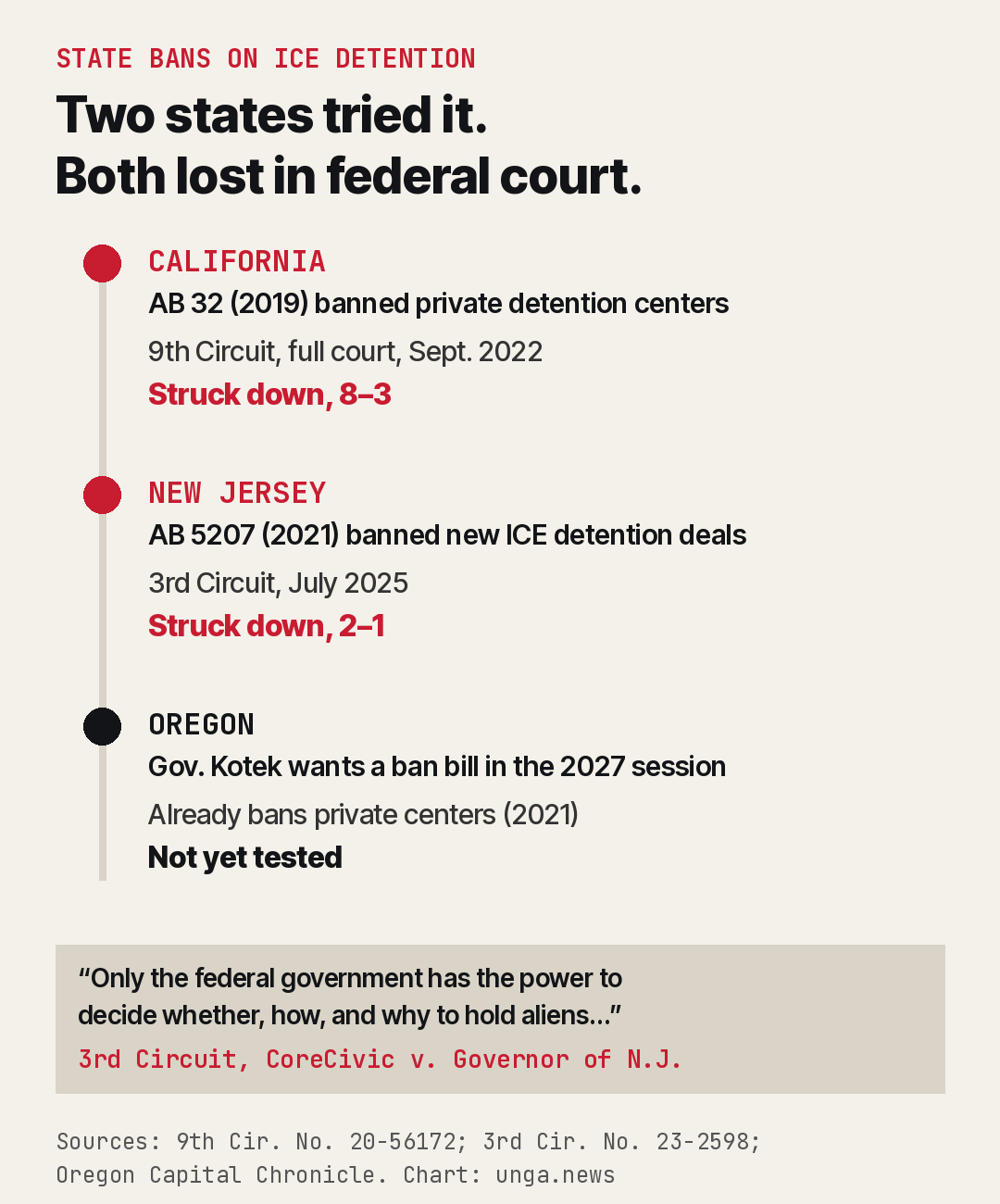
The heart of the ruling is a sentence Oregon lawmakers should tape to their desks: “Only the federal government has the power to decide whether, how, and why to hold aliens for violating immigration law. It alone has the power to make these contracts in the first place.” Because the only buyer of private immigration detention is the federal government, the court said, a ban on selling it “destroys the federal government’s marketplace.” It was a direct regulation of Washington dressed up as a rule for contractors.
The stakes were real. ICE told the court Elizabeth was the only facility in New Jersey that met its needs, and its spot near JFK and Newark made it “crucial” for removals nationwide. The fallback was a center in the middle of Pennsylvania, more than 250 miles away.
When New Jersey defended its law on appeal, a group of Democratic-led states filed a brief backing it. Oregon was one of them. So Oregon has already seen this argument up close, and watched it fail.
Oregon’s own law already pushes the limit
Oregon is one of only a few states without an overnight, large-scale federal immigration detention facility. People picked up in Oregon are held briefly at processing sites such as Portland’s and then moved to long-term detention in Tacoma, Washington. The state’s 2021 Sanctuary Promise Act already bans private immigration detention centers and bars state and local agencies from helping with immigration enforcement without a judicial warrant.
A new bill could try to go further by controlling how state services like utilities and permits are handed out for detention projects, the Capital Chronicle reports. That’s the same back-door play New Jersey tried with contracts.
Even a Portland law professor isn’t buying it. Tung Yin of Lewis & Clark Law School told the Capital Chronicle he understands why Kotek would push a bill “as a statement of Oregon’s commitment to sanctuary status,” but “I don’t see any way in which this could survive a challenge by the federal government.” He noted that courts have already blocked state laws banning masks on federal agents after the federal government sued, and a detention ban goes far deeper than masks.
The Newport fight that set this off
Kotek’s push grows out of a fight over Newport on the Oregon coast. Federal officials acknowledged in court that they were interested in using the U.S. Coast Guard site at Newport’s municipal airport as a temporary processing or holding facility. Oregon sued, using federal environmental and administrative rules rather than state law.
That case settled in October. Attorney General Dan Rayfield announced that ICE confirmed it has no current plans to build detention centers in Newport or anywhere in Oregon, and agreed to give at least 30 days’ notice before starting environmental permitting for a Newport facility. That promise covers only Newport, and it runs out in August 2027.
State Rep. David Gomberg, D-Otis, told the Capital Chronicle the settlement “leaves the door wide open” and that he’s in early talks about “a tool to close that door.” “It’s early — we had an election last week,” he said. “We’re gonna have another session in two months.”
So Oregon Democrats will likely spend part of the 2027 session writing a law two federal appeals courts have already told other states they can’t have. If it passes, the federal government won’t need a new legal theory. It can hand the judge the California and New Jersey opinions and let them do the talking.
Sources
- Oregon Capital Chronicle — Gov. Kotek wants Oregon to ban immigration detention centers. Others have tried and failed.
- U.S. Court of Appeals for the 3rd Circuit — CoreCivic, Inc. v. Governor of New Jersey, No. 23-2598 (July 22, 2025)
- U.S. Court of Appeals for the 9th Circuit — The GEO Group, Inc. v. Newsom, No. 20-56172 (en banc, Sept. 26, 2022)
- Oregon Department of Justice — Sanctuary Promise guidance