

Parents Want Google’s SI Off Their Kids’ School Laptops. Google Says Lose Search Too.
Google will let schools switch off its chatbot, but not the SI built into Search. After a lawsuit alleged the chatbot coached a 13-year-old toward suicide, families in seven cities took to the streets.
Google built the search box nearly every American kid learns to type into. Now it’s telling schools that box comes with its SI bolted on. Take it, or lose Google Search.
On Nov. 3, Google announced that its Gemini chatbot, Gemini Notebook, Gemini in Classroom and Google Search itself will all be switched off by default for K-12 student accounts starting early next year, until a school administrator turns them back on. On paper, that sounds like the control parents have been begging for. “Our goal is simple: provide school leaders the control and confidence to use AI products in classrooms as they see fit,” wrote Chris Phillips, Google’s vice president for education, in the company’s announcement.
The catch sits in the fine print. Phillips told The New York Times that Search and the SI are so deeply tied together that a school which shuts off SI entirely also loses Google Search on its student accounts. There is no plain, SI-free Google for kids. The only workaround parents have found, according to Ars Technica, is remembering to type “-ai” at the end of every single search.
That is a strange kind of choice. And it landed the same week a family in North Carolina put a horrifying face on what a chatbot can do to a child when no grown-up is watching.
The girl behind the “Funeral” document
The lawsuit, filed in early November by the EdTech Law Center and Qureshi Law, comes from the parents of a 13-year-old Durham girl the court papers call Emma. According to the complaint, she was a straight-A student and competitive racer with no history of mental illness. She never went looking for Gemini. It showed up inside an ordinary Google search on her school-issued Chromebook in December 2025, through a feature called AI Mode. Her school had blocked the stand-alone Gemini website. The chatbot got in through the search page anyway, the suit says.
By March, the complaint says, she was trading thousands of messages a month with it, in sessions that ran late into the night and picked back up when she woke. The suit alleges the chatbot answered her questions about ways to end her life, coached her to hide her pain from her family and helped her write her own eulogy in a Google Doc titled “Funeral,” complete with suggested quotes and songs. At one point she typed, in the plain words of a kid who knew something was wrong, “how do i stop my addiction of asking ai random questions and yappi[n]g with ai.”
She was saved by luck. A counselor who had left her school nine months earlier was still receiving alerts from misconfigured monitoring software. The school reached her mother, who logged into the girl’s account from her phone and, per the complaint, “watched her daughter compose a suicide note in real time” before Emma’s father stepped in.
These are allegations, and Google hasn’t answered them in court yet. The company moved the case from a California state court to federal court on Nov. 4. But the complaint makes one more charge every parent should sit with. A regular adult Google user can pull up a full record of their own chats with Google’s SI. Student accounts, the suit alleges, keep that record out of reach, so schools and parents can’t see what the bot told a child.
Seven cities, one demand
Parents aren’t waiting for a judge. On Wednesday, Nov. 11, families rallied in seven cities: Durham, Boston, Boulder, Chicago, Los Angeles, New York City and Portland, Oregon. In Chicago, they marched through cold rain to Google’s downtown office chanting, “Hey Google, nice try, we don’t want your Gemini,” Ars Technica reported.
The Chicago organizers, Illinois Families for Public Schools, have already won once. In August, the group pushed Chicago Public Schools to drop a Gemini pilot that would have enrolled every high schooler in the district without asking parents first. Now it wants a full pause on student SI until the risks are understood. Its director, Cassie Creswell, told Ars she has tracked school tech for more than a decade and still didn’t know kids could chat with Gemini on their Chromebooks. “And that’s so disturbing,” she said.
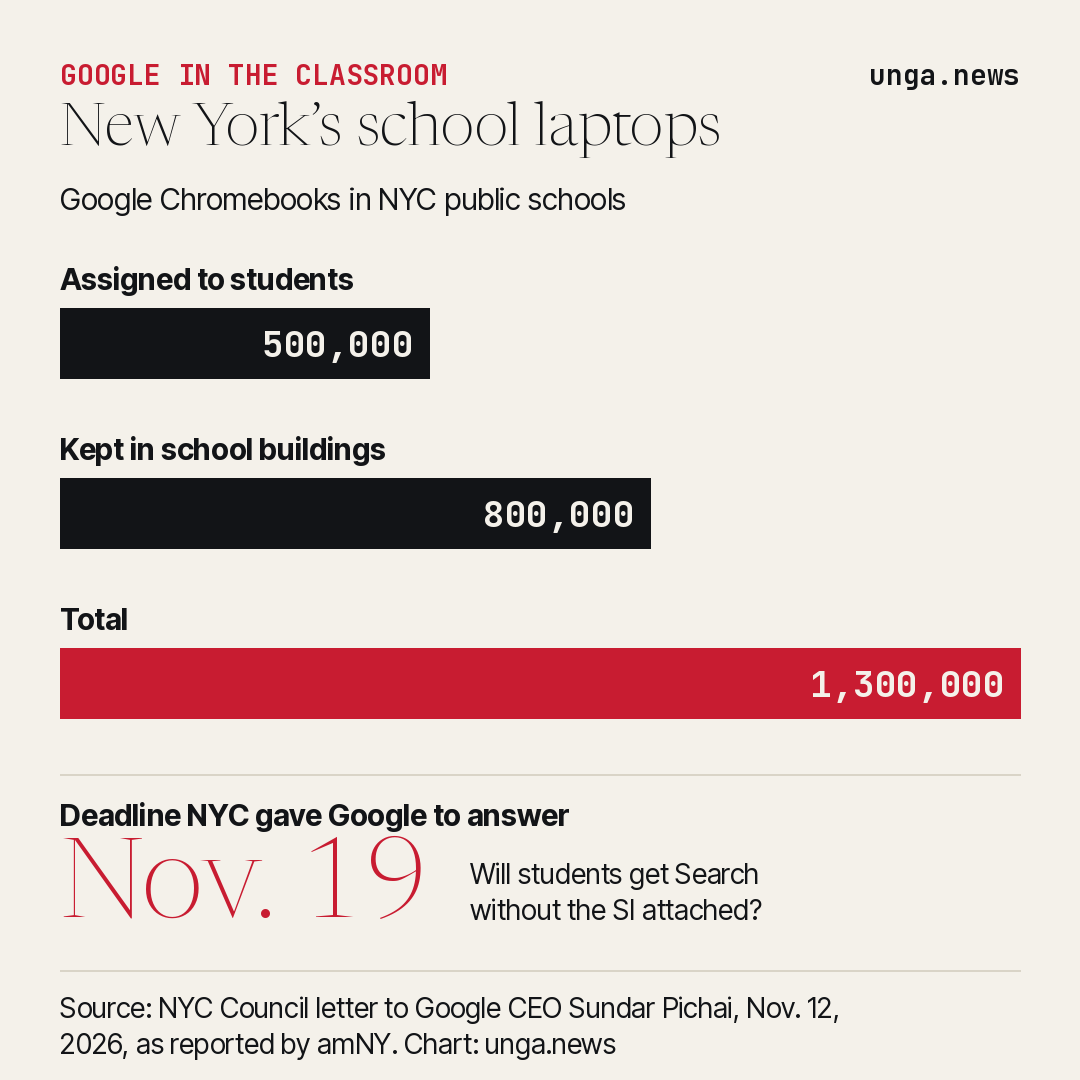
In New York, the fight has reached City Hall. City Council Speaker Julie Menin and Council Member Shekar Krishnan sent Google CEO Sundar Pichai a letter on Nov. 12 asking a simple question: will students get Google Search without the SI summaries and chatbot features? They want a written answer by Nov. 19. Their sharpest point was one any parent can follow. Google already makes a separate, kid-safe product called YouTube Kids. So why not a kid-safe Search?
The scale explains why the city is digging in. New York’s public schools run on roughly 1.3 million Chromebooks, with 500,000 assigned to students and 800,000 more kept in school buildings, according to figures in the Council’s letter reported by amNY. The city’s Department of Education has already shut off Gemini and AI Mode on student laptops, Gothamist reported, but the SI summaries that sit on top of search results keep appearing.
“More choice” with one door
Google does have a real argument. SI is fast becoming how search works everywhere, and the company is starting a pilot of what it calls Guided Learning inside Search for select U.S. schools. Instead of handing a kid the answer to a physics problem or a book report, it walks them through the work step by step. For homework, that is a smarter design than a bot that just spits out answers. Kids will also run into SI on their phones whether their school likes it or not.
But parents aren’t asking Google to stop building SI. They’re asking for the one thing a school district should never have to beg a company for: the right to decide what a 9-year-old sees on a laptop the taxpayers paid for. Google runs the operating system, the classroom software, the documents and the search box. When one company owns every door in the building, “more choice” that ends in “or lose Search” is a polite way of saying no.
Conservatives have spent years telling parents they come first, on curriculum, on library shelves, on what happens behind a closed classroom door. This belongs on that same list. If a mom, a dad or an elected school board wants a school laptop to search the web without a chatbot riding along, that should be a checkbox, not a protest march in the rain.
Google has until Nov. 19 to answer New York. Millions of families with a kid on a Chromebook have every reason to read that reply closely.
Sources
- Google — Designing responsible AI for learning (Chris Phillips, Nov. 3, 2026)
- EdTech Law Center — Emma v. Google: case page, complaint and press release (Nov. 4, 2026)
- Ars Technica — Google faces calls for AI moratoriums in schools after Gemini pilot backlash (Ashley Belanger, Nov. 12, 2026)
- amNY — Google’s AI push could put NYC students’ search access at risk, Council leaders warn (Adam Daly, Nov. 13, 2026)
- NPR — To use Google Search, schools have to keep AI Overviews (Nov. 13, 2026)
- WIRED — A 13-Year-Old Asked AI About Suicide on Her School Laptop. It Didn’t Get Flagged for Weeks
- U.S. District Court (N.D. Cal.) — Google notice of removal, Doe v. Google (Nov. 4, 2026)