

Pelosi’s House Broke the Constitution to Pass a $1.7 Trillion Spending Bill, a Federal Court Rules
Most members weren’t in the room when the 2022 bill passed. Nine appeals judges just said absent lawmakers can’t be counted as “present” by proxy.
On Dec. 23, 2022, two days before Christmas, the House of Representatives passed a $1.7 trillion spending bill with most of its members nowhere near the chamber. On Friday, a federal appeals court said that was not a technicality. It was a violation of the Constitution.
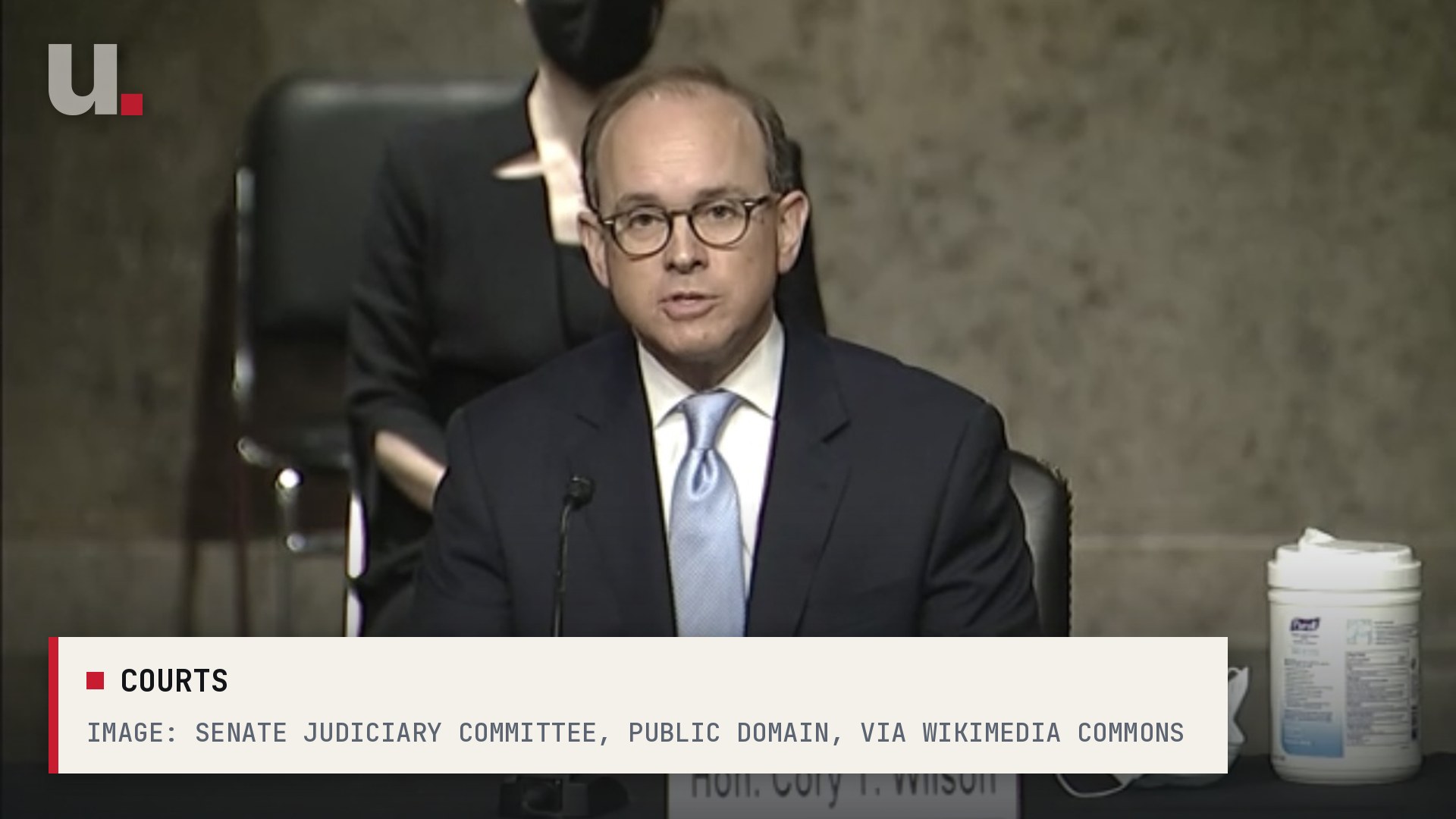
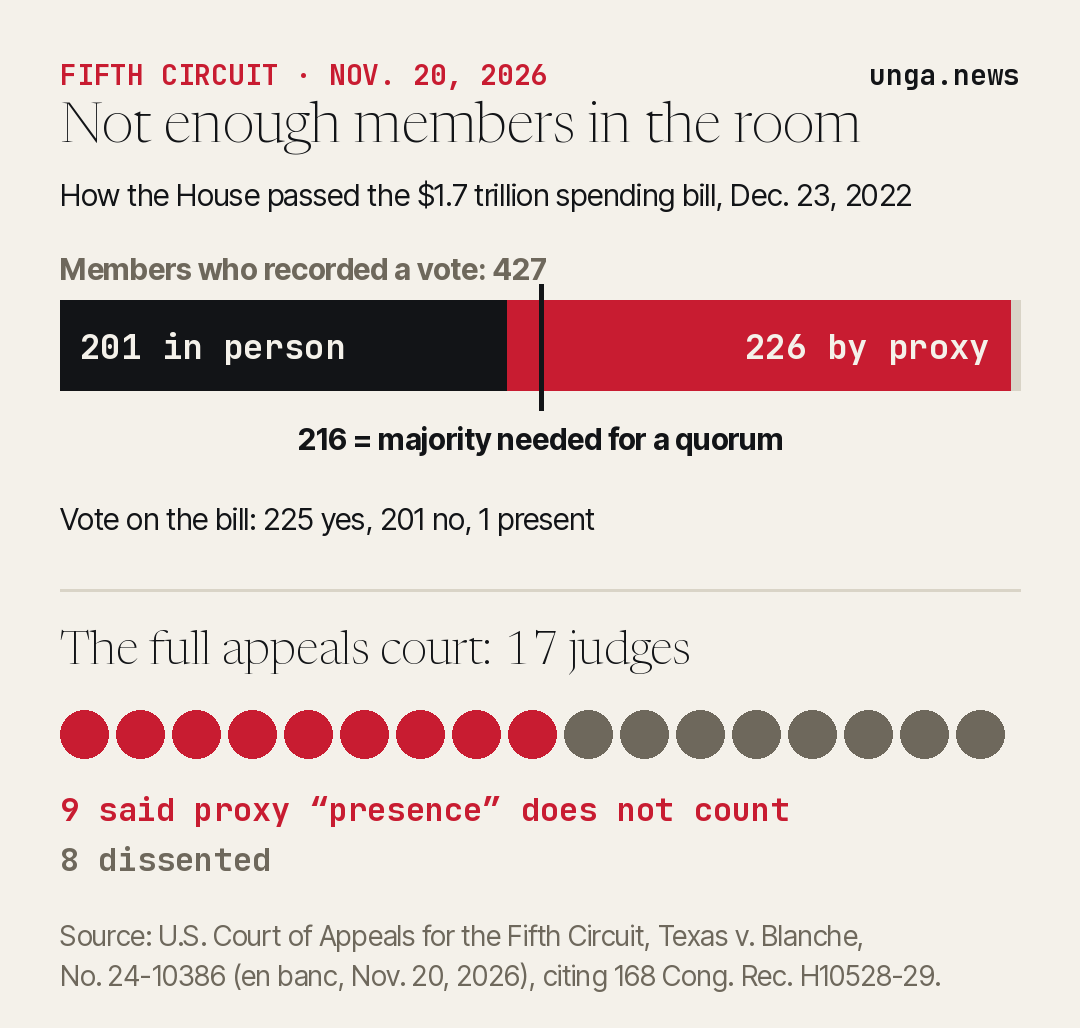
The full U.S. Court of Appeals for the Fifth Circuit ruled 9-8 that the House broke the Constitution’s Quorum Clause when it used a pandemic-era rule to count absent members as “present” by proxy. The 56-page opinion, written by Judge Cory T. Wilson, is blunt about it: “‘Proxy presence’ does not count.”
The case was brought by Texas. Attorney General Ken Paxton’s office went after one piece of that 2022 bill, the Pregnant Workers Fairness Act, arguing that if the House never had a lawful quorum, the federal government can’t enforce the law against the state. A federal judge in Lubbock agreed and blocked enforcement against Texas. The full appeals court has now upheld that order.
A rule written for COVID, used for everything
The rule goes back to May 2020, when Speaker Nancy Pelosi’s House adopted House Resolution 965 in the early weeks of the pandemic. It let one member cast votes for an absent colleague who sent a signed letter, and it said any member whose presence was recorded by a proxy “shall be counted for the purpose of establishing a quorum.” The House kept the rule through the next Congress.
By December 2022, nobody was treating it as an emergency measure. According to the Congressional Record cited in the ruling, the final vote on the spending package was 225 yes, 201 no, with one member voting present. Of the 427 members who recorded a vote, 226 did it by proxy. The House had 431 members at the time, so a quorum required 216 actually there. Fewer than that were in the room.
Rep. Chip Roy, the Texas Republican, flagged the problem on the floor that day. He said the bill was “moving off the floor without a physical quorum present” and asked how a quorum could exist when “there were 226 votes cast by proxy, i.e., not physically present in the Chamber.” The presiding officer, then-Rep. G.K. Butterfield, answered that members voting by proxy were counted for the quorum. Roy had no further recourse in the chamber. Nearly four years later, a court has taken up his point.
Republicans scrapped proxy voting when they took control of the House in January 2023. But the laws passed under it stayed on the books, and that is what made Texas’s lawsuit matter.
What the Founders meant by “present”
The Constitution says that “a Majority of each” chamber “shall constitute a Quorum to do Business.” The court said the text, the history and more than two centuries of practice point the same way: a member has to be there to count.
The majority leaned hard on a Supreme Court case from 1892, United States v. Ballin. In that case the House counted members who were sitting in the chamber but refusing to vote, and the justices said that was fine because those members were physically present. Wilson wrote that the Constitution’s quorum rule rests on presence “as the Supreme Court expressly held over 125 years ago, and as Congress has done ever since the Founding.”
The Justice Department, which defended the law, made two arguments. First, it said courts can’t look behind a signed bill at all, under the old “enrolled-bill rule” that treats a law’s official text as conclusive proof it passed. Second, it said each chamber gets to write its own rules, so the House could decide proxies count. The court rejected both. Texas wasn’t disputing any fact about what happened in the House, the majority said; the Congressional Record shows the proxies plainly. And “while the chambers of the legislature have much discretion regarding their rules of procedure, the Quorum Clause’s constraints on congressional power cannot be circumvented by congressional fiat.”
A reversal, and an angry dissent
This ruling flips the result from last year. In August 2025, a three-judge panel of the same court sided with the federal government and threw out the injunction. Wilson dissented then. Texas asked the full court to rehear the case, and on Friday Wilson’s view won, joined by Chief Judge Jennifer Walker Elrod and Judges Edith Jones, Jerry Smith, Don Willett, James Ho, Stuart Kyle Duncan, Kurt Engelhardt and Andrew Oldham.
Judge James Graves wrote the main dissent for seven judges. He accused Texas of “attempting to veto Congress’s protections for pregnant workers and new parents while retaining millions in federal funding,” and argued the majority “shoehorns a much larger requirement into the Constitution” by demanding physical presence. His closing line: “the majority’s decision is illogical, inexplicable, and invalid.” Judge Catharina Haynes added a short note saying she didn’t think it was appropriate to “throw out the Federal House of Representatives in this arena.”
The relief itself is narrow. The order bars the Justice Department and the Equal Employment Opportunity Commission from enforcing the pregnant workers law against Texas as an employer. It doesn’t erase the whole spending bill, and pregnant workers elsewhere keep the same federal protections they had on Thursday.
The reasoning reaches far past one statute. That 2022 omnibus was a catch-all, more than 4,000 pages, and it carried other major laws along with the spending, including the Electoral Count Reform Act, the rewrite of how Congress counts presidential electors. A post on Election Law Blog warned Friday that the ruling’s logic could threaten that law and others passed the same way.
The proxy rule governed House votes from mid-2020 through the end of 2022. Anyone challenging a law passed that way in Texas, Louisiana or Mississippi now has a Fifth Circuit ruling to point to, and the Justice Department can ask the Supreme Court to settle the question for the whole country.
Hundreds of bills cleared the House under the proxy rule between 2020 and the end of 2022. Anyone sued under one of them in Texas, Louisiana or Mississippi now has a Fifth Circuit ruling to point to, and the Justice Department can ask the Supreme Court to settle it.
For conservatives who called the proxy rule a shortcut from day one, Friday’s ruling is vindication. Chip Roy stood on the floor and said there was no quorum. Texas took the point to court. Nine judges have now agreed that a Congress that wants to spend $1.7 trillion has to show up to do it.
Sources
- U.S. Court of Appeals for the Fifth Circuit — State of Texas v. Blanche, No. 24-10386 (en banc opinion, Nov. 20, 2026)
- U.S. Court of Appeals for the Fifth Circuit — Texas v. Garland, No. 24-10386 (panel opinion, Aug. 15, 2025)
- NBC News — House unconstitutionally passed spending bill in 2022, appeals court rules (Nov. 20, 2026)
- Election Law Blog — En banc 5th Circuit decision threatens to hold Electoral Count Reform Act (among other laws) unconstitutional