

Perplexity Now Puts Up to 16 SI Helpers on One Job, and They Check Each Other’s Work
A new top setting lets Claude, GPT and Gemini agents split up hard tasks like financial forecasts and tax prep, then catch each other’s mistakes. It costs extra, and Perplexity says to save it for big jobs.
Ask one SI chatbot a hard question and you get one answer, delivered with the same confidence whether it’s right or wrong. Perplexity’s bet, launched Tuesday, is that the fix is a second opinion, and a third, and up to a sixteenth, all from different companies’ models arguing it out before you ever see a word.
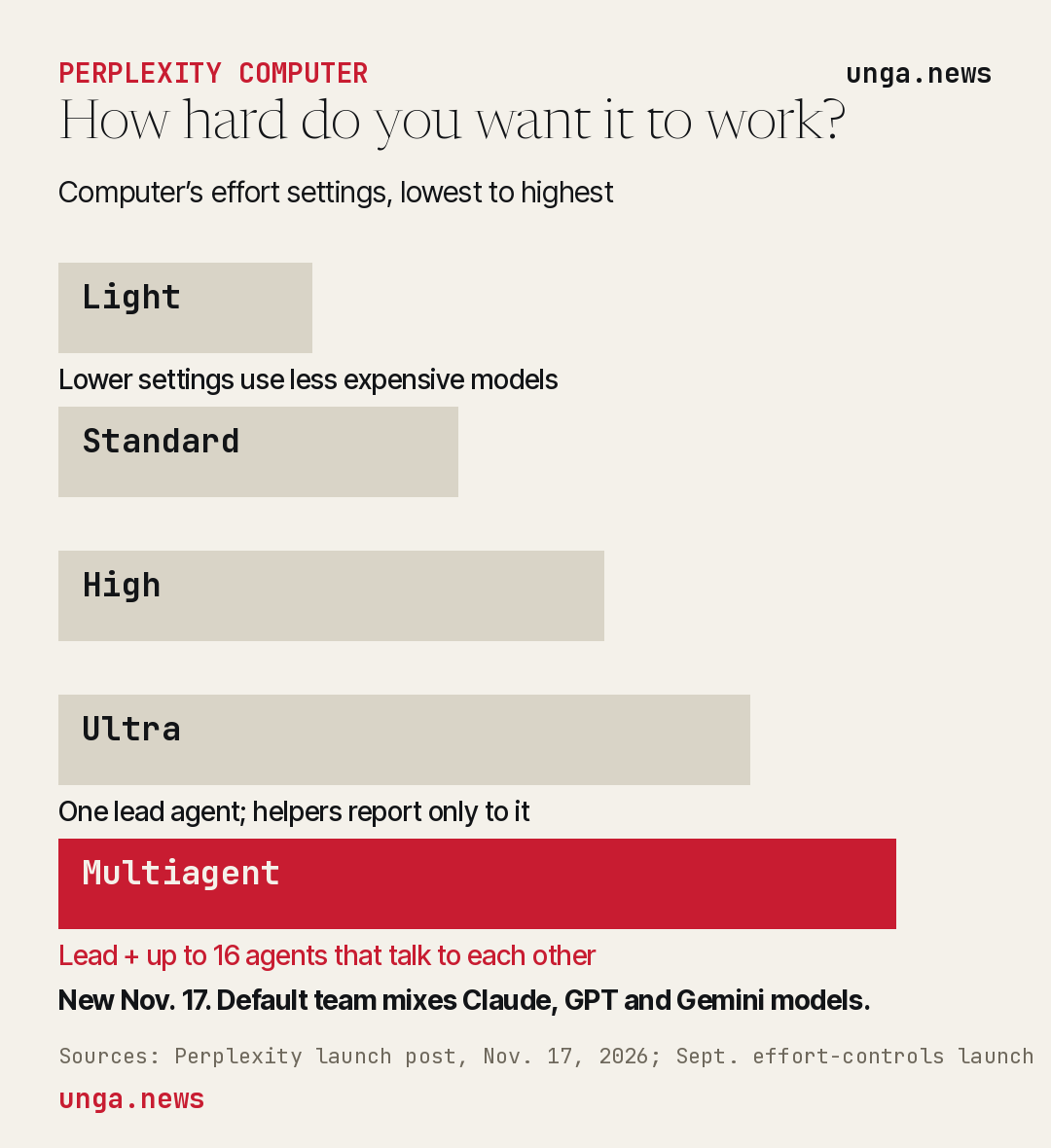
The company added a setting called Multiagent to Computer, its agent product that researches questions and carries out multistep work such as analyzing data or building apps. Pick it on the effort slider and a lead agent plans the job, splits it into pieces and hands them to as many as 16 helper agents. The lead takes a piece of the work itself, then stitches everything back into one answer.
Post by @perplexity_ai
— @perplexity_ai View on 𝕏
Bots from rival companies on one team
The interesting part is who sits on the team. By default, Perplexity says, Anthropic’s Claude Fable 5.2 runs the show and farms work out to agents running Claude Opus 5.5, OpenAI’s GPT 6.1 Sol and Google’s Gemini 4 Carbon. Two pricier models, Fable 5.2 and GPT 6 Astra, join as helpers only when a user asks for them or a piece of the task calls for them. You can also name the models you want right in your request.
That mix is the whole pitch. Models from different labs are trained differently and tend to make different mistakes. Put them side by side and one can catch what another missed. Perplexity says its agents now “share findings directly with each other, and check each other’s work.” One agent can use evidence another dug up, question an assumption, or flag a number that doesn’t add up for a closer look.
That is the change from the setting below it. Ultra, the previous top level, also used one lead agent with helpers, but those helpers reported only to the boss and never talked to each other. In Multiagent the agents also edit shared files together. Perplexity’s example: one agent updates the revenue assumptions in a financial model, then tells another agent to use those new figures in its valuation.
The jobs it’s built for
Perplexity isn’t selling this for recipe ideas. Its examples are the kind of work people pay accountants, analysts and lawyers to do: building several financial forecasts at once and comparing their assumptions, combing an annual report’s statements, footnotes and management commentary for figures that don’t match, digging through a deal’s contracts and operating records, and sorting a year’s income and deduction records to prepare questions for a tax professional.
Notice the wording on that last one. Perplexity frames the tax work as getting you ready for your tax pro, not replacing one, and the annual-report review flags issues “for an auditor’s review.” The company is not claiming the bots sign off on anything.
The user stays in charge of a single conversation. You talk only to the lead agent, which passes changes down to the team on follow-ups. You can see which agents are working and which model each one is running, and stopping the thread stops the whole crew.
What Perplexity says it measured
Perplexity posted one test result on 𝕏, and it is the company’s own number, not an outside review. On Terminal-Bench 4.1, a test of hands-on computer tasks done at the command line, the company ran five frontier models alone, as two and four copies of themselves, and as the leader of a mixed team of four. “Each mixed-model team outperformed both the lead model and multiple copies,” the company wrote, with the Gemini-led mixed team scoring highest at 0.727. Perplexity’s launch post didn’t publish speed numbers, and no independent group has checked the claim yet.
If it holds up, it’s a useful finding. A team of different models beat the same model copied four times, which suggests the gain comes from variety, not just from throwing more computer time at a problem.
Not cheap, and not for everything
Perplexity is blunt about the cost. “It is credit-intensive. Use it only for your most important tasks,” the company posted. Multiagent is only open to Max and Enterprise Max subscribers, on the web for now, with mobile and desktop “coming soon.” Perplexity’s pricing page lists Max at $167 a month billed annually with 10,000 Computer credits, and the launch post doesn’t say how many credits a Multiagent job burns.
Perplexity isn’t the first to put a team of SI agents on one problem. Elon Musk’s xAI built that idea into SuperGrok Heavy, where several Grok agents work a problem and compare answers. Perplexity’s twist is mixing three different companies’ models on one team, which it can do because it builds on top of everyone else’s models instead of training its own frontier system.
For a regular user, the takeaway is simple. The tool is meant to cut down on the confident wrong answer, the one mistake every SI user has run into. Whether 16 bots arguing gets you closer to the truth than one bot guessing is something Perplexity has only begun to show.
Sources
- Perplexity — Introducing Computer’s Multiagent effort level
- Perplexity on 𝕏 — Perplexity on 𝕏 — “We’re rolling out Multiagent, a new effort level in Computer and teammates.”
- Perplexity on 𝕏 — Perplexity on 𝕏 — Terminal-Bench 4.1 mixed-team results
- Perplexity on 𝕏 — Perplexity on 𝕏 — “It is credit-intensive.”
- MarkTechPost — Perplexity Computer Adds Multiagent: Up to 16 AI Agents That Cross-Check Work