

Poland’s President Just Vetoed a Law That Would Let Government Officials Block What You Post
Karol Nawrocki says only a judge, not an official, should decide what’s illegal online. It’s his second veto of the EU-driven bill, and the government can’t muster the votes to override him.
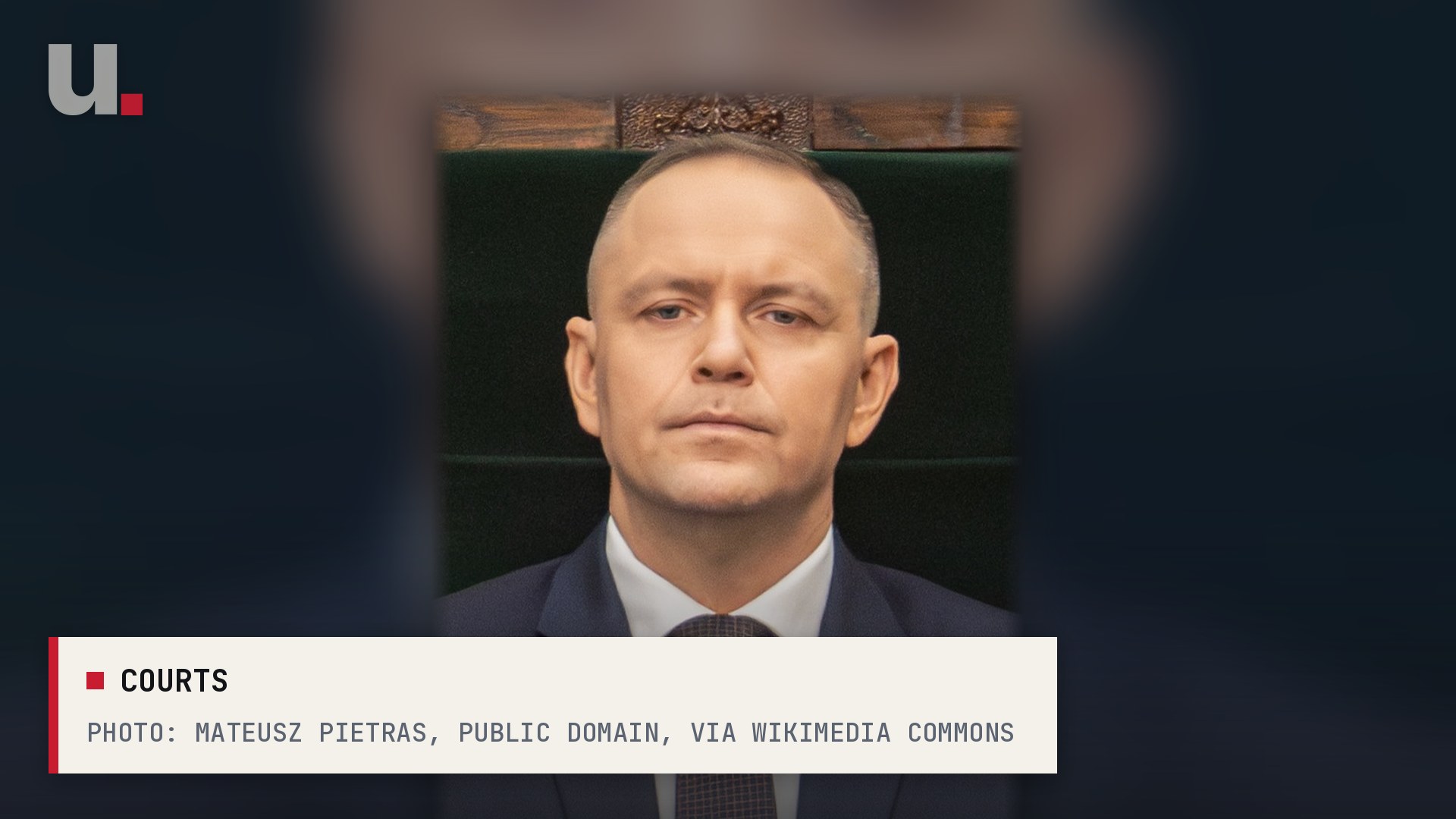
Poland’s president just told the European Union’s speech cops no, and he did it for the second time.
On Friday, President Karol Nawrocki vetoed a bill that would have let Polish government regulators decide for themselves whether a piece of online content is illegal and order it blocked. In a video on X he put the whole objection in two sentences: “It is not the role of an official to rule on whether a given piece of content constitutes a crime or not. That is solely the role of independent courts.”
The bill was Poland’s homework for the EU’s Digital Services Act, the Brussels rulebook that makes every member country name a regulator with power to police what appears online. Prime Minister Donald Tusk’s government has been trying to pass it for almost a year. Nawrocki, a conservative who came to office backed by the opposition Law and Justice party, has now killed it twice.
Two vetoes, one fight over who gets to say what’s a crime
The first veto came in January. Nawrocki says it worked: the government split the EU compliance pieces away from the part about blocking content. Then, he says, the blocking powers crept back in at the last stage. According to his account, the Senate expanded what officials could order blocked, and the government pointed to a series of school attacks to justify it.
His answer is that the state already has the tools it needs. “The October tragedy showed that when the authorities choose to act, they can use existing legal tools effectively and do not need any further changes to the law,” he said. He added that “in the name of safety, a mechanism is being created that gives public authorities, the government, the power to order specific online content to be blocked,” and warned that misuse of it could choke off public debate.
His team went further. Zbigniew Bogucki, the head of the presidential chancellery, wrote that the existing child-protection rules were sound and that Tusk’s people brought the bad provisions back “to cynically invoke child safety and sneak in a tool that would let officials restrict freedom of speech for political reasons without a ruling from an independent court.” Nawrocki himself said he will not “give in to any blackmail from those in power, especially if safety and freedom are to be held hostage.”
The bill as passed by the lower house in October did route appeals through the courts. The president’s point is about the order of events. Under the bill, the official acts first and the judge hears about it afterward. In a free country, he argues, that’s backwards.
Tusk’s side says this is about kids
Tusk answered on X: “Protecting children from online criminals. It is hard to imagine a more important issue that should unite people across political divides. And yet he vetoed it.” Speaking to reporters on a flight home from Dublin, he called it a shame and said the president seemed to be fighting the government “at the expense of Polish children and Polish security.”
Deputy Prime Minister Krzysztof Gawkowski, who runs digital affairs, was sharper still. He said the president “can veto a law, but he didn’t veto the problem,” accused Nawrocki of taking personal responsibility for every child harmed online, and promised a new online safety bill.
That is a real argument and it deserves to be taken seriously. Nobody wants criminals threatening kids on the internet. But the fight isn’t over whether threats and incitement are illegal. They already are in Poland, and Nawrocki says the state already has the tools to go after them. The fight is over handing a political government a faster lane to take things down, with a judge arriving only after the post is already gone. Nawrocki also noted that in normal times he could have sent the bill to the Constitutional Tribunal for review. “But there is no Tribunal today,” he said. “It first has to be rebuilt. So a veto was the only option.”
The math Tusk can’t get around
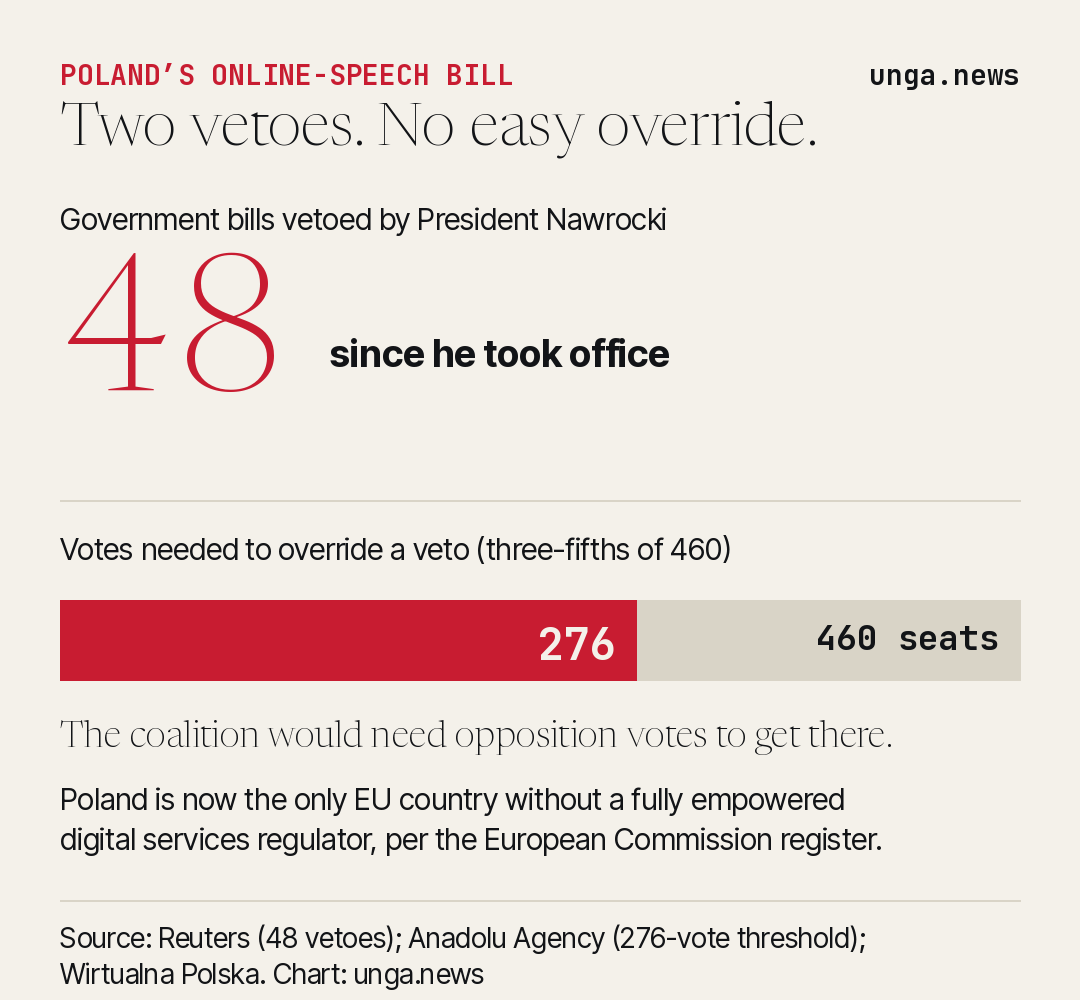
Overriding a Polish presidential veto takes a three-fifths majority in the 460-seat Sejm, with at least half the members present. If everyone shows up, that is 276 votes. Anadolu Agency reports that Tusk’s governing coalition does not have that number and would need votes from the opposition,. Law and Justice and the Confederation party both welcomed the veto. Confederation’s Anna Bryłka, a member of the European Parliament, said it “stops an attempt to introduce internet censorship in Poland.”
This was not a one-off. According to Reuters, Nawrocki has now vetoed 48 of the government’s bills since taking office. The government’s other option is to write a new bill that answers his objections and try again, which is what Gawkowski says is coming.
Brussels is watching
There is a clock on all of this. Polish outlet Wirtualna Polska reports, citing the European Commission’s own register, that Poland is now the only EU country without a digital services coordinator holding the powers the Act requires, including blocking illegal content. The regulator Poland picked in September cannot do the core job without the vetoed procedure. In May 2025 the Commission took five countries, Poland, Czechia, Cyprus, Spain and Portugal, to the EU’s top court over the delay. The other four have since fixed it, leaving Poland alone.
That’s the pressure Tusk and Brussels will lean on: the country is out of step with the other 26 members. Nawrocki’s reply is that being in step is not a reason to give officials a switch for your speech.
There is a bigger story hiding in this one for Americans. The EU’s Digital Services Act is the same law Washington conservatives have criticized for pushing American platforms to police speech across the Atlantic. When a head of state in the middle of Europe looks at the same tool and says a judge, not a bureaucrat, should decide what’s criminal, he is making the argument free-speech defenders here have been making for years.
For now, Polish officials still can’t order a post blocked without a court. Nawrocki left the door open to a different bill, one that fights online crime with the tools that are already on the books. He just won’t sign this one.
Sources
- Reuters via The Straits Times — Polish President Nawrocki vetoes digital content bill for second time (Nov. 13, 2026)
- Anadolu Agency — Polish president vetoes EU online safety law again, deepening standoff with government (Nov. 13, 2026)
- PolandDaily24 — President vetoes bill implementing EU Digital Services Act (Nov. 13, 2026)
- Interia — Zapadła decyzja Nawrockiego. Donald Tusk zabrał głos (Nov. 13, 2026)
- Wirtualna Polska — Weto Nawrockiego ma konsekwencje. Polska została sama w UE (Nov. 14, 2026)