

60 Minutes Said 'Very, Very Few' Noncitizens Vote. The Next Day, Feds Arrested Over Two Dozen.
CBS framed noncitizen voting as too rare to justify the crackdown. Utah's own audit found 13 noncitizens who voted, and agents arrested more than two dozen in California the next morning.
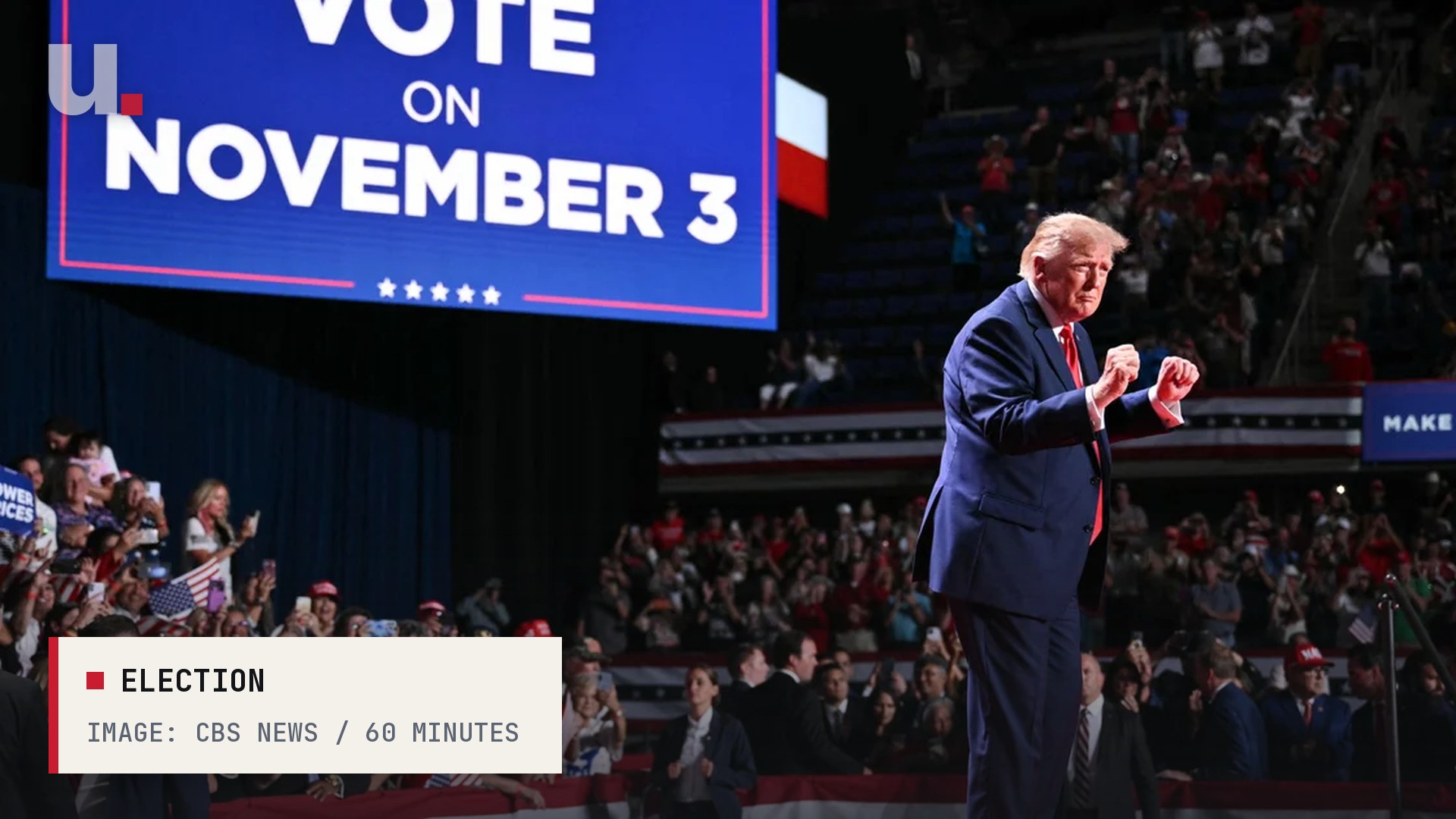
Lesley Stahl framed it as a question of scale. "There are very few people who are non-citizens who end up voting, very, very few," she told the Justice Department's top civil rights official on Sunday's 60 Minutes. Less than a day later, federal agents fanned out across California and arrested more than two dozen noncitizens accused of registering to vote, some of them of casting ballots, ABC7 Los Angeles reported.
Dhillon's reply to Stahl is worth watching in full.
DOJ's Harmeet Dhillon answers Lesley Stahl's "sow distrust" question on 60 Minutes
— @UngaTheGreat View on 𝕏
Both things can be true. Noncitizen voting is rare. It is also real, it is a federal crime, and the officials responsible for stopping it are now fighting over whether Washington is allowed to look.
The exchange
Harmeet Dhillon, who runs the department's Civil Rights Division, started with the law: "Noncitizens cannot vote in federal elections, so the question is simply how many of them there are."
Stahl put the critics' case to her: "There are people who feel that the point is to sow distrust about the whole election system… And so therefore, what's the purpose?"
Dhillon didn't take the premise. "The point is actually the opposite of what you were saying. It's not to sow distrust. The distrust is there."
She noted that "even the Biden administration prosecuted 13 people for non-citizen voting." Stahl cut in: "13 people. I mean, the numbers are tiny." Dhillon's answer was about time, not scale. "So, Lesley, we've been in office for less than two years. We've had investigations ongoing for over a year, and it takes time. There are literally thousands of them out there that we are looking at."
Viewers saw only part of the interview. After the broadcast, Dhillon wrote on X that she had "set some fake news straight" on the program, "though as usual they edit out 95% of the answers." CBS published a transcript of the segment as aired; it has not released the full interview.
What the audits actually found
"Very, very few" is doing a lot of work. Once states got full access to the federal SAVE citizenship database, the totals stopped looking like rounding errors.
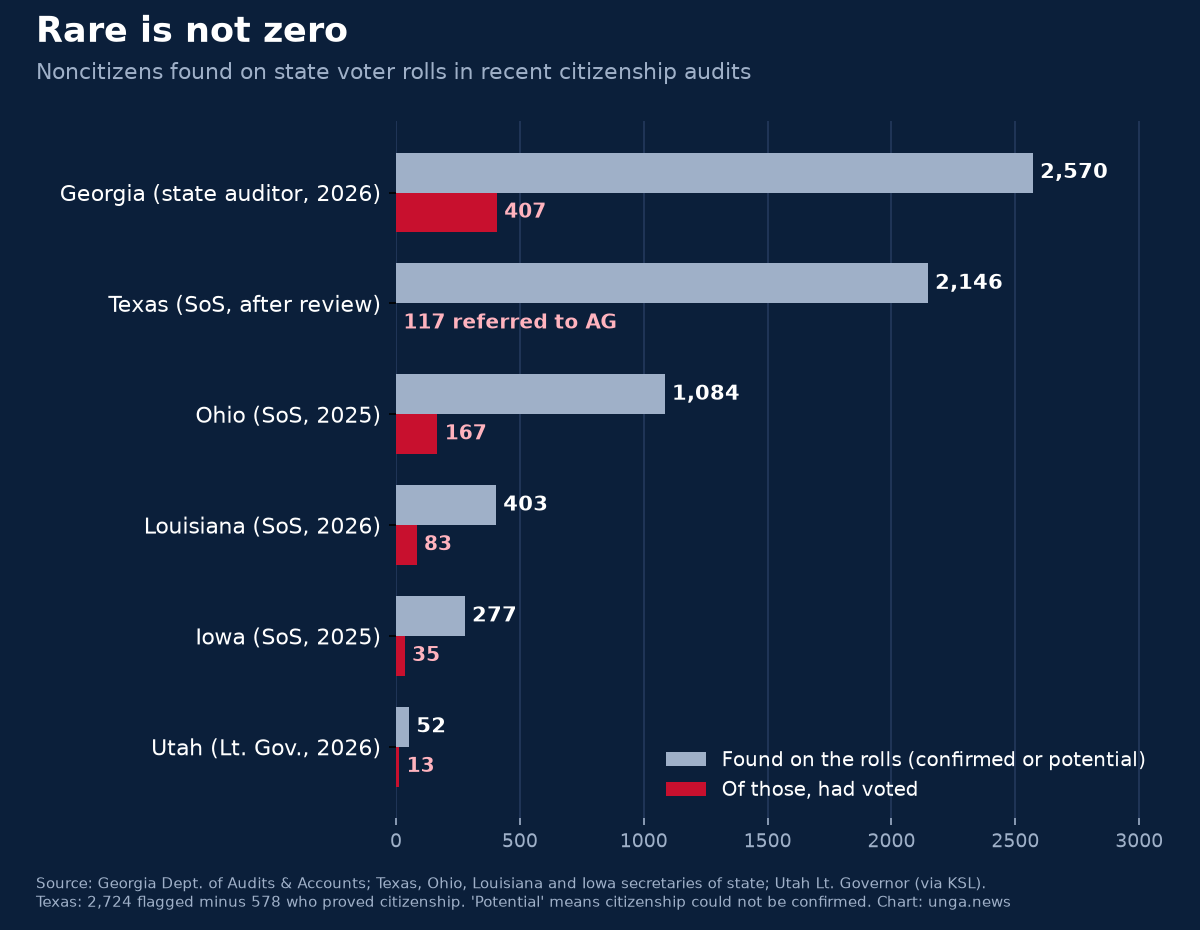
Georgia's state auditor flagged 2,570 potential noncitizen registrations, 407 of them used to vote (Declare). Ohio reported 1,084 apparent noncitizen registrations to the Justice Department, including 167 people who appear to have voted in a federal election (Declare tracker). Iowa confirmed 277 noncitizens on its rolls, and 35 of their ballots were counted in 2024 (Iowa Secretary of State). Texas checked 18 million voters through SAVE and has referred 117 cases to its attorney general (Texas Secretary of State).
Against more than 227 million registered voters, those numbers are small. Against elections decided by a few hundred votes, they are not. A bank that loses one deposit in a hundred thousand does not shrug it off as a rounding error. It calls the auditors.
Utah's answer
Utah Lt. Gov. Deidre Henderson on why she refused the Justice Department's request for the state's voter list
— @60Minutes View on 𝕏
The segment's leading critic of the crackdown was Utah's own Lt. Gov. Deidre Henderson, a Republican in a state President Trump carried by more than 20 points. She refused the department's request for Utah's full voter registration list. "They wanted things that we typically are required by law to keep private. Social Security numbers, full dates of birth, driver's license numbers," she told Stahl.
The department's account is narrower. Its complaint says it asked for the fields federal law already requires to register a voter, including a driver's license number or the last four digits of a Social Security number, and that it sent Utah a proposed privacy agreement in December. Henderson still did not hand over the list, and the department sued her in February: United States v. Henderson, filed Feb. 26 in federal court in Utah (CourtListener). Officials in 29 other states also refused, and the department has sued all of them, CBS reported.
Then came the exchange Utah readers will remember. "So has it ever been an issue in Utah?" Stahl asked. "No," Henderson said. On air, the segment put her review at 52 questionable registrations out of more than 2 million. Her office's own audit, released in May, found 27 confirmed and 25 likely noncitizens on the rolls, and 13 of the confirmed noncitizens had cast ballots, KSL reported. Another 5,007 registrations could not be confirmed either way. Utah has since begun requiring new voters to prove citizenship, a quiet admission that the old system had a gap.
Stahl also told viewers that the Justice Department notified Henderson last month that she is officially "under investigation." Henderson waved off talk of prosecution. "We're not going to prison. No. It's silly," she said, and later, "I'm just doing my job."
Three months of silence on Fulton County
60 Minutes on the internal FBI email moving 260 analysts onto the Fulton County ballots
— @60Minutes View on 𝕏
The broadcast also surfaced something new. Stahl described an internal FBI email, obtained by 60 Minutes, temporarily reassigning 260 analysts to a "priority investigation" of the Fulton County 2020 ballots that agents seized in January. That was three months ago, she said, and nothing has come of it yet. Agents hauled away more than 650 boxes of ballots, tabulator tapes and ballot images under a federal warrant (NPR), and a federal judge has since ruled the government may keep them (PBS).
Nothing made public is not the same as nothing found. Two hundred sixty analysts is the most serious look anyone has taken at those ballots, and for the millions of Americans who still doubt the 2020 count in Georgia, it deserves a public result. When the work is done, the FBI should say what it found. Silence only feeds the distrust everyone claims to want to cure.
California, Monday morning
The California sweep, called Operation Protect the Vote, ran through all four of the state's U.S. attorney districts. The Justice Department said everyone arrested is a lawful permanent resident, not a citizen, charged with crimes including false statements on naturalization applications and fraudulent voter registrations (AP). It follows a lawsuit over roughly 20,000 people the government says are likely noncitizens on California's mail-ballot list, and a letter warning that officials who knowingly count their ballots "risk becoming aiders and abettors to a federal crime."
California Secretary of State Shirley Weber says Washington has offered no evidence for that list. It is a fair demand, and the department should meet it in court. But the arrests are evidence of something, and they landed the morning after a national broadcast suggested there was little to find.
Rare is not the same as zero. In a close election, that difference is the whole game.
Sources
- CBS News — 60 Minutes transcript: Election officials describe impacts of federal actions on voting
- CBS News — Election officials describe federal government's actions around the voting system (60 Minutes segment)
- CBS News — Federal actions around voting system expand weeks ahead of midterms
- X (@60Minutes) — Deidre Henderson clip
- X (@60Minutes) — FBI email on 260 analysts
- ABC7 Los Angeles — Federal operation targeting alleged noncitizen voter registration underway in Commerce area
- AP — Justice Department charges more than 2 dozen in California sweep targeting noncitizen voters
- KSL — New audit finds 'small handful' of noncitizens on Utah voter rolls
- Declare — Noncitizen Voting and Registration Tracker
- Declare — Georgia keeps auditing for noncitizen voting
- Iowa Secretary of State — Audit finds 277 confirmed noncitizens registered to vote
- Texas Secretary of State — Texas refers 117 cases for investigation of noncitizen voting
- NPR — The FBI seizure of Georgia ballots
- PBS NewsHour — Justice Department can keep 2020 ballots seized from Fulton County, judge rules
- X (@HarmeetKDhillon) — Dhillon: 60 Minutes edited out 95% of her answers
- U.S. Department of Justice — Complaint, United States v. Henderson (D. Utah)
- CourtListener — United States v. Henderson, 2:26-cv-00166 (D. Utah)
- X (@UngaTheGreat) — Dhillon flips 60 Minutes' "sow distrust" question