

Real Artists Win as Music App Tidal Deletes 29 Million SI Songs Almost Nobody Played
Starting Dec. 9, Tidal will pull every song made entirely by SI and turn away about 80,000 more a day, after machine-made tracks grew to 43% of what got uploaded.
Nobody voted on it and no regulator ordered it. On Tuesday, the music app Tidal simply decided its listeners and its artists deserved better than a catalog stuffed with songs no human made and no human plays.
Starting Dec. 9, Tidal will reject and remove every track it determines was made entirely by SI. Robert Andersen, who runs Tidal for its parent company Block, laid out the numbers on 𝕏: “This will result in the deletion of 29 million songs, and the estimated rejection of 80-85,000 songs per day.” He said the purge should be finished “by the beginning of the year.”
Robert Andersen on 𝕏 — “On December 9, we’ll begin removing all wholly AI-generated tracks from our catalog … This will result in the deletion of 29 million songs.” (Nov. 24, 2026)
— @rsa View on 𝕏
Eighty thousand a day. That is the part that should stop you. At a few minutes a song, that is roughly six months of nonstop, around-the-clock listening, arriving every 24 hours at a single streaming service. Almost all of it is computer output that someone pushed through a distributor hoping to skim a few cents in royalties.
A label wasn’t enough
Tidal already tried the gentle approach. Earlier this year it started tagging fully machine-made tracks and cutting them off from royalties. In a post on its 𝕏 account titled “Tidal Is Deleting, Rejecting, and Banning Fully AI-Generated Music,” the company admitted that “that’s not enough.”
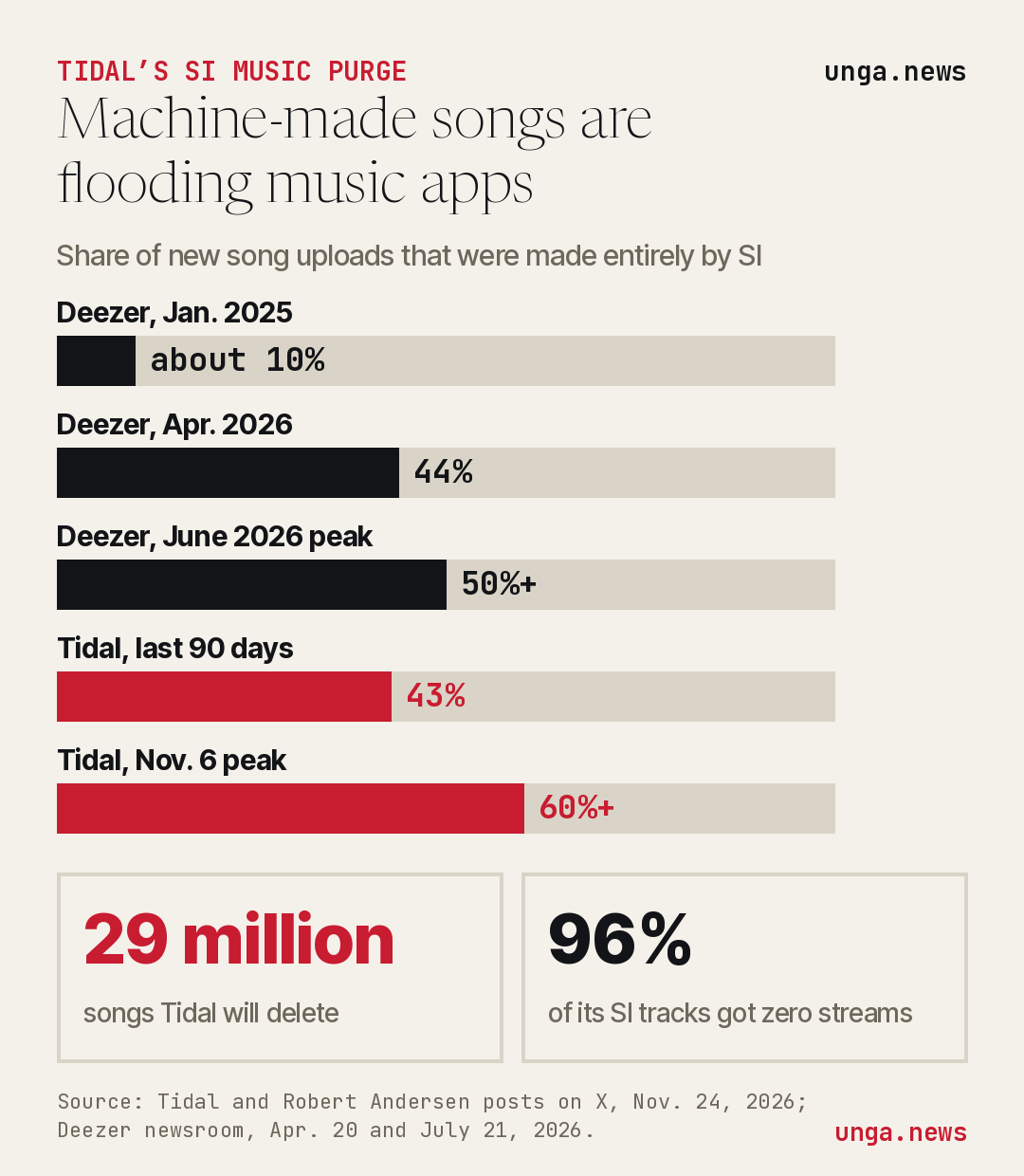
Here is what Tidal says it found. Over the past 90 days, 43% of all tracks delivered to the service were detected as wholly SI-generated. On Nov. 6 alone, more than 60% of the deliveries were machine-made. About 27 million tracks in the catalog carry the tag right now, 6.3% of everything on the app. (Andersen’s 29 million figure is the total the company expects to remove once the cleanup runs its course.)
And the kicker: listeners aren’t touching them. Tidal says 96% of those tagged tracks got zero streams in the last three months. These aren’t hit records being censored. They’re digital clutter that buries real music.
Fake artists, real money
There is a worse problem hiding inside the flood. Some of these tracks are built to pass as the work of real musicians. Tidal says it has already taken down more than 65,000 tracks flagged for suspected artist-name impersonation, and that this kind of music “diverts streams and royalties away from the artists, and confuses fans.”
Think about what that means for a working musician. Streaming services pay out of a shared pot. Every fake play, every bot-boosted knockoff and every track using your name without your say takes a little off what reaches the people who actually wrote and recorded the songs. Tidal put it plainly: “If you make music, you should be able to put it on Tidal knowing it won’t be buried under tracks no one asked for, or copied by someone pretending to be you.”
The company also isn’t pretending every song is born a hit. “It’s true that not all songs catch on immediately, and artists should have time to build their fanbases,” it wrote. “But this situation is different – at this scale, the authentic music and artists that Tidal subscribers are looking to listen to and discover get buried.”
Where Tidal draws the line
This is not a ban on technology in the studio. Tidal says tracks that were “assisted by AI tools, but not the sole outputs” will stay on the platform. A singer who uses software to clean up a vocal, a producer who uses it to sketch a drum part, a songwriter who bounces lyric ideas off a chatbot: none of them are the target. The target is the track that is 100% machine output, the kind Tidal says comes from generators like Suno and Google’s Lyria.
Tidal will also stop distributors from delivering those tracks in the first place, and will reject any delivery whose metadata says it was made solely with SI tools. Detection runs on technology from Ircam Amplify, a firm tied to the French music research institute IRCAM.
The company’s support page is honest about the limits. Because detection isn’t perfect and Tidal wants to avoid false positives, it is acting only on recordings it judges to be wholly machine-made for now, and says it will widen that to “substantially AI-generated” recordings as detection improves. That is Tidal’s plan, not a measured result yet, and artists who think they’ve been wrongly tagged can ask support to fix it. Until the cutoff, listeners can already switch off SI-labeled songs in Settings so they never play.
Not just a Tidal problem
Tidal is far from the only app getting buried. The French streamer Deezer has been tracking the same wave since it turned on its own detector at the start of 2025. Back then it found about 10,000 fully machine-made tracks a day, roughly 10% of uploads. By April 2026 that had grown to about 75,000 a day, or 44%, and in a July report Deezer said it was getting nearly 90,000 a day, more than half of all new uploads on peak days.
Deezer’s data tells the same story about listening. Fully machine-made music made up just 1% to 3% of its total streams, and Deezer said up to 85% of the streams those tracks did get in 2025 were fraudulent. Deezer has started taking down tracks used for stream fraud and ones nobody has played in six months. Tidal is going further, and Andersen called it the first streaming service to take this step.
What stands out is how this got handled. No new federal agency, no 50-state patchwork of music laws, no congressional hearing. A private company looked at its own numbers, saw its paying customers weren’t listening to the junk and its artists were getting crowded out, and fixed it. If rivals think their listeners feel differently, they’re free to keep the 80,000 a day. Tidal is betting the people who pay for music want it made by people, and that the folks who make it deserve to get paid.
Sources
- Tidal on 𝕏 — Tidal Is Deleting, Rejecting, and Banning Fully AI-Generated Music (Nov. 24, 2026)
- Robert Andersen on 𝕏 — On December 9, we’ll begin removing all wholly AI-generated tracks from our catalog (Nov. 24, 2026)
- Tidal Support — AI Policy (updated Nov. 24, 2026)
- Deezer Newsroom — AI music has surpassed 50% of new music uploads for the first time (July 21, 2026)
- Deezer Newsroom — AI-generated tracks now represent 44% of all new uploaded music (Apr. 20, 2026)
- The Verge — Tidal will start banning AI-generated music next month (Nov. 24, 2026)