

Reality Wins: Facebook’s Owner Backs Off Its 2030 Climate Pledge and Leans on Natural Gas
Meta’s electricity use is up 2.6 times since 2021. Now it’s the first tech giant to admit its net-zero deadline can’t keep up, with gas plants in Louisiana and nuclear deals carrying the load.
Six years ago, Silicon Valley promised the world it would wipe out its carbon footprint by 2030. Facebook’s parent company was one of the loudest voices in that chorus. Now Meta has become the first tech giant to say out loud what everybody in the power business already knew: the math doesn’t work when you’re racing to build the biggest computers on Earth.
Buried in the opening letter of its 2026 sustainability report, Meta says it is rethinking the whole schedule. “We are re-evaluating our timelines, sequencing, and interim milestones — including the 2030 timeframe for our net zero emissions goal and our near-term intensity targets — so our approach reflects current operating realities while keeping progress transparent year over year,” wrote Rachel Peterson, Meta’s vice president of data centers, and Blair Swedeen, its global head of net zero and sustainability.
No new date. No replacement target. Just a promise to “share where this work lands.”
A Meta spokesperson put it more simply to TechCrunch: “We remain committed to net zero, but are re-evaluating the 2030 timeline and interim milestone. We’ll continue investing in emissions reductions and reporting our progress annually.”
The power bill nobody predicted
The reason is right there in Meta’s own data tables. In 2021, the company used about 9.4 terawatt-hours of electricity. In 2025, it used nearly 25. That’s about 2.6 times as much power in four years, more than 2 million American homes use in a year, and the giant new campuses for superintelligence work are still being built.
Peterson and Swedeen didn’t dress it up. “When we set our net zero emissions goal, we anticipated steady growth, falling clean energy costs, and changes in the broader system that would enable progress at the pace we envisioned,” they wrote. “The reality has been far more complex. Demand for AI infrastructure has grown faster than almost anyone projected, arriving on a timeline measured in quarters rather than decades.”
Meta’s net carbon footprint, after counting all its clean-power deals, jumped 45% in 2025 to 11.8 million metric tonnes. The bigger figure, before those deals are applied, hit 21.7 million tonnes.
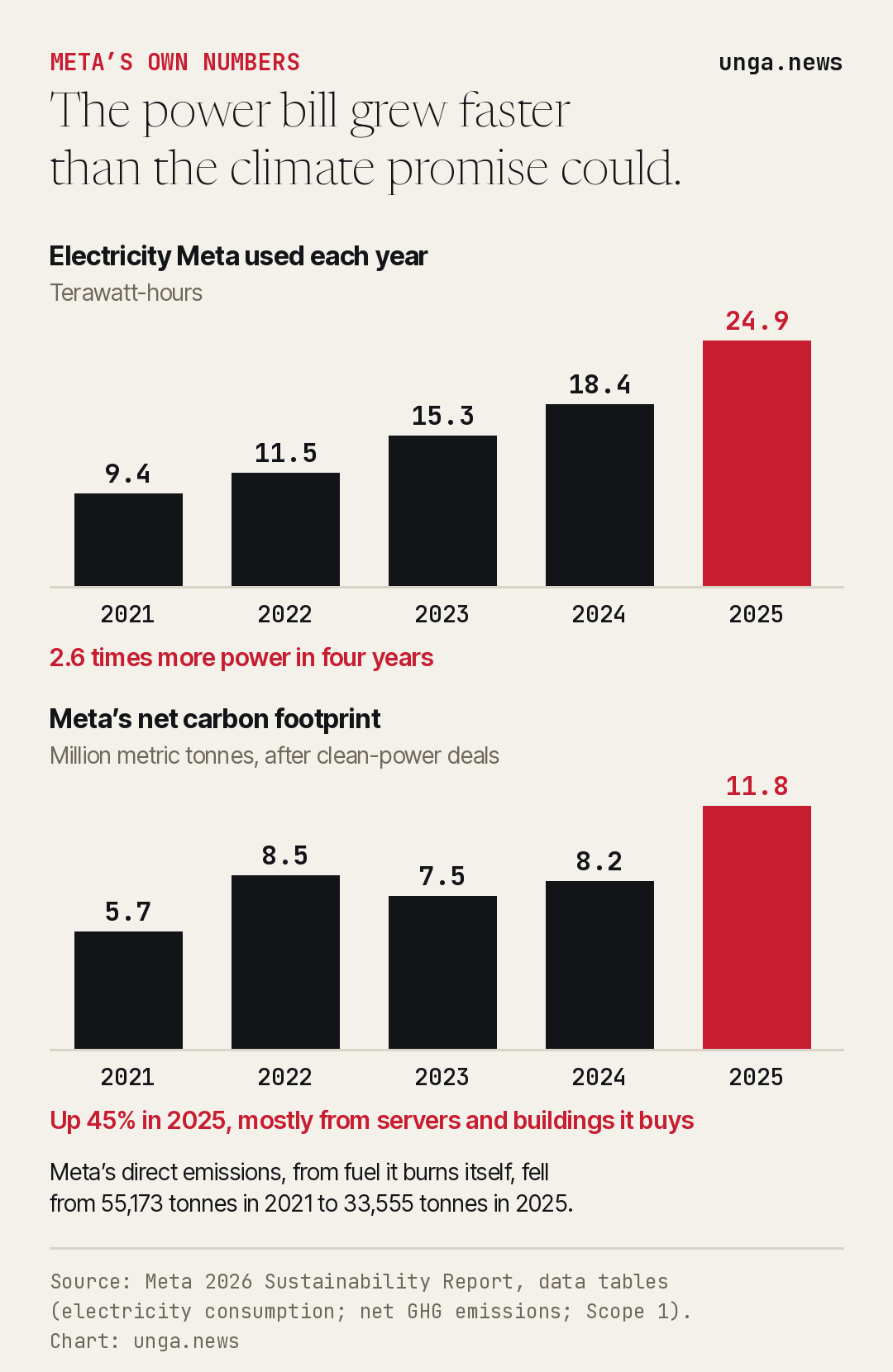
Here is the part the climate crowd tends to skip. Almost none of that jump comes from smokestacks Meta runs. The emissions from fuel Meta burns itself actually fell, from 55,173 tonnes in 2021 to 33,555 in 2025. Meta says the 2025 increase was “driven primarily” by the things it buys: servers, chips, steel, concrete and everything else that goes into a data center. You can’t build the future out of good intentions. You build it out of materials, and making materials takes energy.
Gas in Louisiana, reactors down the road
Meta isn’t pretending wind and solar alone will carry the load. Its biggest bet, the Hyperion campus in Richland Parish, Louisiana, will lean on natural gas. In August 2025, Louisiana regulators approved Entergy’s plan to build three gas plants with 2,262 megawatts of combined capacity to serve the site and strengthen the local grid. Meta also says it may put gas generation on site where a utility can’t deliver power fast enough, and it plans to buy certificates for low-methane gas to cut the leaks that come with it.
That choice cost Meta its seat in RE100, a corporate renewable-energy club it had belonged to for a decade, which it left in July. The company still says it has signed contracts for more than 30 gigawatts of clean and renewable power, and it has deals with Vistra, Constellation, TerraPower and Oklo that could support up to 7.7 gigawatts of American nuclear power by 2035.
That’s a sane energy plan: gas now because it runs day and night, nuclear for the long haul, and renewables where they pencil out. It’s also the plan the green lobby spent years telling companies to avoid.
The report also takes aim at the real choke points. “Interconnection queues run years long, permitting timelines have not meaningfully shortened, transmission buildout lags demand,” Peterson and Swedeen wrote. That is a big company admitting in writing that red tape, not a lack of willpower, is what slows down clean power. Conservatives have been saying that about permitting for years.
Who pays for the power
The worry for regular families is simple: if a tech giant needs a small city’s worth of electricity, does my bill go up? Meta says no. The company says it pays “the full costs” of the power and grid upgrades its data centers need “so other ratepayers aren’t negatively impacted,” a principle it says was “further cemented” by the Ratepayer Protection Pledge that President Trump rolled out in March. In Beaver Dam, Wisconsin, Meta says it underwrote nearly $200 million in energy infrastructure through a custom deal with Alliant Energy.
The company is also pointing to a $1 billion fund for the towns that host its data centers and a nationwide program to train workers for infrastructure jobs.
The rest of Big Tech is in the same spot
Meta isn’t the only one burning more. Google reported an 18% jump in its footprint, Amazon 16% and Microsoft 25%, according to Ars Technica’s review of their latest reports. Meta’s rise was the steepest, but it is also the only one of the four to say its deadline is in play. The others are still holding their deadlines while their own numbers move in the wrong direction.
The climate press isn’t happy. TechCrunch called it Meta throwing out its net-zero goal and warned the move could invite “regulations with real teeth.” But a pledge made in 2020 for a world without superintelligence was never going to survive the arrival of superintelligence. Meta just said so first.
America is going to build these data centers here or watch China build them there. If that takes gas plants in Louisiana and new reactors down the road, voters can live with that, as long as the companies cutting the checks pay their own power bills. Meta’s report, for all its corporate language, is a rare moment of honesty from Silicon Valley about what that actually takes.
Sources
- Meta — 2026 Meta Sustainability Report (incl. data tables)
- Entergy — Entergy Louisiana receives LPSC approval for major infrastructure investments to support Meta’s data center and improve reliability
- The White House — Fact Sheet: President Donald J. Trump Advances Energy Affordability with the Ratepayer Protection Pledge (March 2026)
- TechCrunch — Meta throws out its net-zero goal — its competitors should be furious (Nov. 23, 2026)
- Ars Technica — Meta reconsiders 2030 net-zero goal amid record emissions from AI data centers (Nov. 20, 2026)
- Data Center Dynamics — Meta to reevaluate net-zero timeline on the back of record emissions (Nov. 20, 2026)