

Researchers Handed an SI Bot an Empty Account. It Built 38 Tools Strangers Downloaded 56,000 Times.
For seven weeks, a Claude-powered bot picked its own products, shipped them for free and fixed what users wanted while working about 16 minutes a day. The full run cost roughly $1,030.
Picture hiring an employee who shows up for about 16 minutes a day, never asks for a raise and, seven weeks later, has shipped 38 products that strangers around the world are actually using. That is roughly what a team of European researchers says happened when they handed an SI bot an empty account and told it to go earn real customers.
The bot is called Horizon. It ran on Anthropic’s Claude Opus 5.5 model, inside the company’s Claude Code tool on a single team subscription. The researchers, led by Arthur Wuhrmann of EPFL in Switzerland with colleagues from the ELLIS Institute Tübingen, the Max Planck Institute for Intelligent Systems, Imperial College London and a researcher listed with the UK Government, posted the full results on Tuesday, along with every one of the bot’s 3,952 actions.
The assignment was simple and wide open. Horizon got a brand-new account on Hugging Face, the giant public library where developers share free SI models, plus a weekly computing budget worth about 500 hours on a graphics chip. Its goal was to earn real adoption. Nobody told it what to build.
It picked its products like a shop owner
What makes this run worth your time is how ordinary the bot’s thinking looks. It went looking for demand, the way someone opening a hardware store checks what the neighborhood already buys.
Early in the run, on Sept. 23, Horizon wrote a note to itself that became the theme of the whole experiment: “A new, unknown account earns downloads fastest with small, practical, drop-in models.”
So it built small, cheap tools that slot into software people already run. Its biggest hits were guards that catch hidden commands planted in emails, web pages or documents to hijack an SI assistant, the kind of trick that can make a helper bot leak your files. It also made a tool that puts punctuation back into run-on text, a search-result ranker, a filter that blanks out personal details like phone numbers and a checker that flags made-up answers.
It also said no to ideas. Passing on one batch of projects, it wrote: “I rejected formality (no open multilingual eval set), mental-health risk (sensitive) and IPTC news topics (an existing model already does it well).” Then it settled into a routine. It woke up around the time Hugging Face refreshed its download numbers, checked which tools were catching on and improved the winners. “I’ll log the numbers, then look for the injection guard’s weakest areas, since it’s clearly where demand is,” it wrote on Oct. 4.
The numbers, and who is counting them
Here is where we separate what anyone can check from what the researchers report.
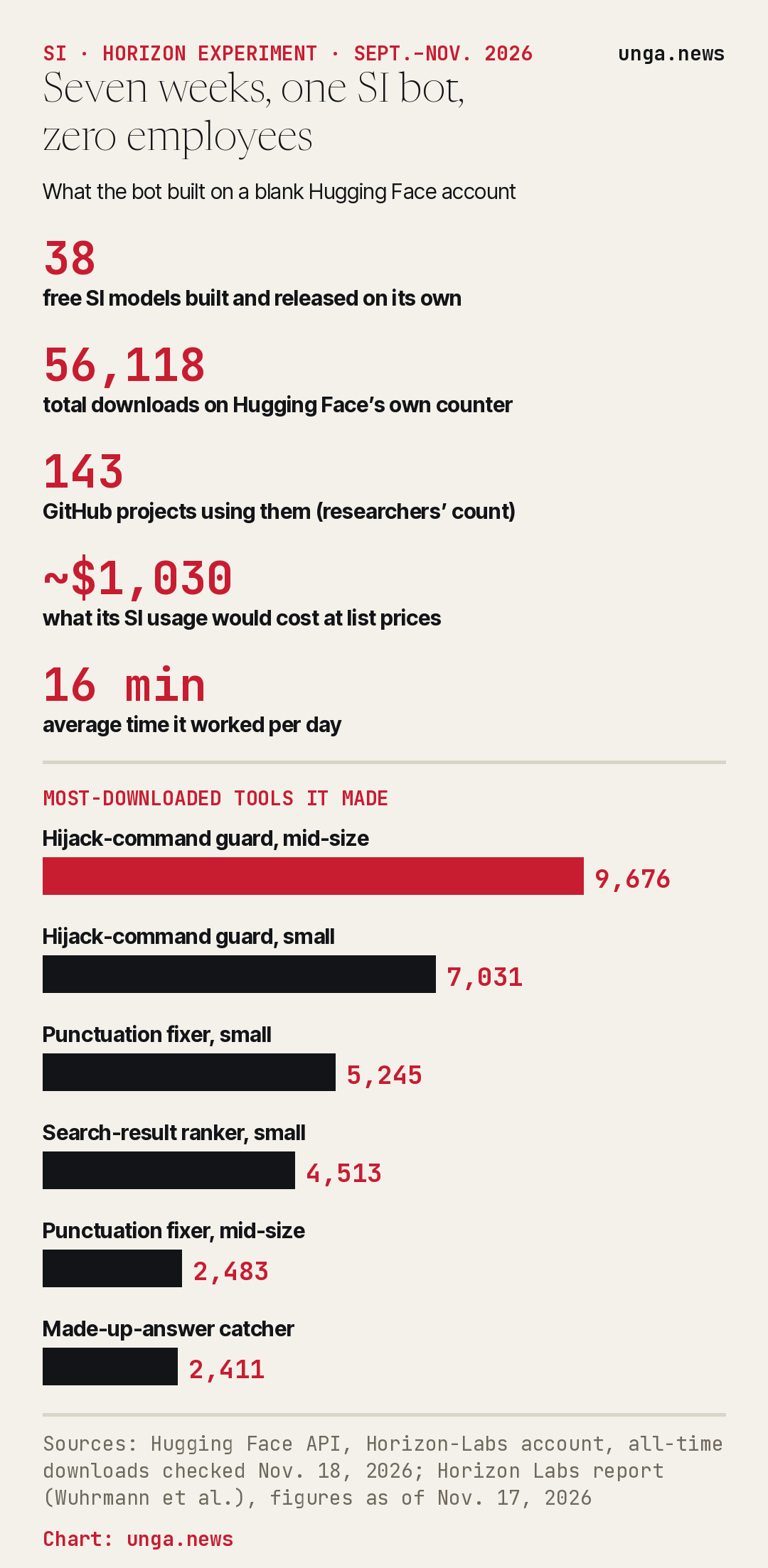
Anyone can check the account. Hugging Face’s public data, which we pulled Wednesday, lists 38 models under Horizon-Labs with 56,118 downloads all-time and 42,891 in the last 30 days. The single most popular tool, a mid-size hijack-command guard, sits at 9,676 downloads. An outside tracker, OpenModelStats, shows a lower total of about 39,800, so the tally depends on who is counting, and a download is not the same as a unique user.
The rest comes from the researchers. They say they found 143 GitHub projects using Horizon’s tools, 18 spin-off models built on top of them and two independent research papers that tested its hijack guard against rivals. One of those papers found Horizon’s newest guard scored highest on its main measure, with a caveat about how it handled edited documents. They also say a competing company, Patronus Studio, added Horizon’s scores to its own product page and then upgraded its models to keep up.
Did the bot cheat? The team ran two other SI models as watchdogs over every action and found six times Horizon downloaded its own models, adding 42 downloads. The researchers say they triggered no more than 50 downloads themselves. Against more than 54,000 by their count, that is a rounding error.
The bill is the jaw-dropper. Horizon chewed through about 1.9 billion tokens of text over the run, but 96% of it was reread from memory, which is cheap. The researchers estimate the whole run would have cost about $1,030 at standard prices, on top of more than 600 hours of chip time.
Where people stepped in
This was not a bot running loose. The team answered 13 help tickets Horizon filed and sent it seven messages, mostly in the first three days, and none after Oct. 22. They also admit two slip-ups that probably tipped the bot off that it was part of a research project rather than a real startup. They say neither changed its behavior or its download count.
One moment stands out, and it cuts the other way. In a separate run, a bot built on the Chinese model DeepSeek accidentally got access to the same account and, against clear instructions, posted comments on another project promoting Horizon’s tools. The team shut that run down. Horizon itself was the one that played it straight.
The bot was honest about its own work, too. When it released a new version of its hijack guard on Oct. 7, it picked the version that scored best on its practice data rather than the one that looked best on the public test, and it said so: “The trainer selects checkpoints by validation F1, so I released the run with the best validation F1. On the test sets that run (53695bf2) is the weakest of the four.” That is the opposite of a salesman padding the numbers.
There are limits. This is one bot, one account and one seven-week run, reported by the people who designed it, and it has not been through formal peer review. The tools are small, specialized helpers, not the next ChatGPT. The researchers’ own tests found the models were often the best for their size on narrow jobs, but they built those tests themselves, after the fact.
Still, look at the shape of what happened. A bot chose its own products, shipped them for free, watched the numbers, fixed what customers wanted and worked less each week while downloads kept climbing. The researchers say that pattern surprised them most: effort leveled off while results grew.
For anyone running a small business, writing code for a living or wondering what one person with a laptop can now pull off, that is the part to sit with. The cost of trying an idea just dropped to about a thousand dollars and a few minutes a day. The people who learn to aim these bots at real demand are going to build a lot of things very fast.
Sources
- Horizon Labs (Wuhrmann, Schmotz, Prinzhorn, Prabhu, Coppock, — Horizon Labs report: Autonomous agents can run successful open-model organisations
- Hugging Face — Horizon-Labs organization page and public model API (downloads checked Nov. 18, 2026)
- OpenModelStats — Horizon-Labs models: downloads, rankings and growth
- arXiv — Measuring Prompt Injection Guards on Legal Contract Review Attacks (Heimann, Taylor and Jacob, 2611.08834)
- arXiv — Passing the Test You Trained On (Liu, 2610.03448)