

Riding Uber Late at Night? You Can Now Ask for a Driver Whose Camera Is On
Uber is testing “Recorded Rides” in four U.S. cities, says more than half of its drivers already film their trips, and plans to switch cameras on by themselves for late-night and teen rides.

Anyone who has climbed into a stranger’s car at 1 a.m. knows the little calculation. Is this the right plate? Does the driver seem okay? Will anybody ever know what happened if something goes wrong? Starting Monday, Uber is giving riders in four American cities a new answer to that last question: you can ask for a driver whose camera is already rolling.
The company calls it “Recorded Rides.” In Baltimore, Raleigh, Indianapolis and St. Louis, riders can now pick that option in the app and get matched with a driver who is recording the trip with Uber’s Record My Ride feature, if one is nearby. Uber announced the pilot in a newsroom post from Annie Duvnjak, its global head of safety, and said the test will spread to more places later.
The pitch is simple. “Knowing a trip is being recorded can give riders and drivers greater peace of mind, encourage respectful interactions, and deter inappropriate behavior,” Duvnjak wrote. The new option, she said, gives riders who want a recorded ride “a way to request one from the start.”
More than half the drivers already hit record
This isn’t a camera Uber bolted onto cars overnight. Record My Ride uses the selfie camera on the driver’s own phone to capture video and audio from pickup to drop-off. Uber first piloted it, expanded it to a dozen U.S. cities in late 2023, and opened it to drivers in all 50 states in September 2024. At that launch, CEO Dara Khosrowshahi pitched it as protection that didn’t require drivers to “invest in a dashcam.”
Drivers took to it. According to Uber, more than half of all active U.S. drivers now record their trips. That number says a lot. Plenty of these men and women are working nights on their own dime, with strangers in the back seat, and a recording is the closest thing they have to a witness when a passenger lies about what happened, refuses to pay or gets violent.
That’s the part of this story that often gets skipped. A camera protects the honest driver as much as the nervous rider. When it’s one person’s word against another’s, the tape settles it.
Cameras that switch on by themselves
The bigger change is coming next. Uber says it will soon start testing turning Record My Ride on automatically for certain trips, starting with late-night rides and Teen accounts, the setup parents use to send their kids out on their own. Drivers who don’t want to record can switch it off in their settings.
Uber is also looking at starting a recording when a trip goes sideways. Its RideCheck system already watches for signs of a possible crash or a car wandering well off the planned route. Under the new idea, those same warning signs would kick on the camera, so there’s footage when it matters most.
Riders get their own version too. In select cities, Uber will test switching on audio recording from the rider’s phone during nighttime trips, so nobody has to remember to tap a button while they’re nervous. Riders who don’t want it can tap “Don’t Record” on the notice that pops up.
The numbers behind the push
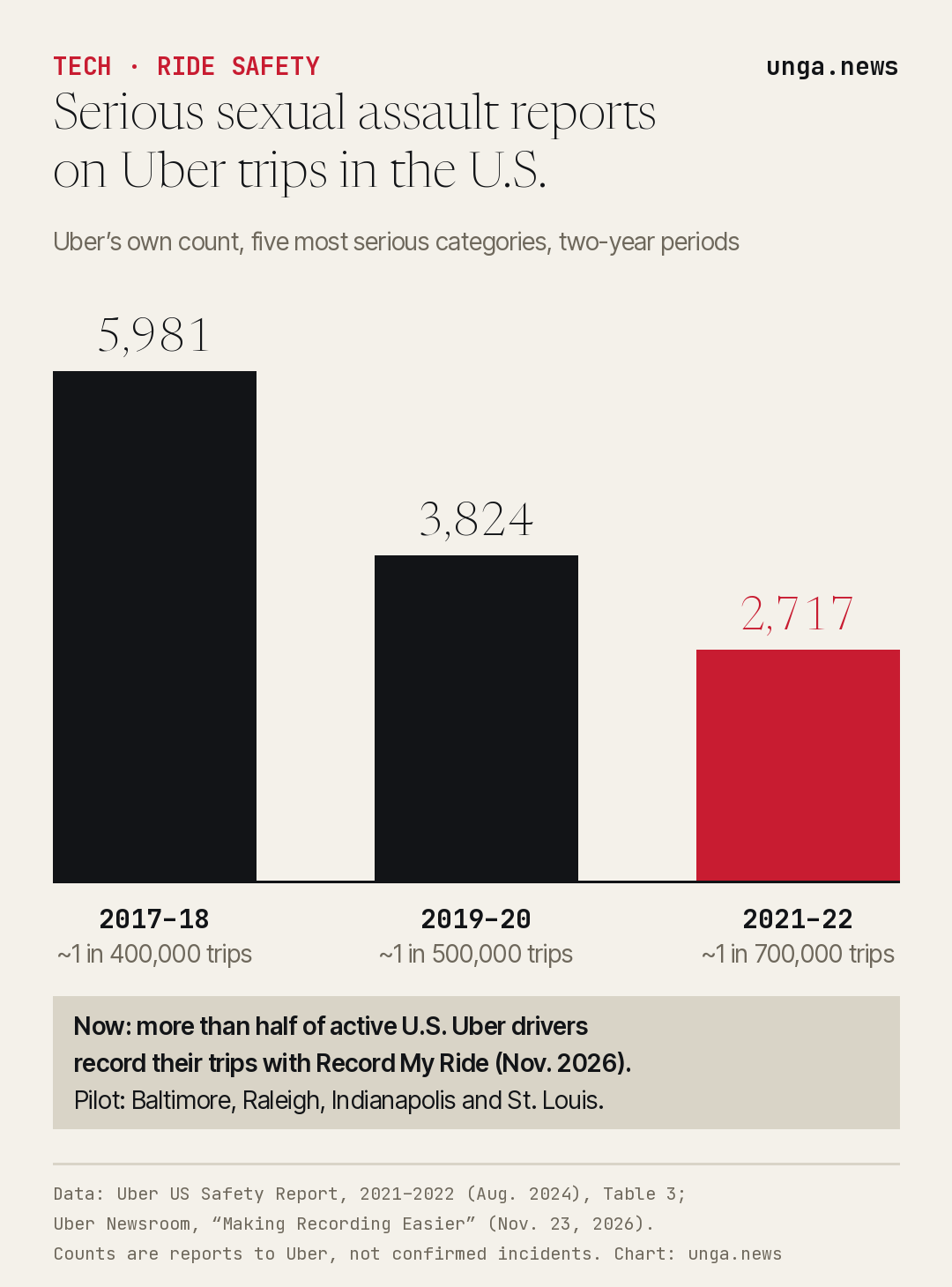
Uber has reason to want more tape. Its own U.S. safety report, covering 2021 and 2022, counted 2,717 reports in the five most serious categories of sexual assault and misconduct. That was down from 3,824 in 2019 and 2020, and 5,981 in 2017 and 2018. By the company’s math, that works out to roughly one report for every 700,000 trips, compared with one in 400,000 in the first report.
Rare is not the same as never, and the courts have made that plain. Uber faces more than 4,500 federal lawsuits from passengers who say the company failed to prevent sexual assaults, according to The Verge. In February, a jury in Phoenix ordered Uber to pay $8.5 million in the first bellwether trial in that federal case, and a second jury in April found it liable and awarded $5,000. Every one of those cases turns on what happened inside a car with two people and no witness. Recordings change that.
Who sees the footage
The obvious worry with any camera is who’s watching. Uber says recordings are encrypted, stored on the user’s own phone and deleted automatically unless they’re uploaded with a safety report or an insurance claim. Uber’s help pages say the company only opens uploaded recordings, doesn’t watch or listen in real time, and clears the rest after 14 days. Riders and drivers are told when they’re matched with someone who is recording.
There’s a lot to like in how Uber is doing this. Nobody in Washington ordered it. No city council wrote a camera mandate. A private company saw what its drivers and riders were asking for, built a tool, let people opt in or out, and is now testing whether making it easier saves people grief. If you hate the idea of being on camera, you can say no, cancel the ride or pick another app. If you’re a mom whose daughter is coming home from a late shift, you can ask for the recorded car.
Recording laws differ from state to state, and some require everyone on a call or in a car to agree before audio is captured. Uber’s answer so far is notice. Riders see a message that the trip will be recorded and can cancel if they’re uncomfortable. Drivers can also download stickers to put in the window.
It’s also fair to say a camera doesn’t stop a determined bad actor by itself. What it does is make lying harder and make the guilty party easier to find. Uber says recordings help its teams “when reviewing a safety report and help support fair outcomes.” For a driver facing a false complaint, that can be the difference between keeping a livelihood and losing it.
The four-city pilot is small, and Uber hasn’t said how many recorded drivers are on the road in each one. Its goal, in its own words, is to “increase adoption” on both sides and see what the technology can do. Given that most of its drivers already chose to hit record on their own, the riders are probably next.
Sources
- Uber Newsroom — Making Recording Easier (Nov. 23, 2026)
- Uber Newsroom — Only on Uber: Helping to make driving and delivering safer, fairer, and easier (Sept. 17, 2024)
- Uber — Uber’s US Safety Report (2021–2022, published Aug. 2024)
- Uber Help — Record My Ride: Frequently Asked Questions
- Uber — Recording for added peace of mind
- The Verge — Everyone’s recording each other, Uber edition (Nov. 23, 2026)
- TechCrunch — Uber now lets you book rides that record the drive by default (Nov. 23, 2026)
- Reuters — Uber ordered to pay $8.5 million in trial over driver sex assault claims (Feb. 5, 2026)
- Reuters — Uber loses another US driver sex assault trial, ordered to pay $5,000 (Apr. 20, 2026)